
Agency SEO Tools for Local Search: The Honest Stack
The six tool categories a local SEO agency actually needs, with verdicts, real current pricing, and how to evaluate vendors. Written by a tool vendor, conflicts of interest named where they exist.

An agency's tool stack is a quiet profit decision. Every subscription is billed to a cost base the client never sees, every manual hour the tools fail to save is billed to a margin that disappears, and every report the stack can't white-label becomes the agency's facelessness in front of a retainer client. Choose badly and you are paying for the privilege of doing extra work.
This guide walks the local-SEO agency stack honestly: six tool categories, what each actually needs to do, what the market charges, and how to evaluate before committing. We build one of the tools in this space, so where the conflict of interest exists, we name it.
Agency SEO tools for local search fall into six categories: grid rank tracking, citation and listing management, review management, profile auditing and monitoring, white-label client reporting, and keyword research. A lean agency stack costs roughly $100 to $250 per month in software before labor, with white-label reporting now standard on mainstream platforms. Choose per category on coordinates control, comparable history, and handover terms, not feature count.
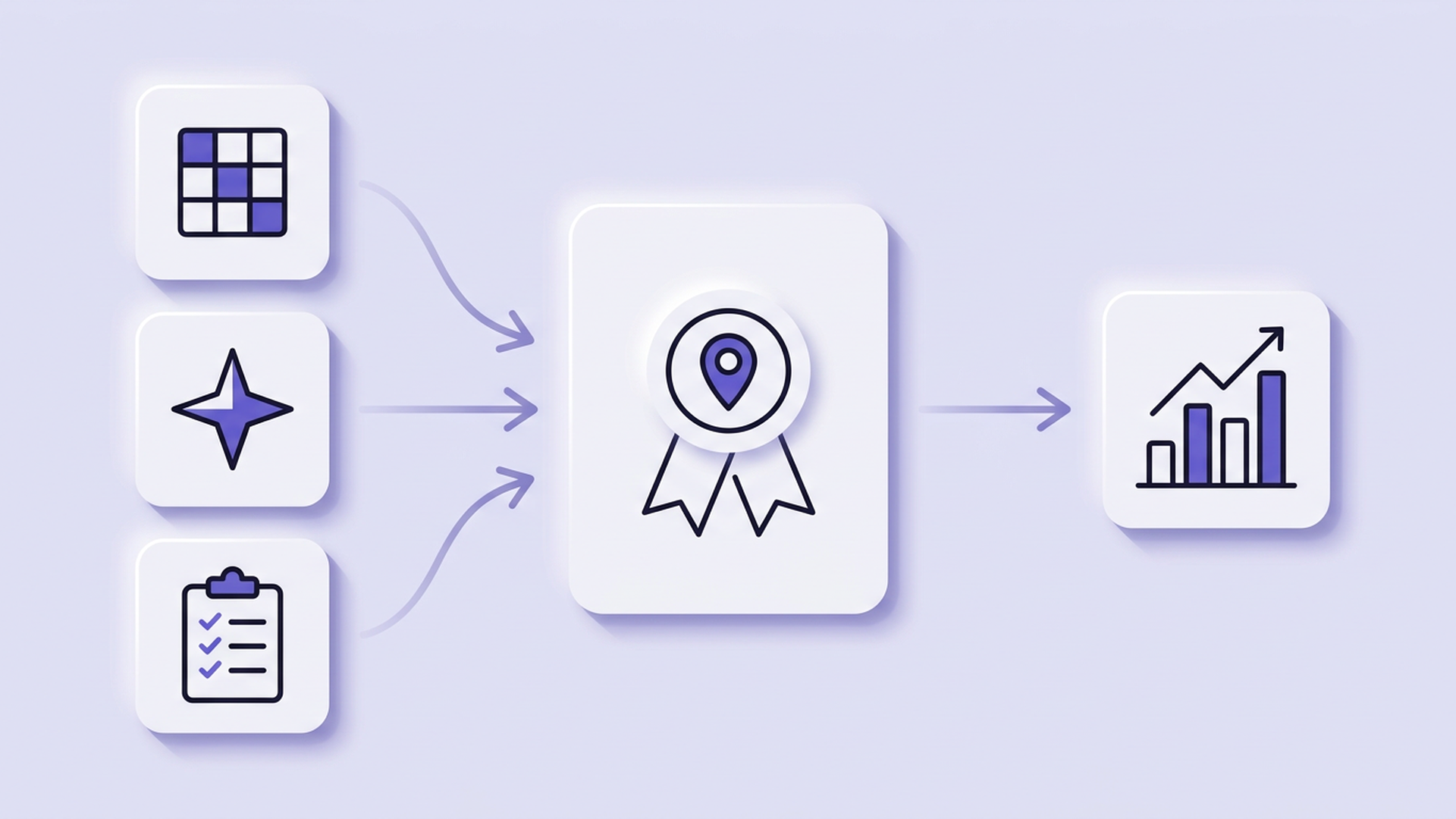
Agency SEO tools: the six categories, with verdicts
- Grid rank tracking. The instrument that proves your retainer. Must scan from real coordinates across a grid, keep comparable history, and show which cells the client loses and to whom. GBPpeak's tracker is ours, built on 5×5 to 15×15 grids; Whitespark's Local Ranking Grids go up to 225 points city-wide (whitespark.ca). Verdict: this category is non-negotiable; own one before anything else.
- Citation and listing management. Pushes name-address-phone consistency across directories and monitors drift. BrightLocal and Whitespark both bundle this; Yext leads on raw network reach at a corresponding price. Verdict: buy consistency, skip vanity networks your client's customers never open.
- Review management. Request generation, response drafting, and alerting across locations. Mainstream platforms include it; the differentiator is multilingual response support, which matters in two-language markets like Bangkok. Verdict: nice to buy, mandatory to have as a workflow even if manual.
- Profile auditing and monitoring. Scheduled checks that categories, hours, and attributes haven't drifted, plus suspension alerts. Suspensions caught in hours cost a morning; caught in a month, they cost a client. Verdict: automated monitoring pays for itself the first time it fires.
- White-label client reporting. The face of the retainer. BrightLocal includes white-label reports on all plans at no extra cost (their white-label page details the customization); Swydo and Vendasta compete on agency workflows. GBPpeak's Growth plan carries white-label scans and reports for agencies that want the grid piece branded. Verdict: never pay extra for a logo on a PDF; it is a standard feature now.
- Keyword research for local intent. Volumes are half the story; the other half is what real autocomplete suggests near the client. Tools that merge both views (GBPpeak's keyword scoring does this from live suggest data) beat generic keyword lists for map work. Verdict: local-specific beats generic here, every time.
What a stack costs
Real, current numbers, so the budget conversation stops being folklore:
| Piece | Lower bound | Upper bound | Source |
|---|---|---|---|
| DIY local SEO software tier | $39/mo | $59/mo | BrightLocal plans |
| Grid tracking for agencies | $29/mo (300 points) | $199/mo (agency scale) | GBPpeak pricing tiers |
| White-label reporting | $0 extra | $0 extra | Included on mainstream platforms |
| Full agency platform (Vendasta class) | ~$100+/mo | varies by seats | Vendor pricing pages |
The pattern worth noticing: a complete lean stack lands around $100 to $250 monthly in software. What separates agencies is not spending more on tools; it is spending on the right category first. The grid tracker and the report are the retainer's proof of life. Everything else optimizes labor.
How to evaluate any agency tool before committing
- Ask who controls the coordinates. For anything touching rank, the vendor must explain where searches run from. A vendor who can't answer this is reselling a black box.
- Demand comparable history. Same grid, same radius, same schedule, every time. Reports without fixed methodology are decoration.
- Check the white-label terms. Included, or surcharged? Your logo on the login, the PDF, and the scan URL, or just the PDF?
- Test the export and handover. If the client leaves, their history leaves with them, cleanly. Data hostage terms are a reputational risk to your agency, not just theirs.
- Price against labor, not features. A $79 tool that saves five report-building hours a month is cheaper than a $39 tool that doesn't. The unit of account is the hour; our local SEO cost guide uses the same arithmetic for client work.
How the stack maps to the monthly retainer
Tools track; people act. The monthly work itself, category checks, review responses, posts, photos, is defined in our Google Business Profile management guide, and the diagnostic that tells the team where to spend its hours is the competitor analysis method. An agency that automates measurement and humanizes the action beats one that reverses the two.
Frequently Asked Questions
Do small agencies need all six categories?
No. One to five clients: a grid tracker and a spreadsheet get you honest. The stack earns its cost when you cross roughly five locations or two staff, because that is when consistency stops being free. Add categories when a manual process actually breaks, not when a pricing page looks persuasive.
Is it better to use one all-in-one platform or best-of-breed tools?
All-in-one wins on procurement simplicity and a single login; best-of-breed wins on being the best at the thing that proves your value, usually grid tracking. The practical hybrid most agencies land on: one mainstream platform for citations, reviews, and reporting, plus one specialist tracker for the map piece.
What should agency tools cost per client as a rule of thumb?
Software should stay in the single-digit percentage range of client retainers. If tool spend approaches labor spend, the stack has become the client. Track it monthly per client the way you track their rankings.
How do I evaluate a tool I can't trial long enough to trust?
Buy the smallest tier, run one real client on it for a month, and compare its numbers against a method you trust, ideally a manual grid or the tool you already use. Divergent numbers with no coordinate explanation fail the test regardless of features.
Whatever stack you assemble, it has to survive contact with a real client's map. Test any tracker's version of the truth against a free grid scan at gbppeak.com/free-maps — no signup, no card.