What Is an Agentic Discovery Sitemap? A Local Business Guide to AI-Driven Search
AI agents read your whole site before any human arrives. What agentic discovery sitemaps are, and the four moves that actually matter for local businesses.
A Bangkok furniture store owner checked her server logs and found something odd: a crawler called GPTBot had read 400 pages in a night — more than her human visitors read all week. Nobody clicked anything. Then, a month later, a customer walked in saying "ChatGPT recommended your teak study desks for small condos." That crawl was the sale.
This is the new audience nobody planned for: AI agents that read your whole website before any human arrives. And a new file is appearing on e-commerce sites to serve them — the agentic discovery sitemap. This guide explains what it is, what it isn't, and what a local business should actually do about it.
An agentic discovery sitemap (commonly sitemap_agentic_discovery.xml, seen on platforms like Shopify) is a file that helps AI crawlers understand not just which pages exist, but how they connect and what they mean. A traditional XML sitemap tells Google "here are my URLs"; an agentic discovery sitemap gives AI agents the context, relationships, and content structure they need to form answers and recommendations. It doesn't replace your normal sitemap or affect your Google rankings — it prepares your site for AI-driven discovery. :::
Two audiences, two maps
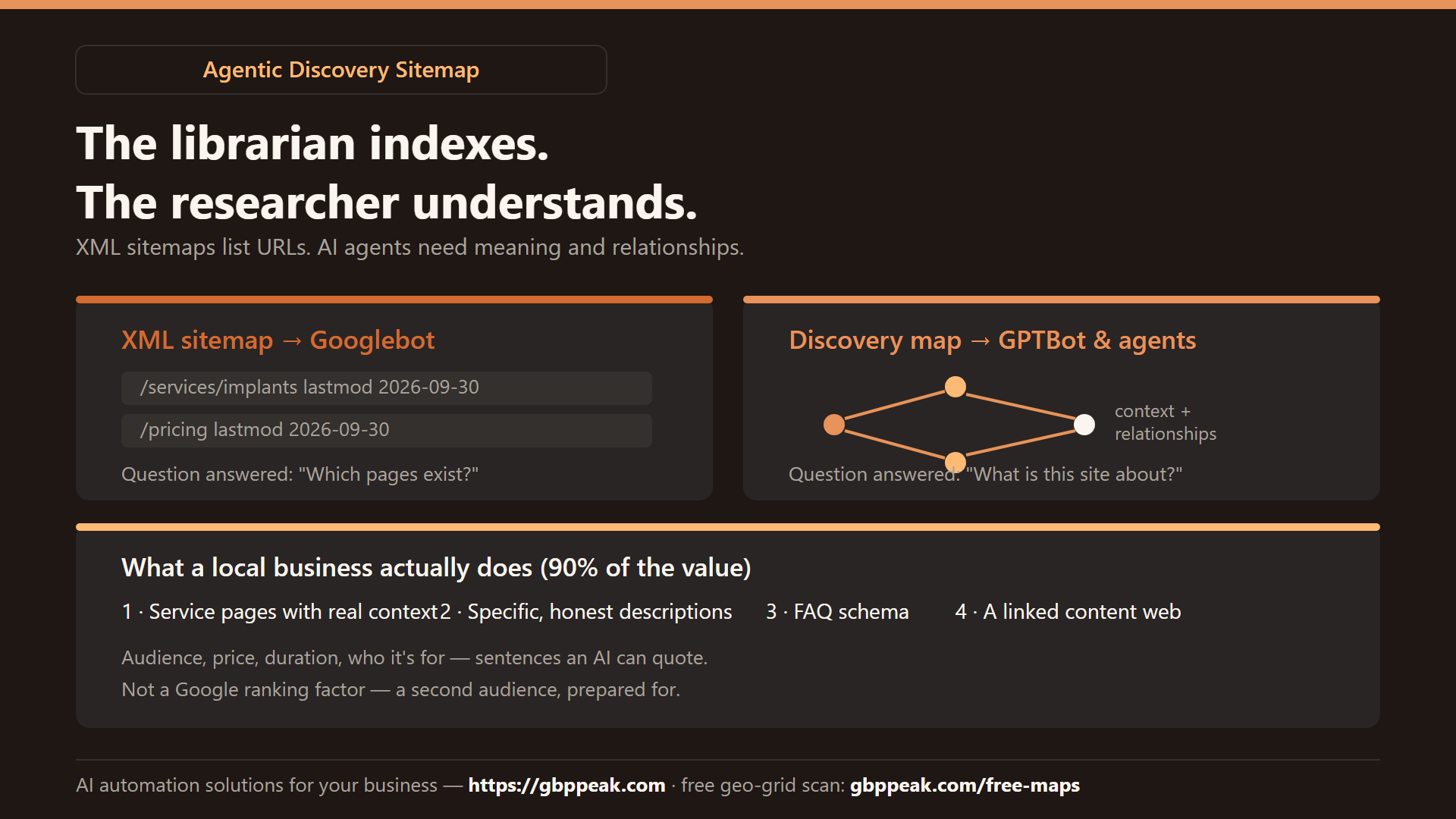
Think of it this way: Googlebot is a librarian. It wants a complete catalogue — every page, its URL, when it changed. GPTBot and friends are researchers. They don't want the catalogue; they want to understand what the library is about.
| Feature | Traditional XML sitemap | Agentic discovery sitemap |
|---|---|---|
| Audience | Googlebot, Bingbot | GPTBot, PerplexityBot, AI agents |
| Question it answers | "Which pages exist?" | "What is this site about, and how do pages relate?" |
| Format | Flat URL list + lastmod | Structured context: categories, relationships, content types |
| Success metric | Pages indexed | Brand/products correctly described in AI answers |
| Needed for Google ranking? | Yes | No — it's for AI discovery, not rankings |
The key word is discovery. Traditional crawlers index — they shelve your page in a giant library. AI agents discover — they gather enough understanding to answer a question or recommend a product. Your job is to make that gathering frictionless.
What's actually in the file?
On Shopify stores, sitemap_agentic_discovery.xml organizes the shop's structure for AI-focused crawlers: which collections exist, what products belong to them, and how content pages relate. The concept generalizes to any site — including a local business site. The machine-readable version of "we're a dental clinic in Sukhumvit, we do implants and whitening, here's our pricing page, here's our FAQ" — expressed so an agent can traverse it without guessing.
For a local business, the equivalent skeleton is small:
<!-- conceptual: what an agentic-discovery structure conveys -->
<collection url="/services/implants" type="Service">
  <related>/pricing</related>
  <related>/faqs#implant-pain</related>
  <context>Single-visit dental implants, Sukhumvit branch,
           from ฿35,000, English-speaking staff</context>
</collection>
You likely don't need to hand-build this file. If AI visibility matters to your business, the practical moves below deliver 90% of the value.
Why this exists: from keywords to context
Old SEO matched strings. Someone typed "lamp Bangkok," your page said "lamp" forty times, you ranked. AI search matches meaning. A user asks an AI: "which lighting suits a warm, minimalist condo living room?" — and the AI needs to understand materials, aesthetic, use case. No keyword list captures "warm minimalist vibe." Structure and honest description do.
This is why AI crawlers reward:
- Clean navigation — a logical path from homepage to categories to specifics
- Internal linking with intent — a blog post on condo decor linking directly to the compact-desk collection
- Structured data — schema that states price, availability, rating explicitly
- Topical consistency — a site that clearly knows its subject, not a scatter of thin pages
How to optimize for agentic discovery (local-business edition)
1. Enrich your category pages
Most local sites have service pages that are just a heading and a phone number. Add 200–300 words of real context: what the service includes, who it's for, what it costs, how long it takes. This gives an AI agent hooks to understand why your pages belong together — and sentences it can quote.
2. Describe like a human, specifically
"Our most popular massage for office workers with shoulder tension — 60 minutes, ฿600, covered by most Thai insurance." That sentence is AI gold: audience, duration, price, differentiator. "Premium wellness experience" is AI noise.
3. Add FAQ schema
FAQ schema is a cheat sheet for AI: it marks exactly which text answers which question. When an agent assembling an answer about "deep tissue massage price Sukhumvit" finds your structured FAQ, it quotes you with confidence.
{
  "@context": "https://schema.org",
  "@type": "FAQPage",
  "mainEntity": [{
    "@type": "Question",
    "name": "How much does a 60-minute massage cost?",
    "acceptedAnswer": {
      "@type": "Answer",
      "text": "60-minute Thai massage is ฿600. Deep tissue is ฿800. Open daily 10:00–21:00, Asok branch."
    }
  }]
}
4. Build a content web, not content islands
Link your guides to your services and your services to your location pages. A blog post on "choosing a clinic for laser whitening" should link to your whitening service page, which links to pricing and FAQs. Every link is a relationship an agent can walk. Isolated pages are dead ends for discovery.
5. Watch your logs — know your AI visitors
Check which AI crawlers already visit (server logs or your host's analytics):
# which AI agents have crawled your site recently
grep -iE "GPTBot|PerplexityBot|ClaudeBot|Google-Extended|CCBot" access.log \
  | awk -F'"' '{print $6}' | sort | uniq -c | sort -rn
If they're crawling you, your robots.txt already permits them — the question is what they found. Ask an AI about your own services afterward and compare its answer to reality.
Mistakes to avoid
- Flooding your site with thin AI content. Agents are trained to detect junk; bulk-generated filler erodes the trust you're building.
- Optimizing for machines and degrading humans. A site that's confusing to people confuses agents too — they increasingly learn from human behavior signals.
- Split personality. If your blog reads like an expert guide but your service pages read like a robot wrote them, the AI can't form one coherent picture of your brand.
- Expecting a ranking boost. No evidence this file lifts Google positions. Its payoff is accuracy and presence in AI answers — a different channel.
Should a Bangkok local business care yet?
If your customers research before visiting — clinics, salons, furniture, real estate, jewelry, B2B services — yes, starting now. The work (clear service pages, honest descriptions, FAQ schema, internal links) is classic good SEO anyway. You're not betting on a new technology; you're doing the fundamentals with a second audience in mind.
To see the other half of your AI-era visibility — where you actually rank across your service area on Google Maps — run a free geo-grid scan at https://gbppeak.com/free-maps.
Frequently Asked Questions
What is the difference between an XML sitemap and an agentic discovery sitemap?
An XML sitemap lists URLs for search engines to index. An agentic discovery sitemap structures how pages relate and what they mean, so AI agents can understand context, not just find pages. They complement each other; neither replaces the other.
Do I need an agentic discovery sitemap to rank on Google?
No. Google's standard indexing doesn't use it, and there's no confirmed ranking effect. Its value is helping AI tools describe your business accurately when they answer questions or recommend products.
Is it just schema markup by another name?
No. Schema defines individual facts (price, hours, ratings) on a page. An agentic discovery sitemap maps relationships across the whole site — how collections, services, and content connect. Strong sites usually have both.
Will adding one hurt my existing SEO?
No. It's an additional file that works alongside your current sitemap and robots.txt. Keep your normal sitemap exactly as it is.