ChatGPT Recommends You. Perplexity Never Heard of You. Why.
Same city, same question, opposite answers — two engines reading two different libraries. Community vs search-centric visibility, distributed trust, the three-engine audit.
A Bangkok coffee roaster noticed something odd: ChatGPT recommended their beans whenever anyone asked about specialty roasters in the city. Perplexity, asked the identical question, never mentioned them — it kept naming a competitor whose owner was active in Reddit coffee threads. Same city, same question, two completely different realities.
The roaster hadn't done anything wrong. The two engines simply read different libraries: one leaned on web content and reviews, the other weighted community discussion heavily. Understanding that — which AI engine sees you through which lens — 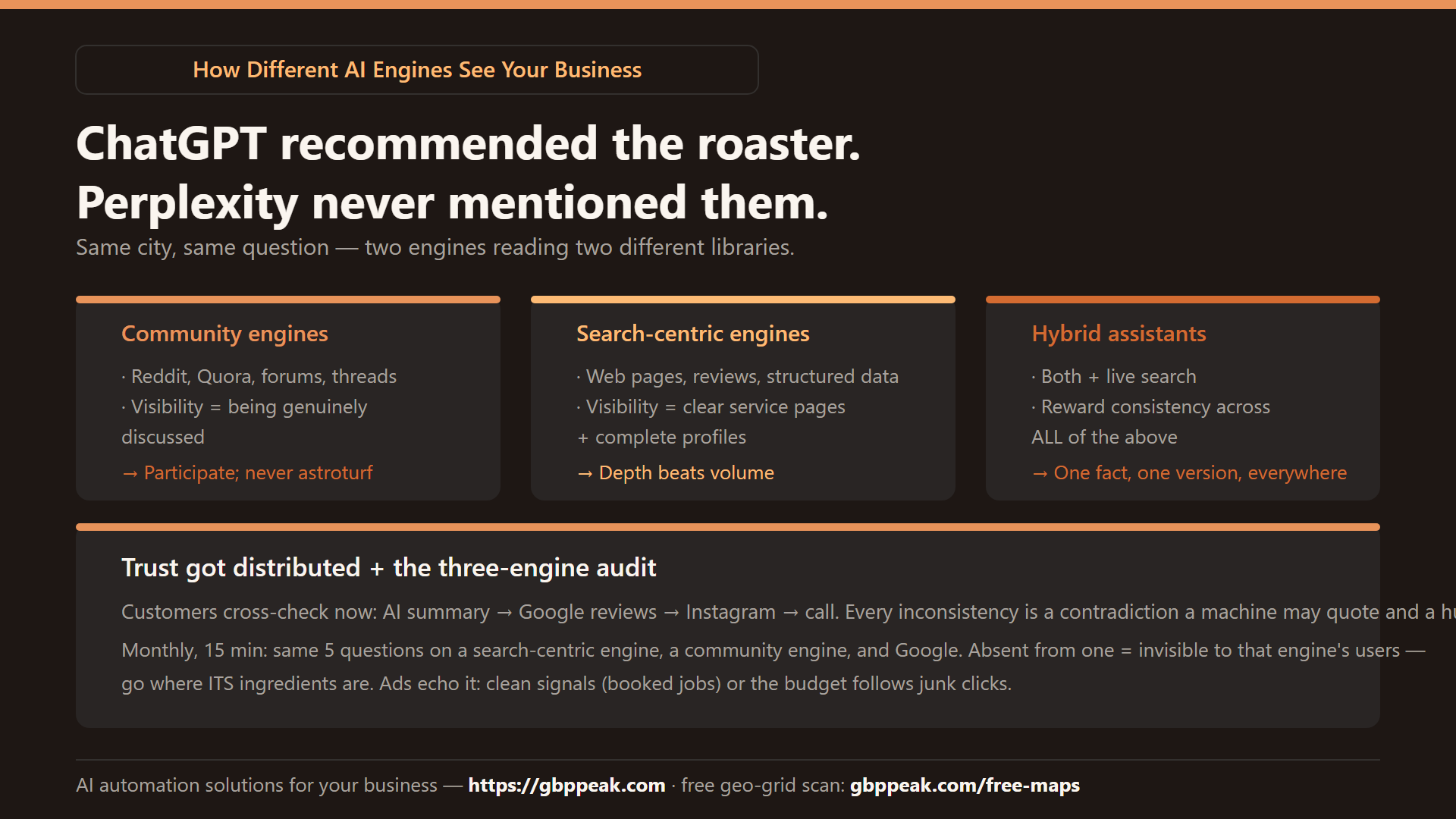
is becoming a basic local-marketing skill.
AI search tools don't all see your business the same way: community-focused engines (heavy on Reddit, Quora, forums) favor businesses discussed in those spaces, while search-centric engines synthesize web pages, reviews, and structured data. So you can be visible in ChatGPT and invisible in Perplexity. Since customers also increasingly cross-check AI answers against Google and reviews before calling, trust is now distributed. The play: audit each engine separately, maintain complete consistent data everywhere (GBP, service pages, NAP), participate where community engines read, and keep ad tracking precise enough to separate junk clicks from booked appointments. :::
Same question, different libraries
The core fact most businesses miss: AI engines are not interchangeable readers of the same internet.
| Engine type | Primary ingredients | What earns visibility |
|---|---|---|
| Community-focused | Reddit, Quora, forums, discussion threads | Genuine participation, being talked about |
| Search-centric | Web pages, reviews, structured data | Clear service pages, complete profiles |
| Hybrid assistants | Both + live search | Consistency across all of the above |
The practical consequence — visibility in one engine is not visibility in the other. A business can dominate ChatGPT recommendations and be entirely absent from Perplexity, purely because its reputation lives on the part of the web one engine reads and the other ignores.
THE THREE-ENGINE AUDIT (monthly, 15 min):
  ask the SAME 5 customer questions on:
    - a search-centric assistant
    - a community-leaning assistant
    - Google (the baseline most still use)
  log per engine: named? facts correct? which source cited?
  absent from one = you're invisible to that engine's users,
  not "unlucky" — go where ITS ingredients are
Trust got distributed
The second shift: people use AI answers more — and trust them less blindly. Cross-referencing is now standard behavior: a prospect sees you in an AI summary, checks your Google reviews, glances at your Instagram, then maybe calls. The journey stopped being a line from Google to your website.
That distribution raises the price of inconsistency. Different hours on your site vs. your profile used to confuse one visitor; now it's a contradiction an AI summary may quote, a review may echo, and a cross-checking human will notice:
distributed_trust_hygiene:
  gbp: "complete — hours, services, photos, Q&A answered"
  website: "service pages with specifics, not a phone number
            and a slogan ([the blueprint](https://gbppeak.com/blog/service-pages-over-blogging))"
  reviews: "recent, answered — they're [engine ingredients](https://gbppeak.com/blog/ai-trust-consistency-local-search)"
  nap: "identical on every directory an engine might crawl"
  social: "current enough that a 2023 post isn't your first impression"
  rule: "one fact, one version, everywhere"
Where community engines read — and how to exist there
For the community-leaning engines, the visibility currency is genuinely being discussed. You can't fake your way into that, but you can legitimately participate:
- Answer real questions where your customers ask them — local subreddits, Facebook groups, Quora — as a knowledgeable local, not an ad with legs
- Make yourself discussable — a specific thing worth recommending ("the only roaster doing X in Bangkok") travels through communities far better than generic quality claims
- Never astroturf — fake community buzz is detectable, reputationally fatal when exposed, and increasingly filtered by the engines themselves
One genuine, helpful presence in two communities beats fifty promotional comments anywhere.
The advertising echo: clean signals still rule
The same "machines amplify what they can see" logic runs your ads. Automated platforms optimize toward the signal you define — and if that signal can't distinguish a 2-second junk click from a 10-minute phone inquiry, the budget follows the junk:
tracking_precision:
  click_button:  "keep, but never optimize on it"
  call_60s_plus: "qualified-call floor, area-filtered"
  booking_done:  "the optimization target"
  monthly:       "test one conversion per channel end-to-end
                  ([plumbing first](https://gbppeak.com/blog/found-vs-chosen-local-search))"
High-budget automation with imprecise tracking is the paid-search version of thin content: lots of activity, unclear value.
The quarterly foundation pass
Because all engines — community, search-centric, and hybrid — reward the same base:
- Audit the three engines (the 15-minute routine above); fix wrong facts at the cited source
- Deepen the service pages — specifics, FAQs from real calls, social proof; retire the volume-posting habit
- Refresh the profile — photos, Q&A, hours; answer every new review
- Participate in the one or two communities your customers actually use
- Verify tracking fires end-to-end on every lead channel
And keep the geographic ground truth current: a free geo-grid scan at https://gbppeak.com/free-maps plots your Google Maps ranking across your service area — the map layer beneath every AI lens.
Frequently Asked Questions
Will AI search replace Google for local businesses?
Not replace — layer. Most local customers still start with Google/Maps, but many now summarize and compare through AI before deciding. Optimizing for Google remains the foundation; consistency is what makes the AI layer represent you correctly on top of it.
How do I get AI models to recommend my business?
Give every engine clean, consistent data: a complete Google Business Profile, specific service pages, matching NAP everywhere, and current reviews. Then cover each engine's diet — web content for search-centric engines, genuine community presence for the community-leaning ones.
Does publishing more content help?
Volume alone doesn't — thin or repetitive content gives models less to verify and can dilute your signal. Fewer, deeper pages that clearly state services, locations, and answers beat a large blog of shallow posts for both humans and AI.
Why am I recommended in one AI tool but not another?
The engines read different sources — one may weigh web pages and reviews, another forums and community discussion. Your visibility lives wherever your evidence lives. Audit each engine separately, then build presence where your missing engine actually reads.
Final note
AI search didn't make local marketing harder — it made it more honest. Every engine, whatever its diet, ultimately rewards the same things: a real business, described precisely, consistent everywhere, talked about genuinely. Cover each lens, keep the base clean, and every path — search engine, chatbot, or forum thread — leads to the same trustworthy door.