Building a Local Brand from Zero: Turning No Experience into an Advantage
No industry experience forces real research instead of borrowed templates — the from-zero playbook for a Bangkok local brand, plus the 90-day visibility stack.
Two nail salons opened on the same Soi Ari street last year. The first was opened by a veteran — fifteen years in the industry, a thick book of contacts, "knows how it's done." The second by a former office worker who had never run a salon. Guess which one now has the stronger Google reviews, the clearer identity, and the queue on Saturdays?
The second one. Not because inexperience is magic — because she couldn't afford to copy anyone. She had to research everything: which neighborhood actually had demand, what a fair price looked like, how customers searched, what made people leave reviews. The veteran defaulted to the industry template. The beginner built from evidence.
If you're starting a local business in Bangkok with no background, 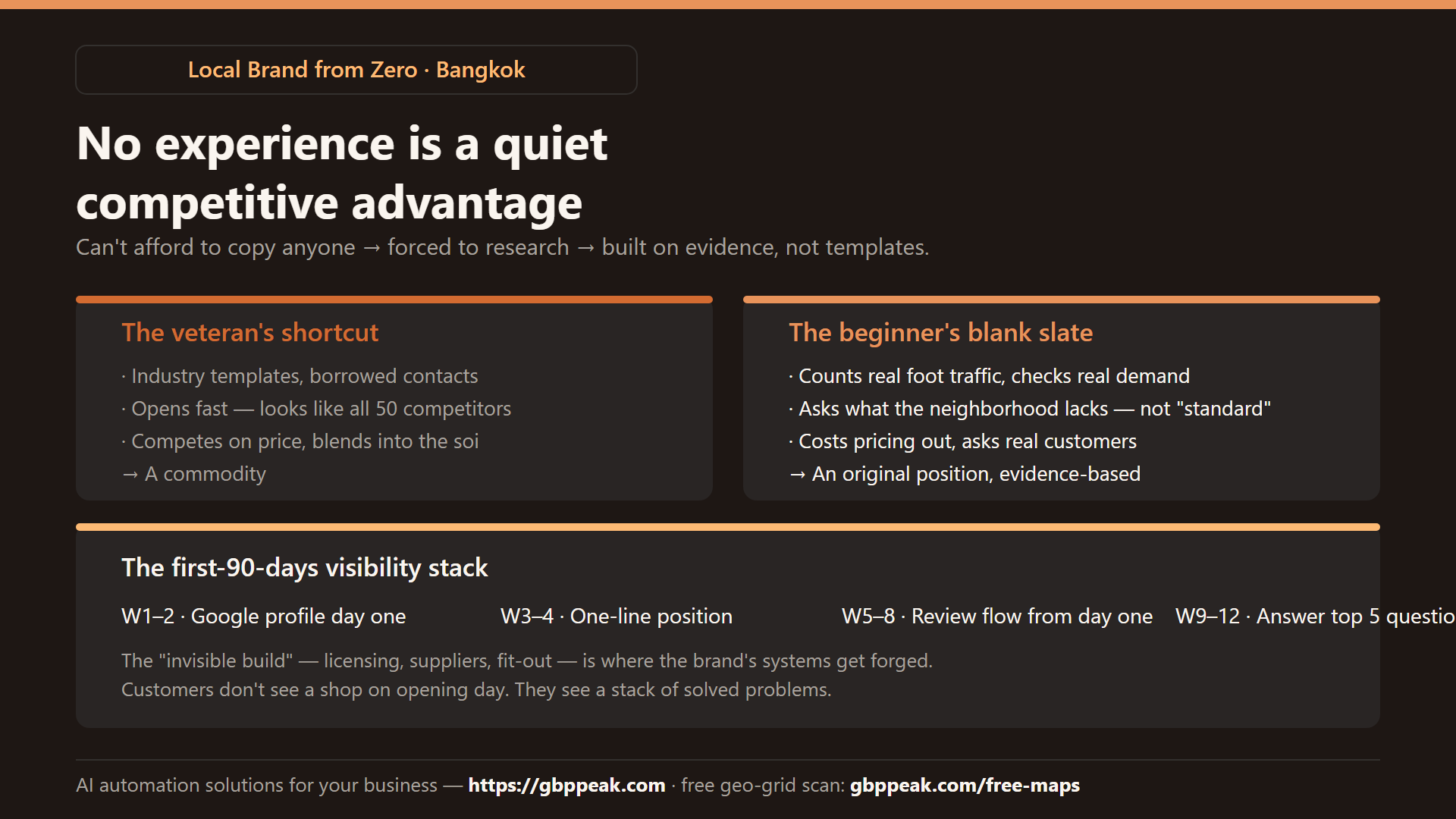
this is your field guide to turning that "zero" into the advantage it actually is.
Starting a local brand with no industry experience is not the disadvantage it feels like. Without inherited "industry habits," you're forced to research every decision from scratch — your neighborhood's real demand, what customers actually search for, fair pricing, and how your category works on Google Maps. That research produces an original identity and a defensible position, while experienced competitors often copy each other into looking identical. The slow early period ("the invisible build") is when the brand's systems and story get forged, and customers consistently reward that authenticity. :::
The blank-slate advantage
Experienced founders carry industry bias. They know how things are "supposed" to work — where a salon should be located, what a menu should look like, how pricing is done. The result is usually a commodity: opening a business that looks and acts exactly like the fifty others in the category.
Starting from zero strips those defaults away. Every decision becomes a conscious choice, which is exhausting — and exactly why it works:
- Location: instead of "retail belongs near the BTS," you actually count foot traffic and check the demand in each soi
- Offer: instead of copying a competitor's menu, you ask what the neighborhood lacks
- Pricing: instead of "industry standard," you cost it out and ask real customers
- Marketing: instead of paying an agency for the same template everyone uses, you build a Google profile and content habit around the questions your customers actually ask
Forced curiosity beats borrowed templates
A beginner who researches one neighborhood deeply often ends up with better answers than an expert who imports assumptions from another market. The expert optimizes for "how it's done everywhere"; you optimize for how it's done here — and local search rewards exactly that specificity.
The invisible build
The hardest part of starting from zero isn't the work — it's that early progress is invisible. Before opening day, weeks disappear into licensing, suppliers, fit-out, and decisions nobody will ever see. The needle doesn't move publicly while you're privately solving problem after problem.
That period has a name worth remembering: the invisible build. Every hurdle you clear — the supplier who ghosted you, the permit maze, the first version of the menu that didn't work — is a repetition that makes the brand stronger. When you finally open, customers see a shop. What actually launched is a stack of solved problems.
| Experienced founder | From-zero founder | |
|---|---|---|
| Speed to open | Faster (templates, contacts) | Slower (research first) |
| Result at opening | Industry-standard clone | Original position, evidence-based |
| Early risk | Blends in; competes on price | Feels uncertain; may overthink |
| Long-run shape | Hard to differentiate later | Differentiation built-in from day one |
| Story | "Another branch" | A journey customers root for |
A from-zero local playbook that compounds
Here's the sequence that turns a blank slate into visibility — the same order we'd recommend to any new Bangkok local business:
# The first-90-days visibility stack (no experience required)
Week 1-2: claim your Google Business Profile the day you have a name
          and location; accurate category, hours, real photos only
Week 3-4: define ONE clear answer to "what do you do, for whom,
          near where" — it drives your profile, signage, and site
Week 5-8: open with a review flow from day one (QR card, personal ask)
          — first 10 honest reviews matter more than any ad spend
Week 9-12: publish answers to your customers' top 5 questions
          (page or short videos); keep NAP identical everywhere
{
  "foundations": {
    "googleBusinessProfile": "accurate + complete",
    "oneLinePosition": "nail studio for office workers near Ari BTS",
    "nap": "same name/address/phone on GBP, Facebook, LINE, directories",
    "reviewAsk": "every happy customer, day one"
  }
}
None of this requires industry background. It requires consistency — which, conveniently, the from-zero founder has in surplus, because there's no old system to unlearn.
Turning zero into your story
A business started from mastery is an expansion. A brand started from zero is a transformation — and customers connect with transformations. "I left my office job because I couldn't find a single place that did X properly" is a story. "We saw market opportunity in segment Y" is not.
Use it honestly:
- Tell the origin in your profile description and your about page — what you couldn't find, why you built it
- Document the build — the fit-out, the first customer, the mistakes fixed; this is exactly the authentic short-form content that outperforms polished ads today
- Let reviews carry it — customers who feel part of the journey write warmer, more specific reviews, and specific reviews are what both Google and AI engines quote
What to watch out for
The blank slate cuts both ways. Three honest cautions:
- Don't romanticize slowness. Research deeply, then decide. Endless comparison is fear wearing a productivity costume.
- Borrow knowledge, not defaults. Ask experienced people how things work — then choose deliberately whether it applies to your neighborhood.
- Don't guess your market position — measure it. The most common from-zero mistake is assuming the whole city is the customer. It never is; a soi is.
And before committing to a location or a category claim, check the map reality: a free geo-grid scan at https://gbppeak.com/free-maps shows how businesses in your area actually rank across the neighborhood, grid point by grid point — evidence you can build on.
Frequently Asked Questions
Is it harder to start a local business with no experience?
In some ways yes — you'll learn licensing, suppliers, and operations from scratch. But it makes the final brand more distinctive: without "expert baggage," you're less likely to open a clone of your competitors, and every decision gets made on local evidence rather than habit.
How do I stay motivated when nothing seems to be happening?
Remember the invisible build — the licensing, sourcing, and profile setup nobody sees are exactly what makes launch day solid. Track solved problems, not just revenue, in the early weeks; that's the honest progress bar.
Does starting from zero make the business look less credible?
Not if you tell the story. Customers relate to a founder who built something because it was missing, and they show it in warmer, more specific reviews. What kills credibility is a generic front, not an honest origin.
What's the single first step for visibility?
Claim and complete your Google Business Profile on day one — correct category, hours, real photos, and a one-line position ("what, for whom, near where"). It costs nothing and every later effort compounds on top of it.