
The Evolution of Digital Marketing After 2020: A Bangkok Small Business Guide
The 2019 playbook quietly died. Five shifts — short video, authenticity, AI, answer-first SEO, channel costs — and what a Bangkok business does next month.
In 2019, a Bangkok café could fill its seats with a Facebook page, boosted posts, and pretty photos. The owner posted three times a week, paid for the occasional boost, and the customers came. Then everything about that playbook — the platforms, the formats, the customers themselves — quietly rewrote itself between 2020 and today. The café owners who noticed are thriving. The ones still running the 2019 playbook are paying more for worse results.
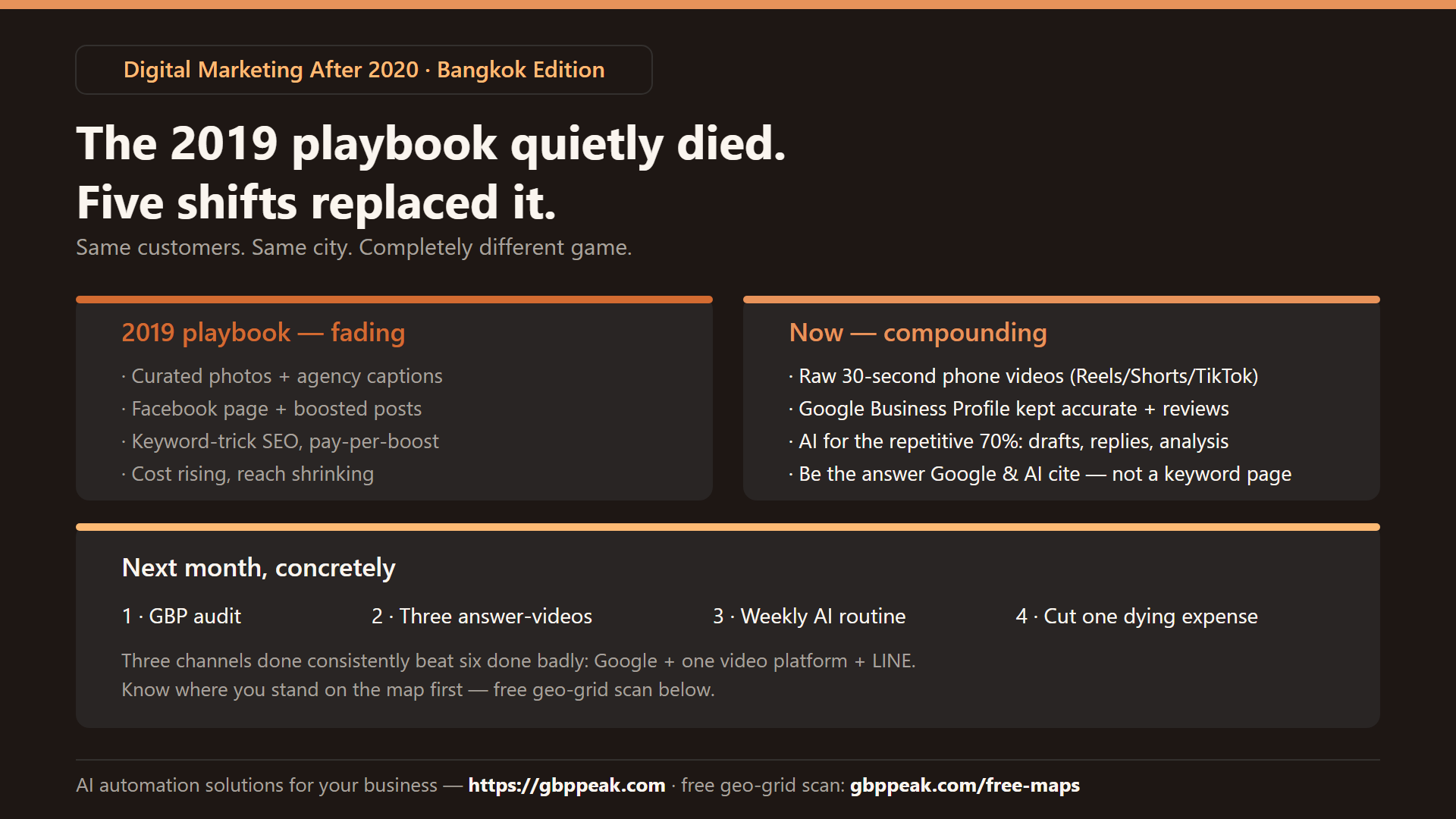
This is a field guide to what actually changed, written for Bangkok small-business owners, not marketing agencies. No jargon walls, no trend-chasing — just the five shifts that matter and what to do about each one.
Digital marketing after 2020 moved from "going online" to customers living online permanently. For a small business this changed three things: content shifted from polished promotional posts to authentic short-form video (Reels, Shorts, TikTok); AI moved from novelty to standard tooling for replies, content drafts, and review analysis; and SEO stopped being about tricking rankings and became about being the clear, trustworthy answer that both Google and AI engines cite. Small businesses that adapted reach more people for less; those still using 2019 tactics pay rising costs for shrinking attention. :::
Shift 1: Nobody "goes online" anymore
Going online used to be an action — sit down, open a browser, check email. Today the internet is the environment people live in. The average Thai user spends over eight hours a day connected, much of it on mobile, jumping between LINE, TikTok, Instagram, and Google Maps.
For you, this cuts two ways:
- The window is always open — a customer can discover your gym at 6 a.m. or 11 p.m.
- Attention is the scarce resource — you're not competing with other gyms; you're competing with everything on their phone
Being present isn't a strategy anymore. Being relevant in the moment they need you is.
Shift 2: Polish lost, authenticity won
The perfectly staged product photo with a caption written by an agency is dying. Short-form video — Reels, Shorts, TikTok — took over, and the content that performs isn't the polished commercial. It's the owner explaining how to choose fresh beans, the barber showing a haircut from three angles, the clinic nurse answering a real patient question on camera.
Thai customers, like everywhere, have developed sharp radar for corporate-speak. A relatable 30-second phone video from the actual owner routinely outperforms a high-budget ad, because it feels like a recommendation from a person, not a billboard.
| 2019 playbook | Today's playbook | |
|---|---|---|
| Format | Curated photos + long captions | Short vertical video, raw and specific |
| Voice | Brand-polished, formal | Owner's real voice, Thai/English as customers actually speak |
| Where | Facebook page + boosted posts | Reels/Shorts/TikTok + LINE + Google Business Profile |
| Goal | Likes and follows | Saves, shares, DMs, direction requests |
| Cost model | Pay to boost every post | One good video works for weeks |
What "raw" actually means
Not sloppy — honest. Show the kitchen, the process, the price, the before-and-after. Answer the question customers actually ask in the caption's first line. Film on your phone. The bar is authenticity, not production value.
Shift 3: AI became the quiet default
Most small businesses use AI daily without labeling it that way: Google Maps' ranked results, automated LINE reply flows, Meta's ad targeting, review summaries on a Google Business Profile.
The practical opportunity in 2026 is using AI deliberately for the repetitive 70% of marketing:
# A realistic weekly AI-assisted routine for one small business
Mon: paste this week's customer questions (LINE/DM/reviews) into an
     LLM → get 3 short-video scripts answering the top 3
Wed: film the 3 scripts on a phone (30 min total)
Fri: ask AI to draft captions in TH + EN, post across Reels/Shorts/TikTok
Sun: AI-summarize the week's reviews → extract 2 improvement actions
     and 1 sentence to answer each new review
The businesses winning with AI aren't the ones with the fanciest tools. They're the ones who used AI to stay consistent — posting, replying, analyzing — without burning out.
Shift 4: SEO stopped being tricks
Old SEO: repeat keywords, buy links, rank a page. Modern SEO: be the answer an engine — Google, ChatGPT, or Google's AI Overviews — chooses to show. AI now summarizes results directly, so ranking first matters less than being quotable: clear prices, direct answers, accurate Google Business Profile info, reviews in real customer words.
For a local business, the priority order is now:
- Google Business Profile accuracy — hours, categories, services, photos
- Reviews — steady, recent, answered, in customers' own words
- A website that answers questions directly — pricing, process, who it's for
That's the foundation both the map pack and AI answers are built on. Keyword tricks are dead; clarity won.
Shift 5: Old channels got expensive, new ones got cheap
Boosted posts and display ads cost more every year while attention fragments. Meanwhile, organic short video, a well-kept Google profile, and genuine review flow cost mostly time. The adaptable businesses reallocated: less boost budget, more content hours.
The honest trade-off table:
| Channel | Cost now | Effort | Best for |
|---|---|---|---|
| Short-form video | Nearly free | Medium, weekly | Trust + discovery |
| Google Business Profile | Free | Low, monthly | High-intent searchers |
| Reviews flow | Free | Low, always | Conversion + AI visibility |
| Meta ads | Rising | Low to run | Offers, retargeting locals |
| Boosted posts (2019 style) | Rising | Low | Weakest option today |
What to actually do next month
- Audit your Google Business Profile — correct hours, full service list, fresh photos, reply to every review
- Film three 30-second answer-videos — the three questions customers ask most (check your LINE history for them)
- Set up a weekly AI routine — even the simple Monday-Wednesday-Friday loop above
- Cut one dying expense — that monthly boosted-post budget, redirected to time or tools that compound
And to know where you stand in local search right now — where your Google Maps ranking holds and breaks across your service area — run a free geo-grid scan: https://gbppeak.com/free-maps. It's the map-side half of the modern playbook, and most competitors never look at it.
Frequently Asked Questions
Is Facebook still worth it for a Bangkok small business?
Yes, but differently. Organic reach for plain posts has collapsed; the platform still works for groups, events, marketplace, and retargeted ads. Treat it as one channel in the mix — not the whole strategy like 2019 — and put discovery energy into short video and your Google profile.
Do I need to be on every new platform?
No. Pick where your customers actually are: for most Bangkok businesses that's Google Maps/search, one short-video platform, and LINE. Doing three channels consistently beats doing six badly.
How does AI change marketing for a business with no marketing staff?
It mostly replaces the work you never had time for: drafting captions, summarizing reviews, answering routine DMs, turning one video into posts for every platform. The winning pattern is AI for volume, you for judgment.
Is short-form video realistic if I hate being on camera?
Yes — process videos, before/after transformations, and hands-only tutorials work without your face. Customers want proof and personality, not a presenter.