From Clicks to Mentions: GEO for Local Businesses in the Age of AI Search
Generative Engine Optimization for local businesses: how ChatGPT and Perplexity pick who to name, and the 90-day plan to become one of them.
Ask ChatGPT for a good dental clinic in Sukhumvit, and it names three or four. No blue links, no map pack to scroll past — just an answer. If your clinic isn't in that sentence, you don't exist for that patient. That's the whole game now, and it has a name: Generative Engine Optimization, or GEO.
Here's the uncomfortable part for local businesses in Bangkok: the AI didn't pick those clinics at random. It cross-checked your Google Business Profile, your reviews, your website, and what other sites say about you — then decided who deserves the mention. This guide breaks down how that decision actually works, and what a small business can realistically do about it in the next 90 days.
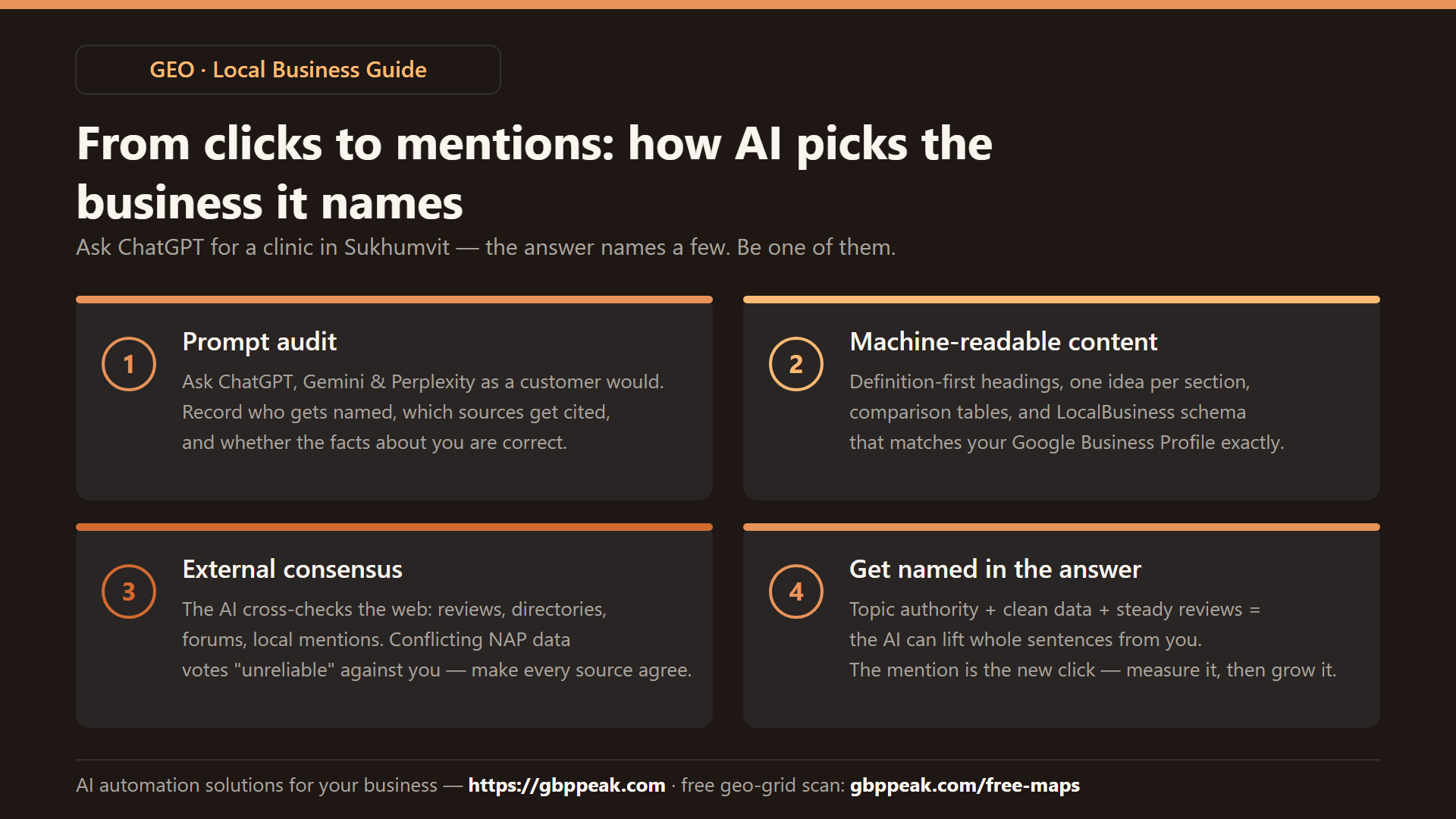
Generative Engine Optimization (GEO) is the practice of making your business easy for AI engines — ChatGPT, Perplexity, Gemini, Google's AI Overviews — to understand, trust, and cite. For a local business it rests on three things: clear machine-readable content (direct definitions, structured data, consistent NAP), semantic authority (covering your topic deeply instead of chasing one keyword), and external consensus (reviews, directories, and forum mentions that agree with what your own site claims). The businesses AI names are the ones whose facts match everywhere the AI looks. :::
Why local businesses feel this shift first
Someone searching "best coffee beans Bangkok" might still scroll ten links. Someone asking an AI "where can I buy fresh-roasted coffee beans near Thonglor?" wants one answer. Questions with local intent are exactly where AI assistants are strongest — they compress the map pack, your reviews, and your website into a single recommendation.
That means the "click" is becoming optional. A tourist planning a trip asks an AI on their phone; a parent asks about a pediatric clinic near their condo. If the AI already answered, nobody visits your website. The visibility moved from your URL to your name inside the answer.
| Classic local SEO | GEO (AI search) | |
|---|---|---|
| Where you appear | Map pack, blue links | Inside the AI's written answer |
| What wins | Proximity, reviews, keyword match | Verifiable facts + consensus across sources |
| Unit of success | The click | The mention / citation |
| Content style that works | Persuasive, benefit-led | Clear, definitional, data-backed |
| Refresh cycle | Weeks to months | Continuous (AI re-crawls and re-summarizes) |
The good news: if you've been doing solid Local SEO — accurate Google Business Profile, steady reviews, a clean website — you already have most of the raw material. GEO is mostly about shaping it so machines can use it.
Shift from keywords to topic authority
Old-school SEO had one page chase one keyword. AI engines don't play that game. They assess whether you cover a topic completely — what SEOs call semantic authority.
Imagine a Bangkok tattoo studio. A keyword page says "tattoo studio Bangkok, best tattoo Bangkok." A topic-authority site answers everything a customer actually wonders:
- How much does a small tattoo cost in Bangkok?
- Which styles does the studio specialize in?
- How do you judge a studio's hygiene?
- Do they work with foreigners? English-speaking artists?
- Aftercare — what happens if it gets infected?
An AI assembling an answer about "clean tattoo studios in Bangkok for tourists" can lift whole sentences from that second site. From the first site, it can lift nothing, because there's nothing specific to lift.
Put definitions where machines expect them
AI models extract snippets from predictable places. If a section is called "How much does a small tattoo cost?", the first sentence after that heading should be the answer — a number, a range, a direct statement — not a warm-up paragraph about your passion for art. Humans skim this way too; you're not degrading your writing, you're front-loading it.
Run a prompt audit before anything else
Before optimizing anything, find out what AI engines currently say about you. Most business owners have never done this, and the results are often surprising.
# A 20-minute prompt audit for your business
1. Open ChatGPT, Gemini, and Perplexity (all three — they differ)
2. Ask as a customer would:
   - "best [your service] in [your neighborhood] bangkok"
   - "is [your business name] any good?"
   - "[your service] near me open evenings — who should I call?"
3. Record for each answer:
   - Are you mentioned? In what words?
   - Who IS mentioned, and what do their profiles/sites have that you don't?
   - Which sources does the AI cite (portals, directories, Reddit, blogs)?
4. Check the facts the AI states about you:
   - hours, address, phone, prices — any stale or wrong?
That last point matters more than people expect. If the AI confidently repeats your old address or last year's hours, it found conflicting data somewhere — and conflicting data quietly demotes you, because the engine can't decide which version is true.
Make your content machine-readable
AI engines reward structure. Fluff buried in metaphor gets skipped; a clean hierarchy gets quoted.
The format checklist
- One idea per heading, with the answer in the first sentence
- Bullet lists for features, steps, and pricing tiers
- A comparison table if you offer packages — tables are the single easiest element for an AI to summarize
- Specific, checkable claims: "over 400 laser treatments since 2021" beats "experienced team you can trust"
Structured data: say it in code too
Schema markup tells machines exactly what each thing on your page is — a business, a service, a price — instead of making them guess from prose. For a local business, LocalBusiness plus FAQPage covers most needs:
{
  "@context": "https://schema.org",
  "@type": "LocalBusiness",
  "name": "Sukhumvit Dental Studio",
  "address": {
    "@type": "PostalAddress",
    "streetAddress": " soi 33, Sukhumvit Rd",
    "addressLocality": "Bangkok",
    "addressCountry": "TH"
  },
  "telephone": "+66-2-XXX-XXXX",
  "openingHours": "Mo-Sa 09:00-19:00",
  "priceRange": "$$",
  "aggregateRating": {
    "@type": "AggregateRating",
    "ratingValue": "4.8",
    "reviewCount": "212"
  }
}
You don't need to write this by hand — most website builders and your web developer can add it in an afternoon. The point is that every field must match your Google Business Profile exactly. Same phone format, same hours, same address spelling. This is where "consensus" starts.
Build external consensus
Here is the part that's genuinely different from classic SEO: the AI doesn't just read your website — it checks whether the rest of the internet agrees with it. Your site claims you're the best nail salon in Ari; the model looks at Google reviews, Facebook, portal listings, and forum threads to see if the world concurs.
If your GBP says you open at 10:00 but a directory listing says 11:00, that's not a small typo — it's a vote of "unreliable data" cast against you.
Consensus-building actions, ranked by effort:
- Fix every directory listing so name, address, and phone match your GBP character-for-character (an afternoon, one-time)
- Grow Google reviews steadily — and note that reviews written in customers' own words ("fixed my cracked screen in 2 hours, ฿900") are far more quotable for an AI than "great service!"
- Show up where your customers actually ask: local Facebook groups, Reddit, Pantip — answer questions helpfully, don't spam your link
- Chase 2–3 real local mentions — a neighborhood blog, a "best of" list for your area, a supplier's partner page. One genuine citation beats fifty directory auto-listings
What NOT to do
- Don't stuff AI-bait phrases. Repeating "as rated by AI search engines" adds nothing; the models ignore self-declared authority.
- Don't create conflicting listings. A second GBP "for more visibility" splits your reviews and confuses every engine that cross-checks. One profile, kept strong.
- Don't rewrite your whole site into robotic bullet-speak. Structure the facts; keep the story. Humans still ultimately choose you.
A simple 90-day GEO sequence
- Weeks 1–2: prompt audit + NAP consistency sweep (GBP, website, every directory)
- Weeks 3–6: restructure your top 5 pages — definition-first headings, one comparison table, LocalBusiness + FAQ schema
- Weeks 7–12: review velocity (ask every happy customer), 2–3 genuine local mentions, then re-run the prompt audit and diff the results
If you want to know where you actually stand in local search right now — including how your Google Maps ranking holds up across your service area — run a free geo-grid scan: https://gbppeak.com/free-maps. It shows you the map coverage an AI (or a customer) sees, grid point by grid point, before you optimize anything.
Frequently Asked Questions
What's the difference between local SEO and GEO?
Local SEO gets you ranked in the map pack so customers click you. GEO gets your business named inside AI-generated answers. They share the same foundation — accurate profile, reviews, consistent data — but GEO adds machine-readable structure and cross-source consensus on top of it.
Will AI search replace Google Maps?
Not soon. Most local searches still end in the Maps app, and Google's own AI Overviews increasingly blend map data into their answers. Treat GEO as a second storefront on top of your existing local SEO, not a replacement for it.
How do I check if my content is machine-readable?
Use the skim test: if a stranger can understand the main point of each section from headings and first sentences alone, an AI can too. Then confirm with a prompt audit — ask ChatGPT or Perplexity about your service and see whether its summary matches what your page actually says.
Does GEO work for a business with no website?
Partially — your Google Business Profile alone carries enough structured data for an AI to cite you. But without a website you can't publish pricing, service details, or FAQ schema, so every competitor with one will out-define you. Even a one-page site changes the equation.