Discovery Without the Website: Local Marketing in the Age of AI
A ฿300k website — fifth-most-visited step in his own customer journey. Discovery has decoupled from the site; here’s the mosaic-first strategy.
A Bangkok tailor recently asked a marketing consultant to check his "website visitors." The consultant's answer surprised him: most of his new customers never visited the website at all. They'd asked ChatGPT for "suit alterations near Silom," skimmed the Google Maps reviews, seen a Reddit mention — and called directly. The website, which he'd spent 300,000 baht perfecting, was now the fifth-most-visited step in his customer journey.
Discovery has decoupled from the website. Customers find, compare, and choose inside a mosaic of AI answers, map listings, and review sites before any click lands on you. 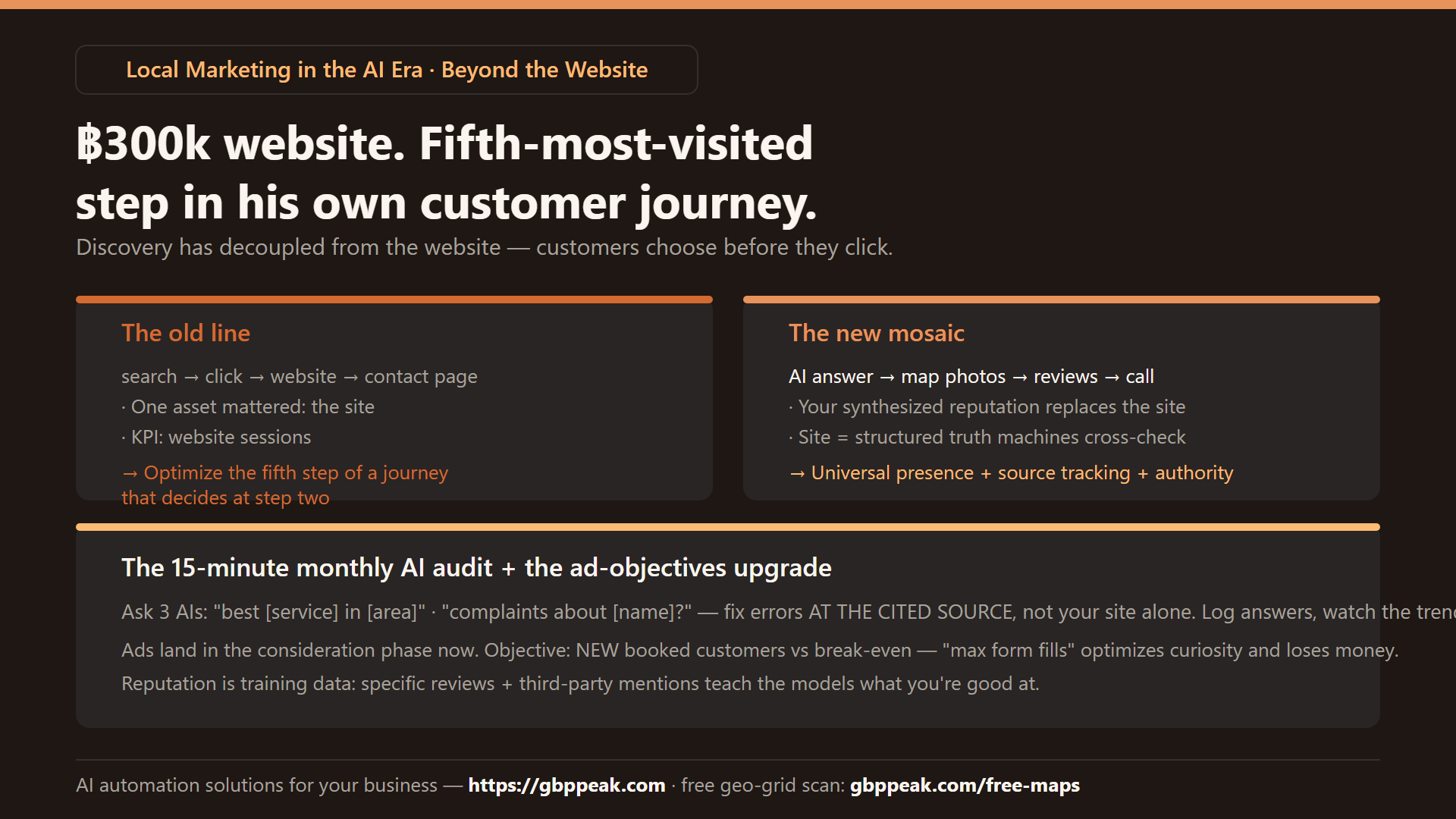
Fighting this is pointless; building for it is straightforward. Here's the map.
Local marketing's core shift is that discovery no longer flows through your website. AI assistants, map listings, and review sites act as the primary discovery layers — AI models synthesize your reviews, mentions, and directory data into a summarized version of your business, and recommend from that. Three capabilities follow: universal presence (accurate representation on every platform where machines look), source tracking (counting qualified leads and where they originate, not raw clicks), and brand authority (enough consistent proof that AI systems put you on their shortlist). Ads shift too: optimize for NEW customers and high-value conversions like booked appointments, not cheap clicks. :::
The journey has shattered
The old funnel was a line: search → click → website → contact. The new journey is a mosaic:
| Old journey | New journey |
|---|---|
| Search engine | AI assistant / map / review site |
| Click a link | Read a summarized answer |
| Your website | Your synthesized reputation |
| Contact page | Call button right in the listing |
| One asset mattered | Every surface matters |
A customer might ask an AI for a recommendation, glance at map photos, scan reviews on a third-party site, and call — your website never loads. If your strategy is "rank the website," you're optimizing the fifth step of a journey that decides at step two.
The three capabilities that replace "website-first"
1. Universal presence
You exist wherever machines look for you — accurately, whether or not you've claimed the listing:
PRESENCE AUDIT (90 minutes, twice a year):
  Google Business Profile    → claimed, complete, current
  Major directories          → NAP identical, service list matching
  Review platforms           → claimed, responded, consistent story
  AI assistants              → ask your real customer questions,
                               check facts + sources they cite
  Your own site              → the structured truth everything
                               else should match
2. Source tracking
When discovery fragments, "website sessions" stops being a useful KPI. The question becomes: where do qualified leads — people ready to book — actually come from? That's the attribution pipeline again: ask every new customer "how did you first hear about us," log it, count it. The tailor above learned "ChatGPT" and "the map reviews" were his top sources — invisible in Google Analytics, obvious in a one-question intake.
3. Brand authority — the AI shortlist
AI models don't match keywords; they build an entity — a synthesized picture of your business from reviews, mentions, locations, citations — and recommend from it. Ask "Is this clinic reliable?" and the AI answers with your aggregated reputation.
That makes reputation a data point, not a vanity metric:
- Consistency is disqualifying when absent — different prices on a directory vs. your site get flagged; the model hesitates, and hesitation means someone else gets named
- Reviews are training data — detailed, specific reviews in customers' own words teach the models what you're actually good at
- Third-party mentions — a local blog, a forum thread — are the citations that make the synthesized story richer than your own claims
Ads inside the answer: the consideration-phase shift
Ads are now appearing inside AI chat interfaces for a meaningful share of commercial queries — and they land at the consideration phase, when the user is comparing options, not at the search box. Two consequences:
- Your offer must be machine-interpretable. A "keyword → landing page" pipeline doesn't work when the AI is summarizing your offer for the user. Scattered, vague info gets misrepresented — or skipped
- Cheap clicks are depreciating. Automated ads happily deliver low-value leads: wrong service, wrong area, or people who were calling anyway. The modern objective is new-customer optimization:
ad_objectives_upgrade:
  old:   "maximize form fills"          # counts curiosity
  new:   "maximize booked appointments" # counts revenue
  exclusions:
    - "existing customers (suppression list)"
    - "wrong service areas"
  measurement: "cost per NEW booked customer,
                vs break-even — nothing else"
If your conversion definition is still "form submitted," the automation is optimizing for the wrong unit — and will happily win at it.
The monthly AI-reality check
The single highest-leverage habit in this era: ask the machines about yourself, monthly, and fix what they get wrong.
THE 15-MINUTE AI AUDIT:
  1. Ask ChatGPT + Perplexity + AI Overviews:
     "best [your service] in [your area]"
     "what are complaints about [business name]?"
     "is [business name] good for [specific service]?"
  2. Compare answers against your GBP + website:
     wrong price? missing service? stale hours?
  3. Fix at the SOURCE — the platform the AI cited,
     not your site alone
  4. Log the answers; watch the trend month over month
Step 3 is the part people miss: when the AI is wrong, the error usually lives in a listing or old article it cited — fix the source, and the answer updates on the next crawl. And pair the audit with the map half of reality: a free geo-grid scan at https://gbppeak.com/free-maps plots your Google Maps ranking across your whole service area — the geographic view of the same fragmented discovery.
Frequently Asked Questions
Why be on multiple platforms if my website is good?
Because a growing share of customers never reach websites — they act inside AI answers, map listings, and review sites. If you only exist on your own domain, you're invisible at the exact moment those gateways decide who gets recommended.
How do I check what AI says about my business?
Ask it, specifically and monthly: "best [service] in [area]," "complaints about [name]," "is [name] good for [service]." Compare the answers to your actual profile and site, and fix discrepancies at the cited source platform — the summaries update when their sources do.
Does AI search make traditional SEO obsolete?
No — it changes the target from clicks to entity clarity: making it trivially easy for any machine to know exactly what you do, where you are, and why you're trusted. That's built from the same foundations — accurate listings, structured site data, genuine reviews — executed for readers who summarize instead of browse.
Should I keep paying for cheap ad clicks?
Only if they convert. Define your conversion as a booked appointment (or equivalent revenue event), add suppression for existing customers, and measure cost per NEW customer against break-even. Automation optimizing for form fills will win that game and lose you money.
Final note
The era of search-and-click is giving way to inquiry-and-recommendation. Your website is still vital — as the structured source of truth every machine cross-checks. But the decision now happens across a mosaic you don't control. Make your truth consistent everywhere, track where qualified customers actually start, and audit what the machines say monthly. Be findable at step two, and the rest of the journey takes care of itself.