Specific Categories, Information Gain, and Bookings: The Local Search Signal Strategy
"Medical Practice" for two years — while a "Cosmetic Dentist" took every veneers search. Three signals that matter now: precise categories, uncopyable content, ads judged by bookings.
A Bangkok cosmetic dentistry clinic spent two years competing under the category "Medical Practice" — because it felt safer, broader, harder to get wrong. Meanwhile a smaller competitor listed as "Cosmetic Dentist" with three matching service pages was quietly taking every "veneers Sukhumvit" search in the neighborhood. The broader label didn't protect the clinic; it hid it.
Local search visibility increasingly rewards precision: specific categories, content only you can write, and ads judged by profit instead of noise. 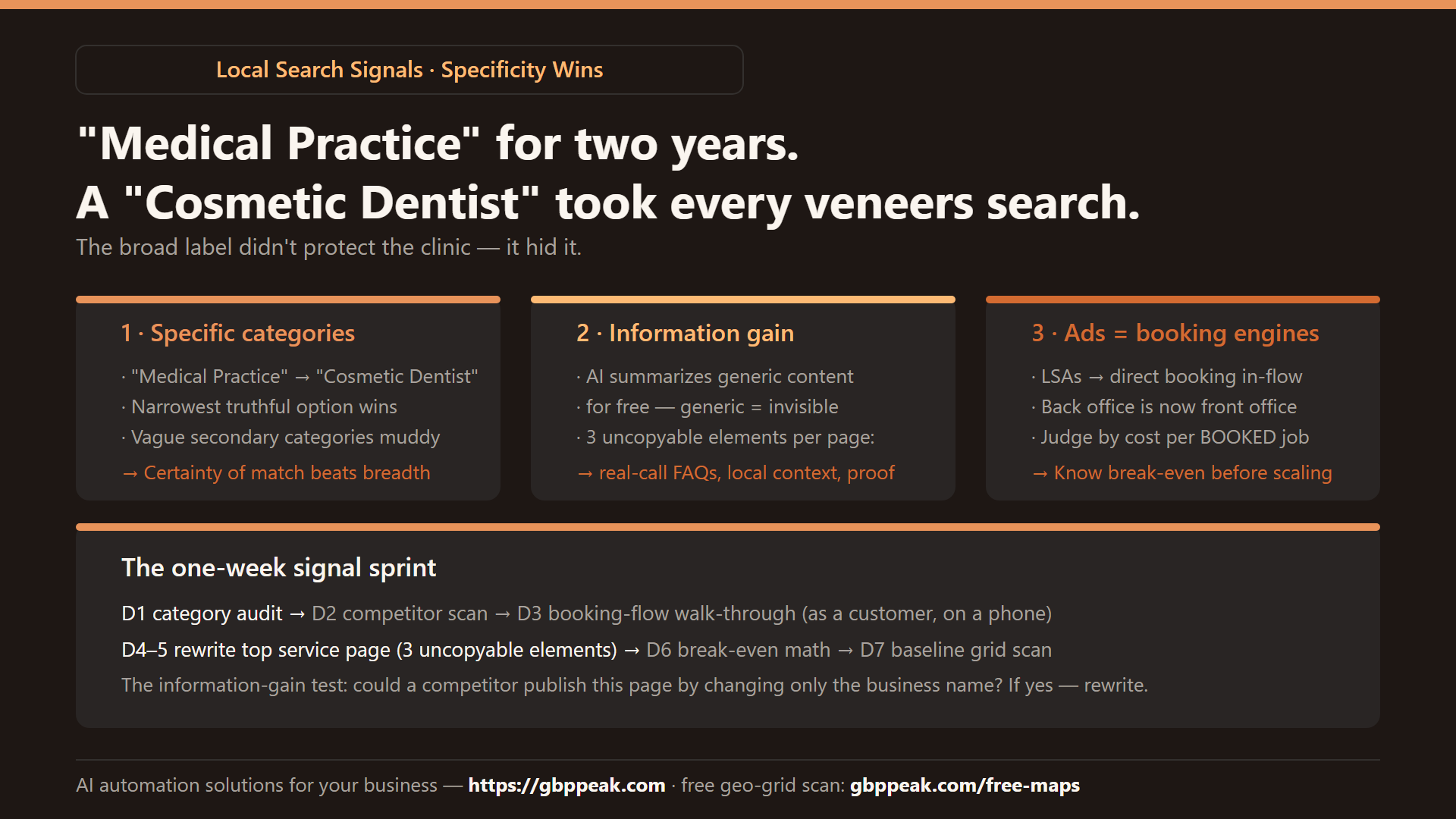
This guide covers the three signals that matter now — plus the booking-flow reality most businesses discover too late.
Improving local visibility today means choosing accuracy over volume in three places. Categories: pick the narrowest Google Business Profile category that truthfully fits ("Cosmetic Dentist" beats "Medical Practice") — specific categories give algorithms the confidence to match you to specific intent. Content: provide "information gain" — details only your business can offer, like FAQs from real calls and neighborhood specifics — because AI summarizes generic text instantly, making it worthless. Ads: define leads by booked appointments, not contacts, and know your break-even cost per booking before raising any budget. Specific, verifiable, profitable — that's the signal strategy. :::
Signal 1: Specific categories beat "safe" ones
Your GBP category is the single strongest declaration of what you do. The instinct to go broad — "Medical Practice," "Contractor," "Store" — feels like casting a wider net. In practice it dilutes the one signal Google uses to match you to intent.
| Broad ("safe") | Specific (better) | What changes |
|---|---|---|
| Medical Practice | Cosmetic Dentist | You surface for "veneers," not just "clinic" |
| Home Services | Aircon Repair Service | Matched to the exact broken-AC moment |
| Store | Sporting Goods Retailer | Appearing in category + product searches |
| Consultant | Marketing Agency | Eligible for agency-specific queries |
The mechanism: when someone searches a specific service, Google wants maximum certainty of match. A narrow category plus matching service pages plus consistent photos is a stack of proof; a broad label is a shrug. The audit takes ten minutes:
CATEGORY AUDIT:
  1. Search your 5 most valuable customer queries
  2. Note which categories the top 3 results use
     (visible via their profiles)
  3. If yours is broader than theirs → change it to the
     narrowest truthful option
  4. Secondary categories: only add ones you genuinely
     deliver — each vague extra muddies the primary signal
Signal 2: Information gain — the anti-generic requirement
Here's the uncomfortable truth about content in the AI era: models summarize generic information for free. If your service page says what every competitor's page says — "quality service, experienced team, customer first" — there is now literally zero reason for a search engine or a buyer to distinguish you. The summary of generic is generic.
What survives is information gain: content that adds something only you can add.
- FAQs from real calls — "Do you do implants in one visit?" with your actual answer, priced. Mine them from your LINE history (the conversation-mining pipeline automates exactly this)
- Local context — neighborhoods you serve by name, the soi you're on, parking reality, Thai-specific regulations for your trade
- Proof points — your real before/afters, your case counts ("400+ whitening treatments since 2021"), named local testimonials
INFORMATION-GAIN TEST (per page):
  Could a competitor publish this exact page by changing
  only the business name?
    YES → generic → rewrite with 3 things they can't copy
    NO  → keep going
Three uncopyable elements per key page. That's the whole bar — and most businesses never clear it, which is why it works.
The shift nobody budgets for: ads → booking engines
Google's local ad products (Local Services Ads and friends) are converging on direct booking: the customer finds you and books you in the same interface. The find-to-book gap is collapsing — and that silently turns your back office into front-office marketing.
If your service menu is confusing or your intake takes two days, you now lose the customer at the moment of maximum intent, inside Google's own flow. The prep list:
- Walk your own booking flow as a customer, monthly — on a phone, from the ad. Where does it get confusing or slow? That's the leak
- Sync your real availability — an instant-booking result that offers next Tuesday when you're full is worse than no booking at all
- Pre-answer intake questions in the flow — the FAQ work above feeds directly into the booking form
Signal 3: Ads judged by profit, not activity
The classic frustration: budget spent, "leads" arrive, nobody books — wrong numbers, wrong services, wrong area. The problem is almost never the ad volume. It's the definition of a lead.
lead_definition_upgrade:
  weak:   "anyone who calls"          → many leads, few customers
  better: "calls 60s+ about a listed service, in service area"
  best:   "booked appointment"        → the only unit that pays
break_even:
  know: "max affordable cost per BOOKED appointment"
  formula: "avg job value × margin ÷ repeat rate"
  rule: "never raise budget before cost-per-booking is known
         and below break-even"
Run that math before touching any budget slider. An automated system told to find "anyone who calls" will find plenty of anyone; told to find "people booking [specific service] in [specific area]," it finds fewer and better. The targeting only sharpens once your success metric is a booking.
The one-week signal sprint
- Day 1: category audit and change; delete vague secondary categories
- Day 2: competitor scan — which services do Google's favorites highlight in your area?
- Day 3: booking-flow walk-through; fix the single worst friction point
- Day 4–5: rewrite your top service page: three uncopyable elements, FAQs from real calls
- Day 6: compute break-even cost per booking; redefine ad success to match
- Day 7: baseline the map — a free geo-grid scan at https://gbppeak.com/free-maps plots your Google Maps ranking across your service area, so the next 90 days of category and content work have a before-picture
Frequently Asked Questions
Why does a specific category matter more than a broad one?
Categories are how Google qualifies you for intent. A specific category ("Cosmetic Dentist") gives the algorithm certainty to match you to specific searches; a broad one ("Medical Practice") makes it guess — and when it guesses, it usually shows someone else. Pick the narrowest truthful option.
What is "information gain" in SEO?
The amount of genuinely new information your page adds. AI summarizes generic content instantly, making it indistinguishable — pages earn visibility by containing things only your business knows: real-call FAQs, neighborhood specifics, verifiable proof points.
How do I know if my ads are actually profitable?
Measure cost per booked appointment, not cost per lead or call. Know your break-even (average job value × margin ÷ repeat rate), track the journey from click to booking, and only scale spend when cost-per-booking sits safely below that line.
How does AI search change local rankings?
AI answers build on your existing data — categories, reviews, photos, service detail. Consistent, specific data lets the model match you to a request with confidence; vague data makes you unquotable, and unquotable businesses don't get recommended.
Final note
Visibility was never about being louder — it's about being more specific than the other guy: a category that says exactly what you are, content nobody can copy, an offer defined by the booking it produces. Precision is the strategy. The ranking follows the proof.