From Experiments to Infrastructure: Scaling AI in a Small Business
AI in one person’s head walks out the door with them. Turn your best AI tricks into packaged skills — the small-business skill factory, one skill a month.
In a 12-person Bangkok logistics company, one customer-service rep discovered she could paste shipping inquiries into an AI chat and get perfectly drafted Thai replies in seconds. She doubled her throughput. Her three teammates kept typing replies by hand — because her "system" lived in her head and a messy note file.
That's the state of AI in most small businesses today: individual heroics, siloed wins, capability that walks out the door when the hero takes a day off. The gap isn't between businesses that use AI and those that don't — it's between businesses where AI lives in one person's head and businesses where it lives in the system.
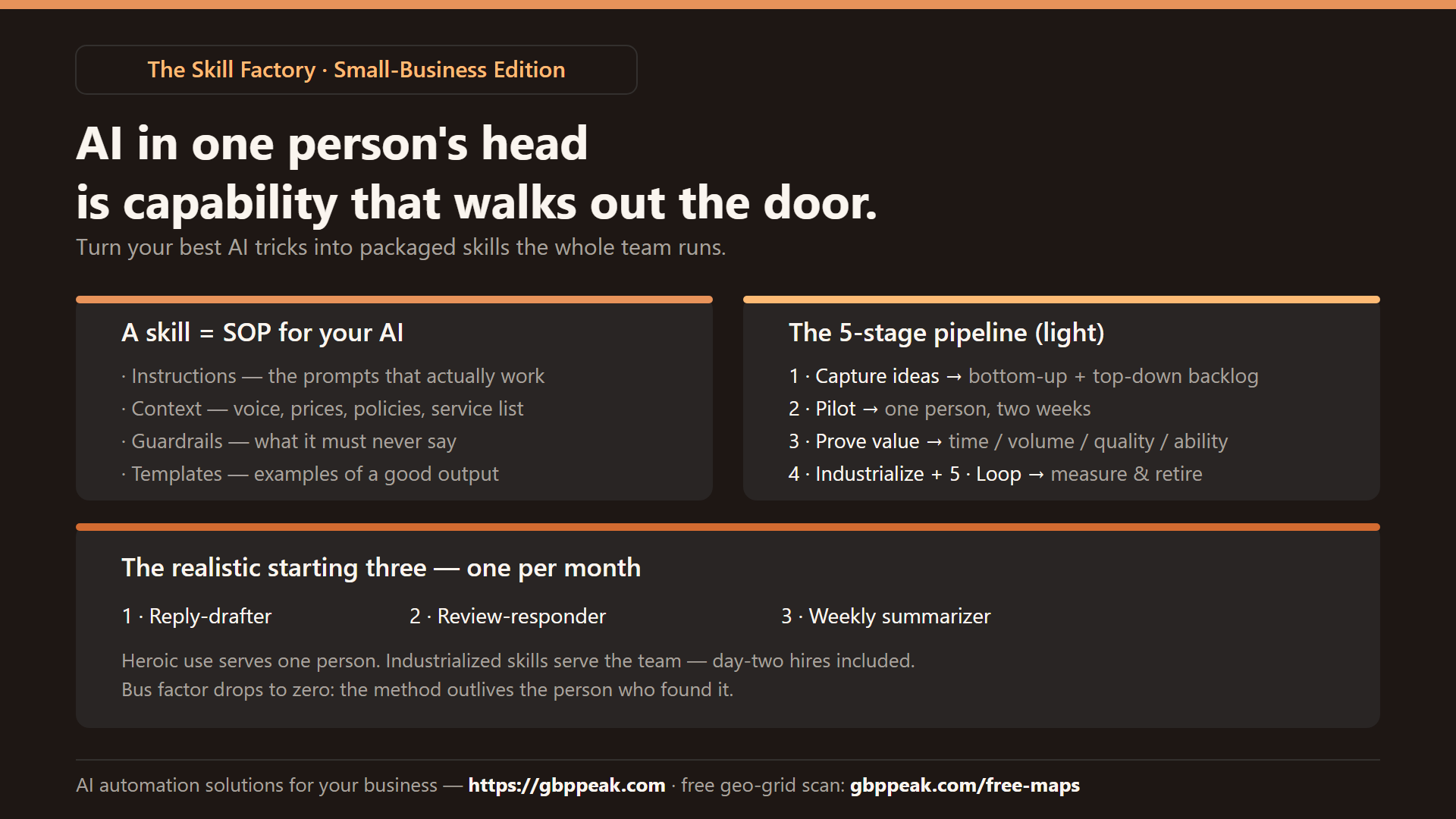
The fix, borrowed from how larger companies industrialize AI, works at small-business scale too: turn your best AI tricks into skills — packaged, repeatable procedures anyone on the team can run.
To scale AI in a small business, stop relying on individual "AI heroes" and turn winning use cases into skills: documented packages containing the instructions, your business context (tone, prices, policies), the tools/data needed, guardrails on what the AI must never say, and example outputs. Run each idea through a mini pipeline — pilot with one person, measure the value, then industrialize it (standardize, test, document) so every teammate gets the same capability. The result is AI as company infrastructure rather than personal tricks. :::
Assistant vs. skill: the distinction that matters
An AI assistant (ChatGPT, Claude, Gemini) is the interface everyone types into. A skill is a packaged procedure the assistant runs — the small-business equivalent of an SOP. If your best employee has a magic prompt chain for answering quote requests, that's a skill trapped inside a person. Written down and packaged, it becomes a company asset.
A well-defined skill has five parts:
- Instructions — the exact steps, the actual prompts that work
- Context — your brand voice, price ranges, policies, service list
- Tools/knowledge — where it looks things up (rate sheet, FAQ, past cases)
- Guardrails — what it must never do (no discounts, no delivery promises, no medical claims)
- Templates — two or three examples of a good output
With that package, a new hire on day two produces replies at the quality that used to take your best person a year to reach.
| Heroic use (person-dependent) | Industrialized skill (system-dependent) | |
|---|---|---|
| Who benefits | One person | Everyone, including future hires |
| Consistency | Varies with mood and memory | Same rules every time |
| Bus factor | Leaves when the hero leaves | Documented, transferable |
| Safety | Unchecked outputs | Guardrails baked in |
| Improvement | Random | Measured, versioned |
The skill pipeline, small-business edition
Big companies run five-stage pipelines. A small business needs the same five, just lighter.
1. Capture ideas from both directions
- Bottom-up: ask each person monthly — "where did AI save you time this month?" The rep closest to the pain finds the practical fixes.
- Top-down: the owner picks one high-volume repetitive task (quote replies, review responses, weekly stock summaries) and commissions a solution.
Keep a simple backlog — one sheet, three columns: idea, owner, expected saving.
2. Pilot with one person, not everyone
Run the promising idea with a single person for two weeks. Small enough to fail cheaply; real enough to prove it works. Watch for what they do that you didn't predict — power users always bend tools in ways the builder missed.
3. Prove the value in numbers
Before packaging anything, measure it:
# The 4-value test (needs at least one YES to proceed)
time    : quote replies 25 min -> 6 min each?          YES/NO
volume  : 30 reviews answered/week instead of 12?      YES/NO
quality : reply tone consistent across all staff?      YES/NO
ability : every call transcribed+summarized (never
          possible before)?                            YES/NO
"Cool" fails this test constantly. Frequency × impact is the filter — a task done 40 times a week that saves 15 minutes each is worth industrializing; an impressive demo used once a month isn't.
4. Industrialize — project becomes product
This is where most small businesses stop, and where the value actually multiplies:
skill: quote-reply-v1
instructions: prompts/quote-reply.md
context: [brand-voice-th, price-list-2026, delivery-policy]
guardrails: [no-discounts, no-delivery-dates, thai-only-replies]
examples: [good-quote-1.txt, good-quote-2.txt]
tests: [price-accuracy, no-promises, tone-check]
owner: customer-service-lead
Industrializing means: standard naming, real customer data swapped for placeholders, degraded-state handling (what the skill does when the price sheet is missing — ask, don't guess), one page of documentation, and a couple of automated checks so a prompt edit can't silently break it (see our guide to AI workflow evals for how).
5. Loop it
Track usage, collect failures, and retire dead skills. Every two months, review: which skills are used weekly, which quietly died, what new pain showed up. The pipeline is a loop, not a launch.
The realistic starting three
For most Bangkok small businesses, these three skills cover 80% of the win:
- Reply-drafter — inbound questions (LINE/DM/email) to polished drafts in your voice, with prices from your actual sheet
- Review-responder — every Google/Facebook review answered warmly, negative ones flagged for the owner first
- Weekly summarizer — sales, bookings, and top customer questions condensed into one page every Monday
Build one per month. By month three, your team runs on machinery, not heroics.
And when AI drafts customer-facing content, remember discovery still runs through the map: check where you actually rank across your service area with a free geo-grid scan at https://gbppeak.com/free-maps — one look tells you whether visibility or conversion is your real bottleneck.
Frequently Asked Questions
What's the difference between an AI assistant and an AI skill?
The assistant (ChatGPT, Claude, Gemini) is the interface everyone types into. A skill is a packaged procedure — instructions, your business context, guardrails, examples — that the assistant runs to perform a focused task, like drafting quote replies. Skills turn a general tool into your tool.
Why not just let each employee use AI their own way?
Individual experimentation is great for finding ideas, but it stays siloed — if one person holds the method, the team doesn't benefit and you lose it when they leave. Packaging wins as skills shares the capability, keeps outputs consistent, and lets you enforce guardrails.
How do I know a use case is worth industrializing?
Apply the frequency × impact filter: done often (weekly, by multiple people) AND clearly better (faster, higher volume, better quality, or newly possible). If it passes, measure it during a two-week pilot, and only industrialize with numbers attached.
We're only five people — is this overkill?
No — small teams benefit most, because every person covers more roles and bus factor is highest. A three-skill setup (replies, reviews, weekly summary) is roughly a weekend of packaging and immediately makes everyone's baseline your best person's output.
Final note
The next year of AI adoption won't be defined by who has the best prompts — it'll be defined by who turned their best prompts into machinery everyone operates. Start with one skill. Ship it this month.