From SEO to GEO: How to Build Brand Authority in the Age of AI Search
AI search ranks entities, not keywords. The three levers of entity trust — and how to measure mention rate for a local business.
A Bangkok gym owner once asked a consultant why his traffic dropped 30% while bookings stayed flat. The answer: Google's AI Overview now answered "gym near Asok with day passes" directly in the results. Fewer people clicked anything — but the ones who clicked his link had already read the AI's summary and chosen him anyway. He lost traffic and kept the customers.
That's the SEO-to-GEO shift in one story. It's not the death of search visibility; it's a change in what visibility is. This guide is about the brand-authority side of that shift — how AI engines decide who counts as a trusted name, and how a local business can earn that status instead of renting clicks.
Moving from SEO to GEO means optimizing to be cited by AI engines (Google AI Overviews, ChatGPT, Perplexity) rather than just ranked in blue links. Brand authority in this era is "entity trust": AI models recognize you as a distinct, reputable entity when your facts are consistent everywhere, your content covers your topic deeply, and third-party sites corroborate what you claim. Measure it with mention rate — how often AI names you when answering questions in your niche — not raw traffic. :::
What actually changed: from clicks to citations
Traditional SEO competed for positions. GEO competes for inclusion in the answer. The AI reads your site, your Google Business Profile, your reviews, and the wider web, then synthesizes one response. Your goal is to be quoted or named in it.
| Dimension | Traditional SEO | GEO / AI search |
|---|---|---|
| Target | A ranking position | A mention inside the answer |
| Currency | Keywords + backlinks | Entities + corroborated facts |
| Content that wins | Persuasive, lengthy | Answer-first, modular, specific |
| Risk | Losing position #1 | Being factually contradicted elsewhere |
| Metric | Clicks, sessions | Mention rate, citation share, referral quality |
Notice the risk column. In classic SEO, your worst case was a competitor outranking you. In GEO, your worst case is the AI knowing about you but not trusting you — stale hours here, a different phone number there, and the engine quietly drops you from its answer because it can't resolve which version of your business is real.
Zero-click is a filter, not a funeral
When the AI answers directly, most users never click. That sounds like lost traffic — and it is. But think about what's left: the person who reads the AI's summary, sees your name and your prices, and clicks through anyway. That visitor is pre-qualified. They know roughly what you offer and roughly what it costs.
For a local business with limited capacity — a clinic with 8 treatment slots a day, a salon with 3 chairs — a hundred pre-qualified visitors beat a thousand random ones. The AI is doing your filtering for free.
The catch: you only get those visitors if the AI describes you accurately and favorably. Which brings us to authority.
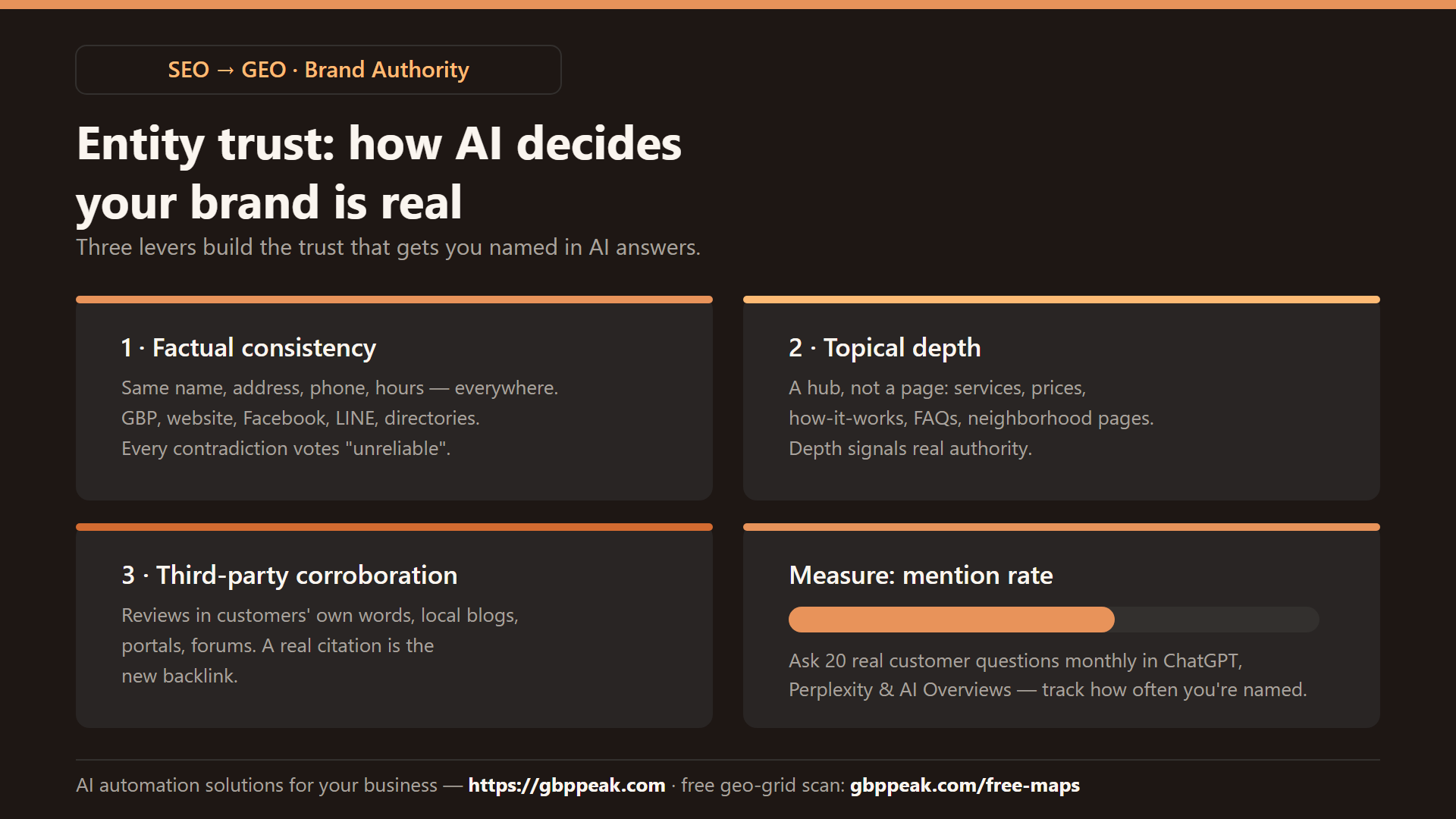
Entity trust: how AI decides you're real
To an AI model, your business is an entity — a node in a giant graph of facts. "Nailosophy is a nail salon, located Ari, phone 02-XXX, rated 4.8 from 400 reviews, mentioned by BangkokBeautyBlog." Every consistent mention strengthens the node. Every contradiction weakens it.
Three levers build that trust:
- Factual consistency (NAP+): identical name, address, phone, hours, and price signals across your GBP, website, Facebook, LINE OA, and every directory. Character-for-character where possible.
- Topical depth: not one "About Us" page, but a hub — services, prices, how-it-works, FAQs, neighborhood pages. Depth signals you're the real authority, not a keyword chaser.
- Third-party corroboration: reviews in customers' own words, local blog mentions, portal listings, forum threads. In GEO, a genuine citation from an unrelated site is the new backlink.
# Entity-trust spot check (15 minutes, monthly)
1. Google your business name + phone — note every listing with wrong data
2. Search "site:gbppeak.com" style queries for your own site's NAP page
3. Ask an AI: "is [business] good for [service] in [area]?"
4. Compare the AI's stated facts vs your GBP — every mismatch is a
   listing somewhere feeding the model stale data
Answer-first content: write for extraction
AI engines lift sentences, not paragraphs. Structure every section so its first sentence can stand alone as the answer.
The format that gets quoted
- Question-shaped headings ("How much does a lash extension cost in Bangkok?") with a direct first-sentence answer ("Between ฿800–2,500 depending on style and volume.")
- Tables for tiers and comparisons — the single most quotable element in any AI's diet
- Specific, checkable claims ("2,000+ treatments since 2019") over slogans ("premium quality you can trust")
- FAQ schema so machines know your Q&A is literally a Q&A
This is not writing worse. It's front-loading. The story and the personality still matter — humans choose you — but the facts need to sit where a machine expects to find them.
Measure what matters: mention rate
Traffic dashboards under-count AI referrals, so GEO needs its own scoreboard. Track two things monthly:
- Mention rate: across ~20–50 questions your customers actually ask, how often does an AI name you? Which competitors show up instead?
- Citation share: when the AI lists sources, are you among them — and how do engaged visitors from those citations behave on your site (calls, bookings, form fills)?
# The 20-question mention audit (repeat monthly, same questions)
1. List 20 real customer questions, e.g.
   "best facial for sensitive skin bangkok", "dentist open sunday sukhumvit"
2. Ask each in ChatGPT, Perplexity, and Google AI Overview
3. Score per engine: named / cited / absent — and who appeared instead
4. Log results in one sheet; the trend matters more than any single check
If your name appears but the facts are wrong, fix listings first — trust before promotion. If you're absent entirely, the gap is usually topical depth or third-party corroboration, not your website's wording.
What NOT to do
- Don't panic-publish AI slop. Flooding your site with shallow generated articles erodes the exact trust you're trying to build.
- Don't chase every new AI tool. The audit matters; the platform of the week doesn't. ChatGPT, Perplexity, and Google's AI Overviews cover most local queries.
- Don't abandon classic SEO. The AI reads Google's index. Your map-pack ranking, reviews, and site health are the raw material GEO is built from.
A 90-day authority sequence
- Weeks 1–2: entity-trust spot check; fix every conflicting listing
- Weeks 3–6: restructure your top pages answer-first; add FAQ schema; publish one genuine depth piece (pricing guide or how-it-works for your core service)
- Weeks 7–12: run the 20-question mention audit monthly; chase 2–3 real local mentions; compare named-vs-absent trends and adjust
And to see the geographic side of your visibility — where you actually rank across your service area on Google Maps, grid by grid — run a free scan at https://gbppeak.com/free-maps. Authority starts with knowing your current position.
Frequently Asked Questions
What is the difference between SEO and GEO?
SEO optimizes to rank in a list of links; GEO optimizes to be understood, trusted, and cited by AI engines that synthesize a single answer. They share foundations (site quality, relevance, authority) but GEO adds factual consistency across the whole web and answer-first content structure.
Is zero-click search bad for my local business?
Not usually. Fewer, better-informed clicks often convert better for capacity-limited local businesses. The real risk isn't zero-click — it's the AI describing you inaccurately, which costs you both clicks and trust.
How long does building entity trust take?
Consistency fixes show up in weeks, since AI models re-crawl constantly. Deeper authority — topical hubs and third-party corroboration — builds over months. The monthly mention audit is the honest progress bar.
Can a small business compete with big brands in AI answers?
Yes, in its niche. AI answers local questions locally — "dentist near Ari" has no multinational winner. Depth and consistency in your neighborhood and category beat a big brand's generic content.