
Owner Burnout: Automate the Repetitive 70% Before It Automates You
Huge effort, little progress — the signature of owner burnout. The automation ladder that buys back the hours that compound: FAQ, booking, reviews, content.
Ask a Bangkok small-business owner what they did yesterday and you'll hear a familiar list: opened the shop, answered LINE messages until midnight, posted on Instagram, replied to Google reviews, chased a supplier, fixed the booking calendar, and — maybe, at 11 p.m. — thought about the marketing they never got around to. They're working incredibly hard. The business is barely moving forward.
That gap — huge effort, little progress — is the signature of owner burnout. And the usual advice ("work smarter!" "hustle harder!") makes it worse, because the problem was never effort. It's that the effort goes to the wrong kind of work. 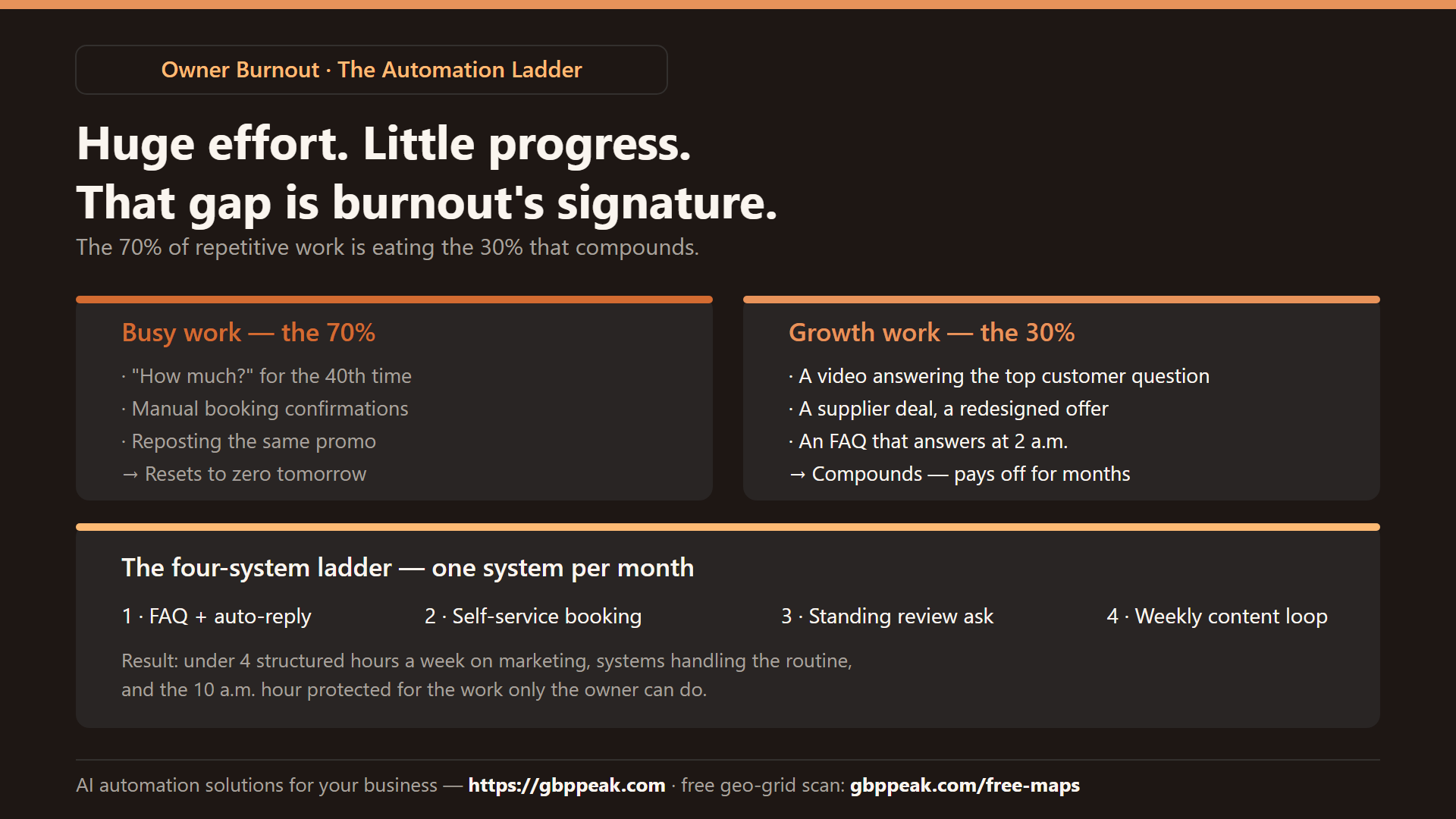
This guide is about telling the difference, and about the one lever small businesses actually have: automating the repetitive 70% so the human saves their energy for the 30% only they can do.
Small-business owner burnout usually isn't caused by working too little or too hard — it's caused by spending most hours on repetitive operational work (answering the same questions, chasing bookings, posting updates, managing reviews) instead of the growth work only the owner can do. The practical fix is automation: connect your channels (LINE, DMs, reviews, bookings, social posting) so routine tasks run themselves or get batched, and measure success by recoverable hours and customer response quality — not by how busy you feel. :::
Growth work vs. busy work
The core confusion: growth work and busy work both feel like work. They're opposites.
| Growth work (the 30%) | Busy work (the 70%) | |
|---|---|---|
| Examples | Negotiating a supplier deal, filming a video that answers customers' top question, redesigning a service offer | Answering "how much?" for the 40th time, reposting the same promo, manually confirming bookings |
| Effect | Compounds — pays off for months | Evaporates — must be redone tomorrow |
| Who can do it | Only you | A rule, a template, or a machine |
| How it feels afterward | "I built something" | "I survived the day" |
Burnout is what happens when the 70% eats the whole day for months. You become a high-performing engine for your own inbox.
The three traps that keep owners stuck
1. "If I just work a bit harder"
Every owner believes next month will calm down. It won't — the routine work regenerates daily. Adding hours doesn't reduce the load; it just deepens exhaustion until the quality of everything (service, marketing, decisions) starts to slip.
2. Presence mistaken for value
Constant availability feels like good service. "Customers can reach me any time" — but answering LINE at midnight trains customers to expect midnight answers, and it quietly destroys the thinking capacity you need to run the business. True service is a fast, consistent answer during defined hours, not a permanently exhausted human.
3. Busyness as the scoreboard
When being busy is the measure of a good day, the business optimizes for motion: more posts, more replies, more tasks. What actually grows a local business is fewer, better moves: accurate Google profile, steady reviews, one strong content habit.
What "ease" actually means (it's not laziness)
Ease is structural, not a mood. For a small business it looks like:
- Space to think — a weekly hour where nothing is on fire, to decide what's next
- Room to explore — trying one new offer or channel without drowning
- A life that isn't only the shop — because a rested owner makes better decisions than an exhausted one
The counterintuitive part: businesses with ease usually serve customers better. Fast automated answers at 9 a.m. beat slow exhausted answers at 11 p.m.
The automation ladder for owner-operators
You don't need to automate everything. You need the four systems below, roughly in this order — each one buys back hours that fund the next.
# The four-system ladder (start at 1, climb when it holds for a month)

1. FAQ layer     → pinned answers + auto-reply on LINE/IG/Messenger for
                   the 10 questions that make up most of your inbox
                   (price, hours, location, booking, how long it takes)

2. Booking      → self-service booking with automatic confirmations
                   and reminders (kills the confirm-by-hand loop)

3. Reviews      → a standing ask (QR card / post-service message) +
                   a 30-minute weekly window to answer every review

4. Content      → one weekly filming session; a repeatable edit/post
                   routine — or an AI-assisted loop that drafts captions
                   from your top customer questions
The technology is the easy part — LINE OA auto-responses, a booking tool, and a spreadsheet checklist cover most of it. The hard part is deciding that your midnight replies are not the business.
A realistic weekly rhythm after the ladder
monday:   review weekend numbers + answer accumulated DMs (1h, batched)
wednesday: film 3 short videos answering top customer questions (1h)
friday:   posts scheduled, reviews answered, checklist glance (45m)
daily:    nothing reactive before 10am — that hour is growth work
That's under four structured hours a week on the marketing side, with the routine handled by systems. Compare it to the daily drip that never ends, and you see where burnout actually comes from — and where it goes.
Spotting the difference: a self-check
Ask monthly, honestly:
- Growth vs. execution — did anything I built this month keep working while I wasn't touching it (an FAQ, a video, a review flow)? Or was every hour consumed by tasks that reset to zero?
- Support vs. presence — does my customer service run on systems with defined hours, or on me being reachable around the clock?
- Sustainability — if the next three years look exactly like last month, am I building something, or slowly emptying the tank?
If the answers lean the wrong way, don't respond by working harder — respond by automating one more layer.
And if marketing is the piece that keeps falling off your plate because the day eats it: the map side of local visibility can run on a system too. A free geo-grid scan at https://gbppeak.com/free-maps shows where your Google Maps ranking stands across your service area — one look, one decision, no daily grind.
Frequently Asked Questions
What's the difference between being busy and being productive as an owner?
Busy is volume — mostly reactive tasks that reset to zero tomorrow (answering the same questions, manual confirmations). Productive is compounding — building things that keep working without you: an FAQ that answers customers at 2 a.m., a booking flow that confirms itself, a video that sells for weeks. Owners escape burnout by shifting hours from the first bucket to the second.
How do I start automating when I have no time to set anything up?
Start with the single biggest inbox item — usually the top 10 repeated questions — and spend one focused hour creating pinned answers and an auto-reply. That one hour typically removes more daily load than any other change. Then ladder up: booking, reviews, content — one system per month.
Isn't instant personal replies better customer service than automation?
Not usually. Customers want fast, accurate, consistent answers — not a specific human typing them at midnight. Automation handles the routine instantly; you handle the genuine exceptions personally. That combination beats exhausted-everywhere service on every measure that matters.
Is easing off a sign my business is failing?
No — it's usually the sign it's maturing. Businesses that survive decades are built on systems that don't require the owner's constant presence. Ease is what makes room for the decisions that actually grow revenue.