Where AI Automation Actually Works (and Where It Quietly Fails)
The AI wrote the report in four minutes — then couldn’t paste it into the team deck. One pattern explains every AI win and failure; route work by task shape.
A Bangkok marketing manager watched a demo: an AI agent wrote a full campaign report in four minutes. She assigned it her actual Monday task — "update the Q4 deck the team shares, add last week's numbers, keep the template." Four hours later the report existed as a wall of text, the deck was untouched, and she'd rebuilt the slides by hand. The AI did the hard thing and failed the easy one.
That's not a broken tool — it's a map of where AI actually works today. If you run a small business and wonder why AI feels superhuman at some tasks and useless at others, the pattern is consistent and knowable. 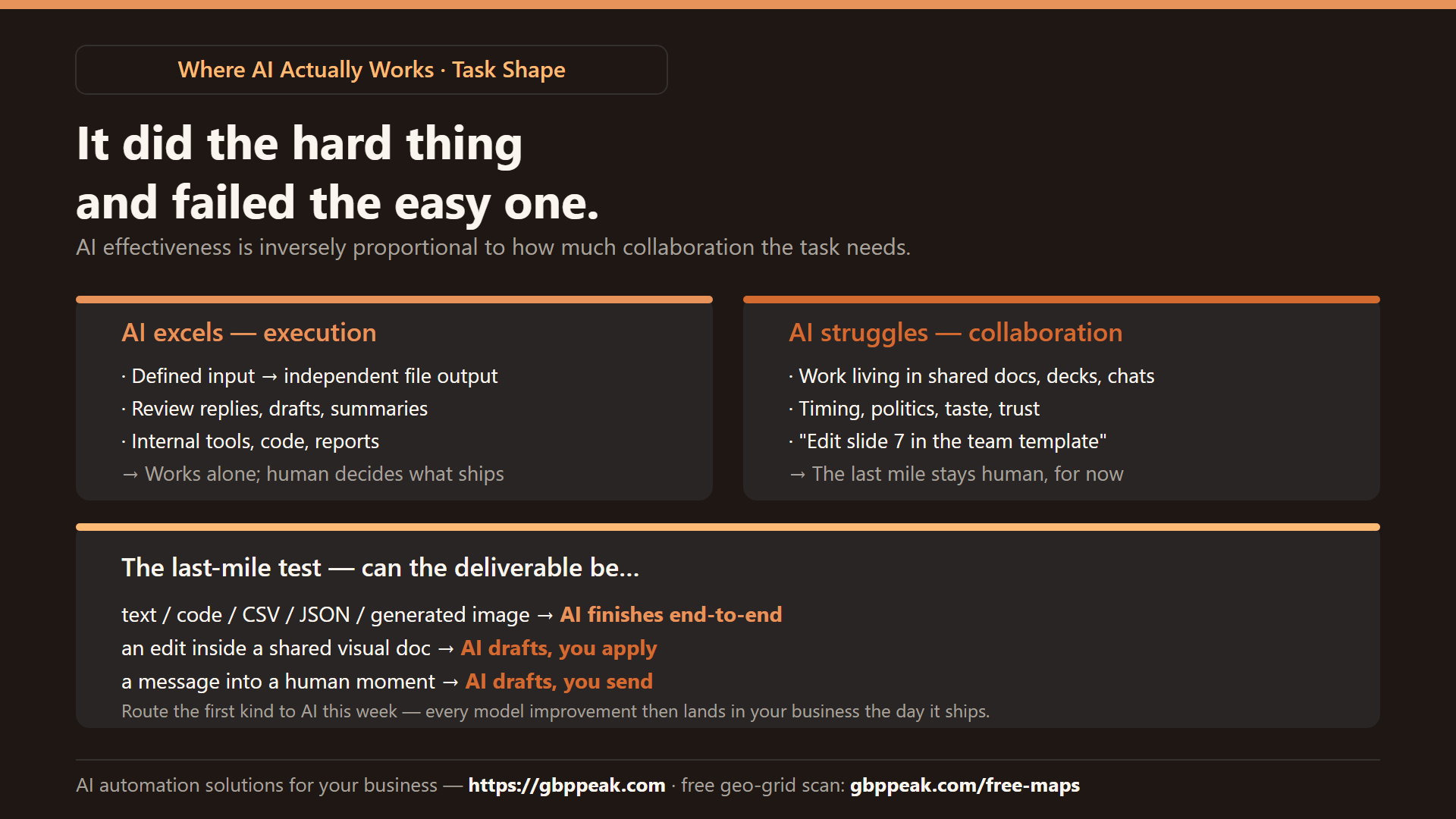
This guide lays it out so you point the machine at work that pays.
AI agents excel at execution — producing independent deliverables like drafts, code, summaries, and reports from clear instructions. They struggle where the work lives in shared, human collaboration spaces (a Google Doc the team edits, a group chat, a slide template) because those environments weren't built for agents to act in safely. The practical rule for a small business: give AI anything with a defined input and a file output (replies, posts, analysis, internal tools), and keep humans on anything requiring coordination, judgment about people, or editing inside shared visual documents. That split is stable today and maps cleanly onto a small team's week. :::
The one pattern behind every success and failure
AI effectiveness is inversely proportional to how much collaboration the task requires. Watch it hold:
| Task | Input | Output | Collaboration | AI today |
|---|---|---|---|---|
| Draft 30 review replies | Reviews | Text drafts | None | Excellent |
| Summarize 200 customer chats | Chats export | Report file | None | Excellent |
| Build an internal booking sheet | Spec | Code + file | None | Excellent |
| Rewrite the shared pitch deck | The actual deck | Edits in the shared file | High | Poor |
| Resolve a team disagreement in the group chat | Chat context | The right message at the right moment | Extreme | Useless |
The first three have something in common: a defined input and an independent deliverable. The AI works alone, produces a file or text, and a human decides what to do with it. That's the shape of work AI does brilliantly right now.
The last two happen inside shared spaces — documents, chats, decisions — where the hard part is human: timing, politics, taste, trust. AI has no safe way to enter most of those spaces yet, and even where it can, it can't read the room.
Why software got the head start
Developers work in a gated structure: edit a file, test it in isolation, merge through review. If an AI goes rogue, the damage is contained and reversible. That's why coding agents are years ahead of "office" agents.
Most business work has no such guardrails. Marketing iterates a Google Doc live. Ops shares one spreadsheet with five tabs and no version discipline. Recruiting trades feedback in a comment thread. These collaboration surfaces have no sandbox, no rollback, no review gate — so letting an autonomous agent loose in them is simply too risky, and toolmakers have (sensibly) not tried.
For a small business the takeaway is liberating: you don't need to wait for "AI that works in your shared docs." You need to route the right work to files, where AI already shines.
The last-mile problem
The most frustrating AI failure: it does the hard thing, then fumbles the easy finish. Classic case — slide decks. An AI can analyze a 50-page transcript, synthesize the narrative, and outline the deck perfectly. Then it fails at "put it into our company template" — because a slide is a visual interface designed for mouse-and-keyboard humans, and "edit the third bullet on slide 7" requires navigating pixels, not text.
# The last-mile test before you delegate anything to AI
Can the final deliverable be:
  [ ] a text file / markdown / code        → AI can finish it end-to-end
  [ ] a CSV / JSON / database row          → AI can finish it end-to-end
  [ ] an image (generated)                 → AI can finish it
  [ ] an edit inside a shared visual doc   → AI drafts, YOU apply (last mile is yours)
  [ ] a message sent into a human moment   → AI drafts, YOU send
Run that checklist on your own task list and it splits cleanly: everything in the first three rows is automatable this week; the rest is AI-assisted, human-finished.
Solo operator vs. company: the governance gap
A solo business owner can connect AI to everything — inbox, calendar, files — because they own the whole risk surface. The moment there's a team, three questions appear:
- Leakage — does customer data leave the company when the AI processes it?
- Blast radius — if the agent errs, what can it touch? (One shared doc? The whole drive?)
- Accountability — when an automated reply goes wrong, who answers for it?
Small businesses can answer these with simple rules rather than policy departments:
ai_usage_policy_smallteam:
  data: "no customer PII into consumer chatbots; use workspaces with data controls"
  blast_radius: "AI writes to drafts folders only; humans publish"
  accountability: "every automated customer-facing message has a named owner"
  review: "weekly 15-min sample check of AI outputs"
Drafts folders, not shared docs. A named owner per automation. Fifteen minutes of sampling per week. That's corporate governance scaled to five people — and it's what lets you move fast without betting the shop.
What this means for your week
Map a typical small-business owner's tasks through the pattern:
- Route to AI fully — review replies, post drafts, chat summarization, competitor price checks, monthly report generation, internal spreadsheet tools
- AI-assisted, human-finished — the shared pitch deck, the negotiation email with a tense supplier, anything customer-facing during a complaint
- Human only — hiring decisions, pricing strategy, resolving team friction, the taste calls that define the brand
Notice the direction of travel: every quarter, another item climbs from the bottom list to the top. The collaboration-surface problem is temporary — toolmakers are actively building agent-safe ways into shared documents. The businesses that benefit first are the ones already organized around defined inputs and clean outputs when that door opens.
And for the growth work that is yours alone: knowing where you stand on the map. A free geo-grid scan at https://gbppeak.com/free-maps shows your Google Maps ranking across your service area — a defined input, a clean report, and a decision only you can make with it.
Frequently Asked Questions
Are AI agents good for every role in a small business?
No — they're excellent for execution-heavy work with defined inputs (drafts, code, summaries, internal tools) and weak for roles dominated by coordination, negotiation, and reading people. Match the tool to the shape of the task, not the hype.
Why can't AI just edit my shared slides?
Slide interfaces are built for mouse-and-keyboard humans; navigating visual elements in a live shared file is far harder for an agent than producing text. AI can generate the content and structure — the "last mile" of applying it in your template stays human for now.
What's the "last mile" problem?
The gap between AI handling the hard part (synthesizing 50 pages into a narrative) and fumbling the easy finish (formatting it into the company template). Test for it early: if the deliverable can be a file, AI can finish; if it's an edit inside a shared visual document, plan on applying it yourself.
Is it safe to connect AI to our team's tools?
With basic guardrails, yes: keep customer PII out of consumer chatbots, let AI write only to drafts (humans publish), name an owner for every automated customer-facing message, and sample outputs weekly. That's governance scaled for a small team.
Final note
The question isn't whether AI is smart enough — it's whether the work is shaped for it. Move your automatable work into files and defined pipelines now, and every model improvement lands in your business the day it ships. That's the compounding position.