Which Search Engine Is the Most Accurate for Local Searches?
For local searches Google leads on accuracy, Apple Maps trails on POI but wins on privacy, Bing feeds the AI assistants. An honest engine-by-engine comparison, why accuracy varies street by street, and what owners should do.
"Which search engine is the most accurate?" sounds like a question with a scoreboard answer. For local searches, the honest answer is stranger: the engines disagree with each other, they disagree with themselves from one street to the next, and the one that is "most accurate" for finding a business is not always the one most customers use. Accuracy, it turns out, is a property of the match between engine, question, and location.
This guide compares the major engines honestly for local searches, explains why accuracy varies block by block, and tells business owners what to actually do about it.
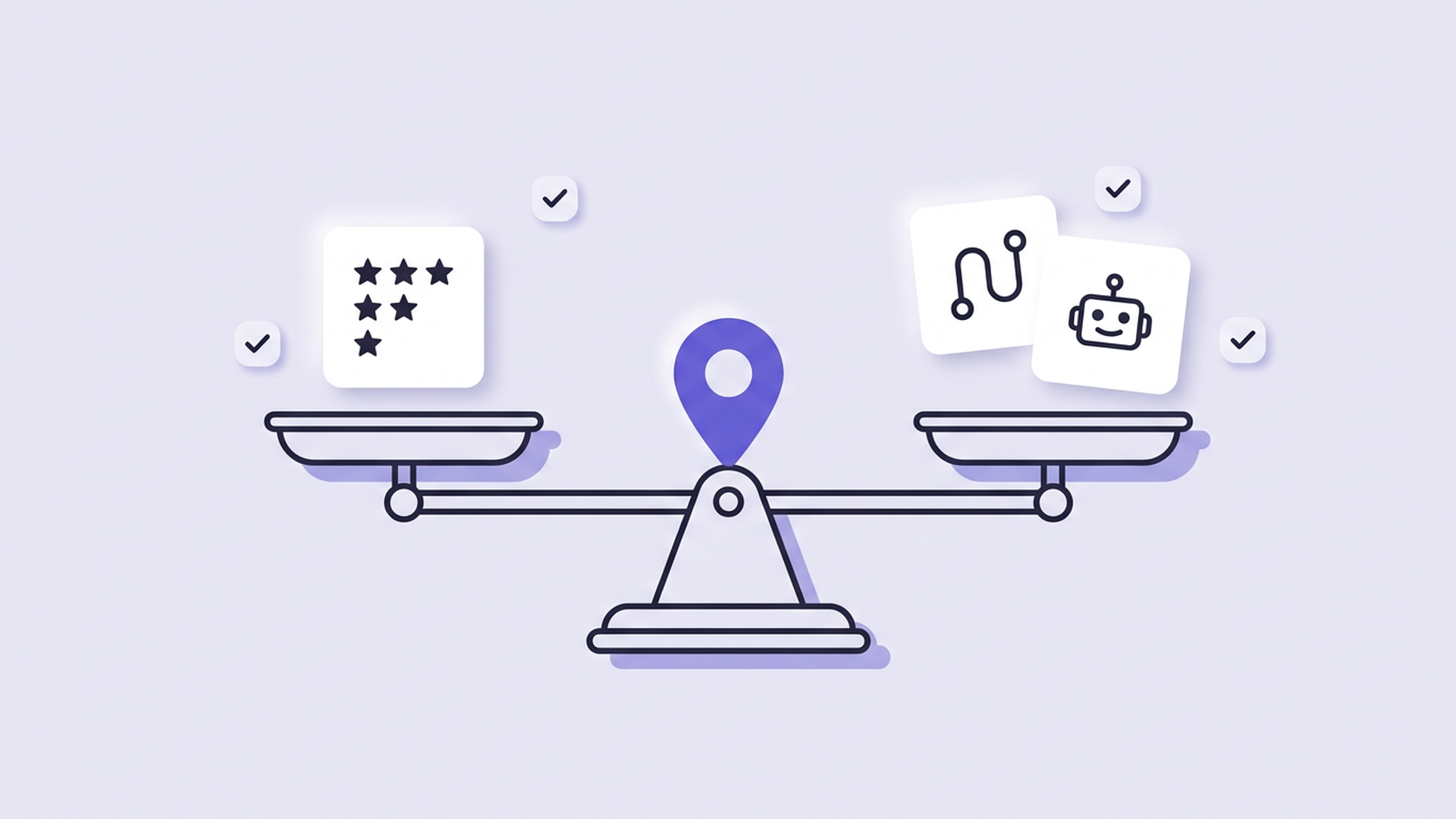
For local searches, Google is the most accurate engine for business discovery: deepest business data, review integration, and the strongest point-of-interest search. Apple Maps is competitive on navigation and privacy but trails on POI accuracy; Bing Maps lags both for local discovery. For business owners, accuracy is less about picking a winner than being findable and consistent on all three.
Which search engine is most accurate for local searches?
| Engine | Local accuracy strength | Where it trails | What it means for owners |
|---|---|---|---|
| Google (Search + Maps) | Deepest business data, reviews, POI search; the default local habit | Personalization can make results feel inconsistent | Your primary battlefield; claim and complete your profile first |
| Apple Maps | Strong navigation and ETAs, privacy posture, polished on iPhone | POI search accuracy still trails Google; weak web interface | Free to claim via Apple Business Connect; iPhone customers arrive through it |
| Bing Maps | Ties into Microsoft's ecosystem and grounds Copilot answers | A distant third for local discovery | Five free minutes at Bing Places keeps you visible where AI assistants look |
The pattern behind the table: Google's local accuracy is not one clever algorithm but a decade of businesses, customers, and corrections feeding it through profiles and reviews. Accuracy at local scale is mostly data freshness, and nobody has fresher local data than the company operating the review system.
Why "accurate" is the wrong question for local
Here is the uncomfortable part for anyone wanting a single accuracy verdict: local results are rebuilt around the searcher's coordinates, so the same engine returns different answers from different places. We scanned one Bangkok eyewear shop, one keyword, same week: average rank 1.48 with 92% top-3 coverage at a 1 km radius, collapsing to 10.55 and 44% visibility at 5 km (GBPpeak geo-grid scans, October 2026). Three different eyewear shops, same keyword, same day: average ranks of 3.8, 5.4, and 16.0 (GBPpeak, October 2026).
Which engine is "accurate," then, depends partly on where you are standing when you ask. Google's accuracy for a given customer is a map-shaped thing, not a list-shaped one, which is why serious local measurement uses grids instead of single checks, a method our map rank tracker guide covers in full.
The engines people forget: AI assistants
Ask ChatGPT or Copilot for a nail salon in Ari and you are not querying one engine. These assistants ground their answers in web search and entity data, which in practice means the accuracy of their recommendation inherits the accuracy of the listings underneath, Google's web results, and Microsoft's Bing entity graph among them. Our local SEO in the AI search era guide unpacks the mechanics; the practical conclusion for owners is simple and a little old-fashioned: consistent, complete, fresh business data everywhere is what every layer above reads.
What business owners should actually do
- Win Google first. It has the local audience and the strictest data standards; meeting them raises your data quality everywhere else. Start with the profile fundamentals in our Thai starter guide if you are beginning from zero.
- Claim Apple's free listing. Business Connect costs nothing and the iPhone-owning half of your customers checks Maps by reflex.
- Spend five minutes on Bing Places. It feeds Microsoft's ecosystem and the assistants built on it. A stale or absent listing there is a quiet accuracy problem someone else's AI will inherit.
- Keep name, address, and phone identical across all three. Engines cross-check each other and third-party directories; mismatches quietly erode the confidence behind every ranking.
- Measure on the engine that matters, weekly. For most local businesses that is Google, via grid scan, so your decisions rest on positions rather than vibes.
Frequently Asked Questions
Is Google really the most accurate search engine?
For local business discovery, the practical evidence says yes: deepest listings, integrated reviews, and the strongest POI search. But accuracy for your business specifically depends on your data being complete and current, and on where each searcher stands. An engine with perfect data still returns different answers from different neighborhoods, by design.
Why do Google, Apple, and Bing show different businesses for the same search?
They hold different business databases, updated through different channels, and rank with different priorities. Google leans on profile data and reviews; Apple curates and corrects aggressively but from a thinner data pool; Bing indexes what it can reach. Same question, three different answers, which is why consistency across all three matters more than loyalty to one.
Should a small business bother with Apple Maps and Bing?
Yes, because both are free and both own audiences you cannot reach through Google alone: iPhone reflex-checks on Apple, AI-assistant answers partially grounded in Microsoft's data. Twenty minutes total covers both, against the hours your Google presence deserves.
How do I check whether my business is accurate everywhere?
Search your category near your address on each engine as a stranger would, then compare hours, categories, and phone numbers against reality. Anything stale, fix at the source listing. For the deeper question of where you rank around your own neighborhood, a grid scan answers it in one pass.
Every engine reads the same truth about your business: your data. Make it identical everywhere, then see where you actually stand on the engine that matters most, with a free grid scan at gbppeak.com/free-maps — no signup, no card.