
What Is a Map Rank Tracker? (And Why One-Number Rank Checks Lie)
A map rank tracker measures your Google Maps ranking across a grid of points around your business, not one phone. Here's how it works, what avg rank / found % / top-3 % mean, with real Bangkok scan data.
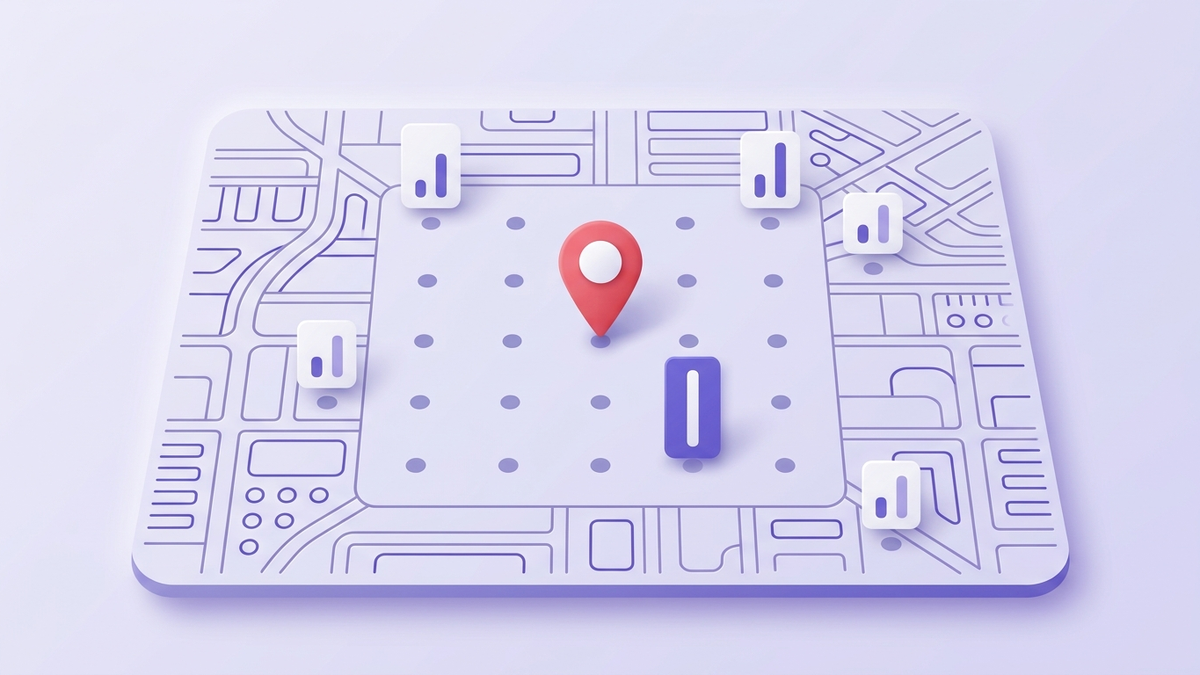
Ask a room of shop owners where they rank on Google and you get one number. Ask a map rank tracker and you get a map. That difference is the whole point: local results are computed per searcher location, so a single rank was never a real thing — it was an average pretending to be a fact.
This guide explains what a map rank tracker is, how it works, what the numbers mean, and who actually needs one — with real scan data from Bangkok businesses.
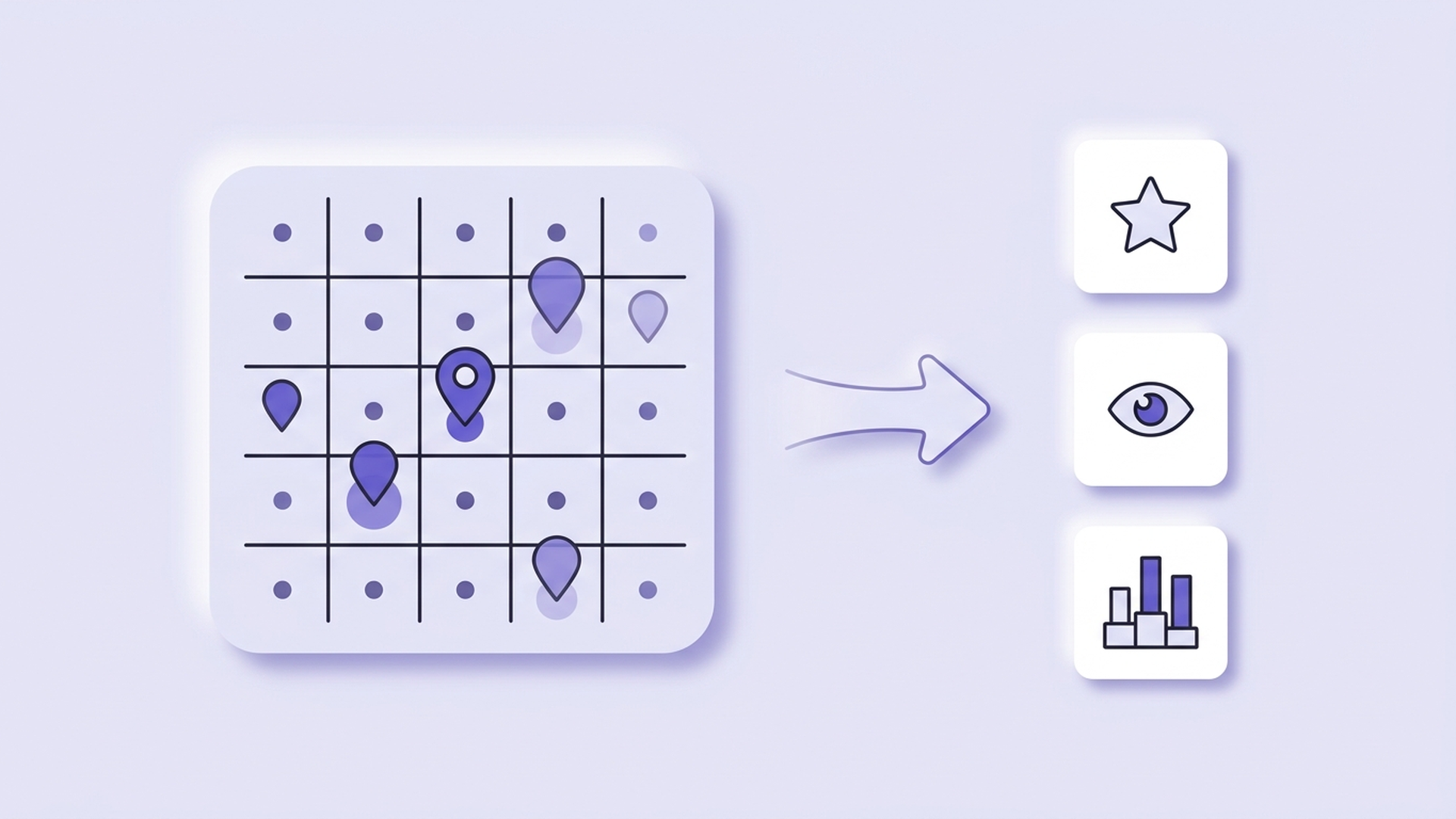
A map rank tracker measures your Google Maps ranking at many points around your business instead of one. It lays out a grid of coordinates (typically 5×5 within 1 km), checks who ranks at each point, and summarizes the grid as three numbers: average rank, the share of points where you appear, and the share where you hold top 3 — the local counterpart to a traditional SERP tracker.
What is a map rank tracker?
A map rank tracker is a rank-checking tool built for the way local search actually works. Google builds the map pack fresh for every search, weighted toward where the searcher is standing, so a business can be #1 two streets away and invisible three kilometers out. A map rank tracker embraces that instead of fighting it: it places a grid of virtual searchers around your location, runs the same keyword at each one, and shows you the shape of your visibility — not just a number.
The alternative — typing your keyword into one phone and reading one position — measures one coordinate at one moment. Fine for organic blue links, misleading for maps.
How does a map rank tracker work?
- Pick the keywords that matter. Two or three phrases customers actually type, in the language they type them — for Bangkok businesses usually one Thai and one English pair.
- Lay a grid around the business. The standard is 5×5 points over a 1 km radius for foot traffic; service-area businesses stretch to 2–5 km where they genuinely serve.
- Scan each point from its own coordinates. The tracker queries Google from each grid point's location — not from your office IP — so every result is the pack a real searcher at that spot would see.
- Reduce the grid to three numbers. Average rank, percentage of points where the business appears at all, and percentage of points where it sits in the top 3. Those three metrics — strength, coverage, click-zone — say more than any single position.
- Repeat on a schedule and watch the trend. Weekly re-scans at the same day and time turn the map into a moving picture: which fixes moved which cells, and which competitor is eating your edge.
What the numbers mean — real Bangkok data
Three eyewear shops in Bangkok, the same keyword (ร้านแว่นตาใกล้ฉัน — "eyewear shop near me"), identical 5×5 grids, scanned the same day (GBPpeak geo-grid scans, October 2026):
| Shop | Avg rank | Found | Top 3 |
|---|---|---|---|
| Shop A | 3.8 | 100% | 68% |
| Shop B | 5.4 | 72% | 28% |
| Shop C | 16.0 | 16% | 0% |
Read them as one story: Shop A is strong almost everywhere; Shop B is visible but rarely in the click zone; Shop C is effectively closed as far as most nearby searchers can tell — same city, same keyword, same day. And the ceiling is real: a Bangkok Greek-yogurt shop scanned at average rank 1.16 with top-3 in 100% of its grid (GBPpeak scan, October 2026). A map rank tracker is how you find out which of these three profiles you are living in — before your competitors tell you.
Map rank tracking vs a traditional rank tracker
| Traditional SERP tracker | Map rank tracker | |
|---|---|---|
| Measures | One organic position per keyword | Position at 25+ coordinates per keyword |
| Best for | National content, e-commerce | Local pack, foot traffic, service areas |
| Output | A number per keyword | A map plus coverage and top-3 percentages |
| Blind spot | Hides location variance entirely | Says less about pure organic results |
Most local businesses need the second column and are checking the first. If you also watch organic, how to analyze your local competitors shows how the two views combine into one monthly work queue.
Who actually needs one?
- Single-location shops — know your true 1 km footprint and stop guessing from one phone.
- Multi-branch businesses — compare branches on identical grids; the weak branch is invisible in averages.
- Service-area businesses — you compete across a wide radius, so you need wide coverage data even more.
- Agencies and consultants — per-client grids turn "we did work" into "top-3 coverage moved from 28% to 46%," which is the only report retainers renew on. Our daily Bangkok grid scan reports show the format in action.
- Anyone courting AI answers — assistants grounding in search see roughly what grid scans see; Google Business Profile insights then show what searchers did after finding you.
Frequently Asked Questions
Is a map rank tracker different from a regular rank tracker?
Yes, in what it measures and how. A regular rank tracker checks one organic position for a keyword — one number, one URL. A map rank tracker checks the local pack at many coordinates around a business and returns a map plus coverage metrics. For businesses whose customers come from maps, the second is the honest measurement; the first answers a question nobody local is asking.
How many grid points do I need?
5×5 (25 points) over 1 km is the working standard for foot-traffic businesses — dense enough to see the shape, cheap enough to run weekly. Widen the radius rather than adding points when you serve a larger area; a service-area business covering 5 km learns more from a wide grid than a dense narrow one. Thai-language readers can follow the full setup in our Thai companion guide.
How often should a map rank tracker run?
Weekly, at the same day and time, is the sweet spot for most businesses. Daily scanning mostly records normal system wobble; monthly scanning is too slow to connect a fix to its effect. Keep the keyword, radius, and schedule fixed so the trend line stays honest.
Are map rank trackers accurate?
An honest tracker doesn't predict — it reports what Google actually returned at each coordinate, which is exactly why results differ from what you see on your own phone. Your phone reports your location and your history; the grid reports the neighborhood. When two tools disagree wildly, ask whether both scanned the same coordinates, radius, and language.
Is there a free map rank tracker?
Yes — GBPpeak's free scan at gbppeak.com/free-maps runs a multi-point grid around your business with no signup. It is built for the check described in this guide: see your current footprint, then rescan after fixes to compare.
One number tells you a story someone chose for you. A grid tells you the truth neighborhood by neighborhood. See yours now: run a free grid scan of your business at gbppeak.com/free-maps — no signup, no card.