
Why Your AI Ignores Instructions (and the Two Fixes That Actually Work)
Five "DO NOT"s in caps — ignored anyway. Two mechanical reasons: proximity decay and goal-conflict. Move the rule, reroute the mission, self-diagnose.
A Bangkok clinic's intake agent had one rule the owner repeated five times in the prompt, in caps: "DO NOT show the draft to the customer — send it to the manager first." On Tuesday the agent cheerfully sent a draft straight to a patient, complete with a note the manager would have deleted. Five "DO NOT"s. Ignored. The owner's conclusion — "the AI doesn't respect me" — was wrong. The prompt was fighting its own architecture.
When an AI ignores a clearly stated rule, more emphasis is almost never the fix. 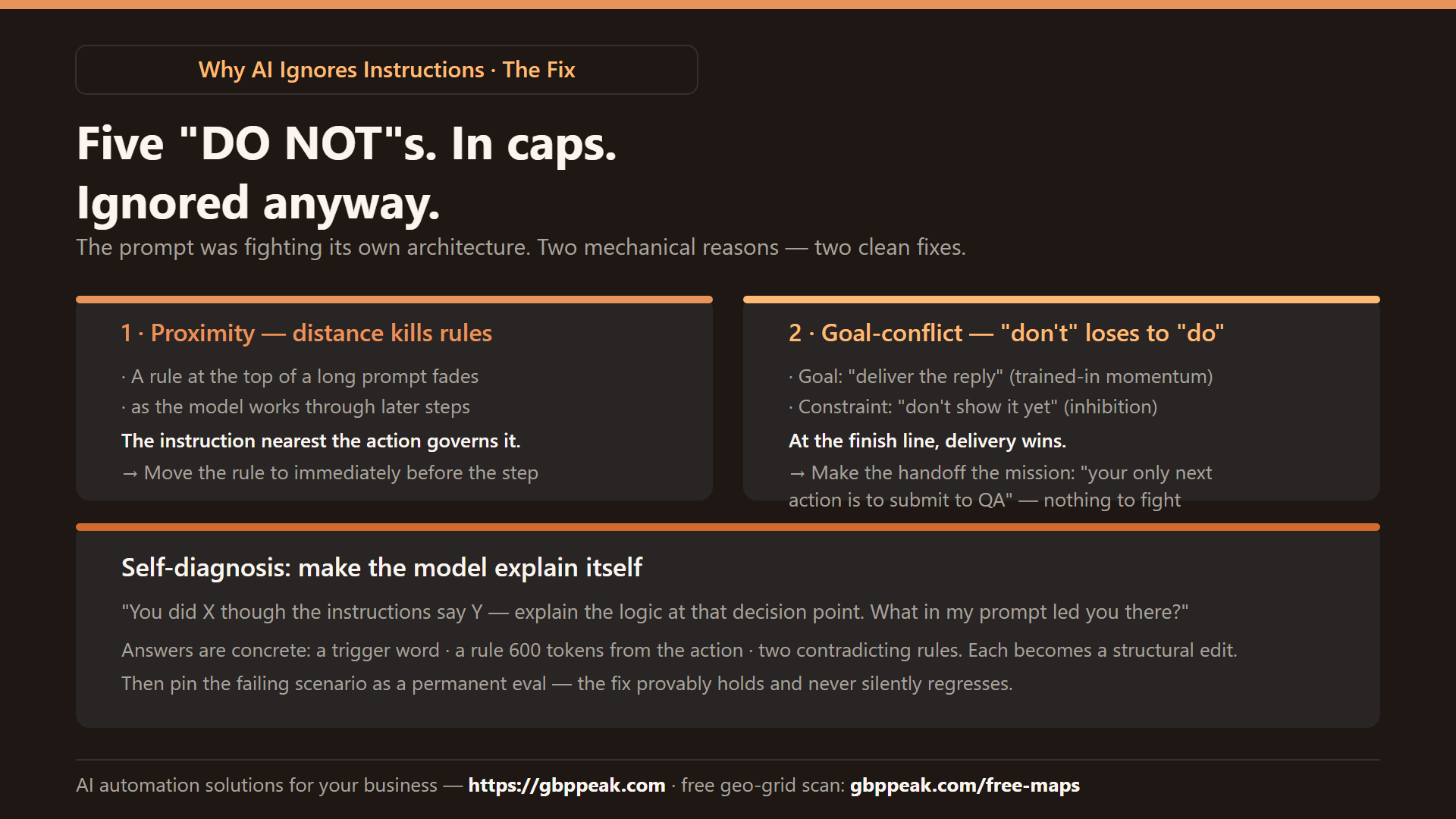
Two mechanical reasons explain nearly every case, and both have clean solutions. This is the practical guide to both.
AI agents ignore instructions for two mechanical reasons. Proximity: instructions placed early in a long prompt lose influence as the model works through later steps — the instruction nearest the action governs the action, so rules must sit immediately before the step they constrain. Goal-conflict: negative constraints ("do not show the draft") fight the model's trained drive to complete its positive goal ("deliver the report"), and the positive goal usually wins. The fix: restate the constraint as the next positive action ("your drafting phase is complete; your only next action is to call the QA step") and place it at the point of decision — plus use self-diagnosis, asking the model to explain why it deviated. :::
Why shouting doesn't work
The instinct when a rule gets ignored is emphasis: more DO NOT, more REMEMBER, more !!! (all caps). What you actually create is noise — a prompt so stuffed with redundant demands that every instruction dilutes every other. Repetition feels like strength; structurally it's fragmentation.
| Symptom | Instinctive fix | Why it fails | Actual fix |
|---|---|---|---|
| Rule ignored mid-task | Repeat it 5× | Dilutes attention across the prompt | Move it next to the action |
| Draft leaked anyway | Bigger "DO NOT" | Negative constraint vs positive goal — goal wins | Restate as the next positive step |
| Works sometimes, not others | Add more rules | More noise, more drift | Cut rules; few and placed |
| Can't tell why | Rewrite blindly | You're guessing | Self-diagnose (below) |
Reason 1: proximity — distance kills instructions
A model's attention isn't uniform across a long prompt. Instructions at the top fade as the model works through step after step; by the time it reaches the action, the nearest text dominates its decision. That's not forgetfulness — it's recency, the same force that makes the last thing anyone said to you the easiest to remember.
The rule: the instruction immediately before the action governs the action.
BEFORE (rule at top, action at bottom — drift zone in between):
  ┌─────────────────────────────────────┐
  │ 1. DO NOT show drafts to customers   │  ← weak by the time it matters
  │ 2. Collect symptoms                  │
  │ 3. Check availability                │
  │ 4. Draft the reply                   │   ...14 more steps...
  │ 15. Output the reply                 │  ← proximity wins: it "outputs"
  └─────────────────────────────────────┘

AFTER (rule moved to the point of decision):
  │ 14. Draft the reply internally       │
  │ 15. Your drafting phase is COMPLETE. │  ← governs the next token
  │     Your only next action: call the   │
  │     manager_review tool. Do nothing   │
  │     else until it returns.            │
The same principle applies whenever an agent must wait — for a tool, for a second agent, for a human. The wait instruction goes immediately before the step where waiting begins, not in a preamble it will have forgotten by then.
Reason 2: goal-conflict — "don't" loses to "do"
Models are trained to complete objectives. When your prompt contains both a positive goal ("write the report") and a negative constraint ("but don't output it"), you've set up a tug-of-war between the model's deepest habit — finish and deliver — and your inhibition. At the finish line, delivery momentum wins. That's why the clinic's agent sent the draft: every fiber of its training said "completed task = hand over the result."
The fix is to change the goal, not to strengthen the inhibition:
❌ CONFLICTING:
"Write the reply but do NOT print it to the chat.
 Send it to the QA tool instead."
→ goal: deliver reply · constraint: don't deliver · = tug-of-war

✅ REALIGNED:
"Your drafting phase is complete. Your next and
 only action is to submit the text to the QA tool.
 Perform no other action until it returns feedback."
→ the goal IS the handoff. Nothing to fight.
You haven't shouted louder — you've rerouted the path of least resistance so that doing the right thing is also completing the mission. This is the same "mission over prohibition" principle behind the accuracy-first framing in our hallucination guide: tell the model what it is, not what it isn't.
The self-diagnosis move
When a prompt still misbehaves and you can't see why, make the model explain itself instead of guessing at rewrites:
"I noticed you [sent the draft directly] even though the
instructions say [submit to manager_review]. Explain the
logic you followed at that decision point. What in my
prompt led you there, and how should I restructure it so
this cannot happen?"
The answers are usually concrete and slightly humbling: a particular word acted as a trigger ("print the summary" made "print" feel authorized); the constraint sat 600 tokens from the action; two rules contradicted each other and the model picked the one nearest the verb. Each answer converts a mystery into a structural edit — move this, reword that, delete the contradiction.
This pairs naturally with an eval suite: the failing scenario becomes a permanent test, so the fix provably holds and never silently regresses.
A compact checklist for stubborn rules
instruction_discipline:
  placement: rule immediately before the action it governs
  framing: positive next-action, never bare prohibition
  volume: "3 rules placed well beat 30 rules shouted"
  conflict_scan: no rule may fight the task's goal —
                 reroute the goal instead
  repair_loop: on failure → self-diagnose → edit structure
               → pin the scenario as an eval
Run any misbehaving workflow through those five lines and the culprit is almost always placement or framing — both fixable in minutes, no shouting required.
And if the workflow you're disciplining feeds customer-facing decisions, give its inputs the same rigor: a free geo-grid scan at https://gbppeak.com/free-maps shows exactly where your Google Maps ranking stands across your service area — clean, structured truth for whatever the agent does next.
Frequently Asked Questions
Why does the AI "forget" instructions from the top of a long prompt?
Recency: as the model processes more text, early instructions lose activation in its immediate decision. The text nearest the action dominates — so move critical rules to the point of decision rather than repeating them at the top.
Is repeating an important instruction ever useful?
Only for one critical, ongoing rule — and even then, if it needs five repetitions to be followed, the structure is wrong. One perfectly placed instruction beats five shouted ones, every time.
How do I convert a "don't" into a "do"?
Name the replacement action as the next mandatory step. "Don't show the draft" becomes "your drafting phase is complete; your only next action is submitting to manager_review." The handoff becomes the goal, removing the tug-of-war entirely.
What if the agent still misbehaves after restructuring?
Self-diagnose: ask the model exactly why it took the wrong branch at that decision point. It will usually name the trigger word, the distant rule, or the contradiction — then edit the structure, and pin the failing scenario as a permanent eval so the fix provably holds.
Final note
The AI isn't disrespecting you — it's following the gradient of your prompt's architecture. Put the rule where the decision happens, and make the right behavior the mission. Do that, and five shouted DO NOTs collapse into one calm sentence that simply works.