Google Updates, GBP Q&A, and AI-Ready Data: The Local Search Playbook
They rewrote three pages overnight — the rankings returned on their own. The update protocol, the neglected Q&A salesperson, and briefing AI ads so they stop wasting budget.
When a Google spam update rolled out last quarter, a Bangkok plumbing company watched its city pages drop and did what most panicking owners do: rewrote three pages overnight. The update finished rolling out four days later — and the rankings came back on their own. Except now nobody could tell whether the rewrites helped, hurt, or did nothing, because the "before" was never recorded. The company had traded a temporary dip for permanent confusion.
That's update season in local search: the winners are rarely the fastest, they're the ones who observe before acting. 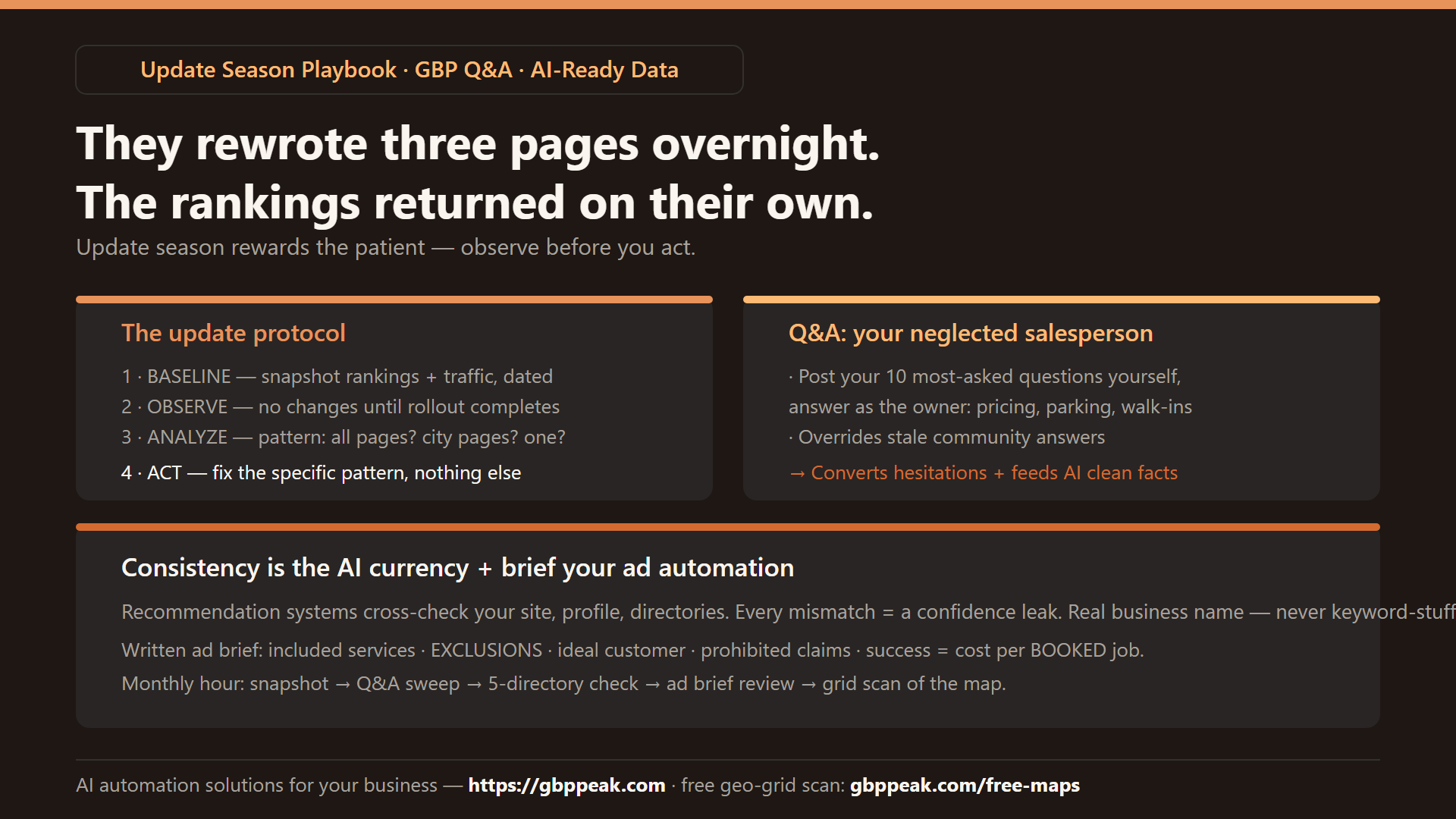
This guide covers the update playbook, the most underused conversion tool on your Google Business Profile (the Q&A section), and how to brief AI-driven ad systems so they stop producing expensive noise.
Navigating local search updates takes a four-step rhythm: baseline your rankings and traffic, wait for the rollout to complete, analyze exactly what changed (site-wide vs specific pages), and only then act. Separately, manage your Google Business Profile Q&A actively — owner-authored answers on pricing, parking, and availability convert browsers and override stale community answers. For AI search, consistency is the currency: aligned service data across website, profile, and directories gives recommendation systems the evidence to pick you. And AI-driven ads only work with a written brief: included services, exclusions, ideal customer, prohibited claims. Patient observation plus consistent data beats reaction every time. :::
The update playbook: observe before you act
Rankings drop during a major update. The instinct is to fix — rewrite, delete, restructure. The discipline is to wait, because updates roll out over days, and changing things mid-rollout destroys your ability to read the result.
UPDATE PROTOCOL (run every time Google announces a rollout):
  1. BASELINE  → snapshot: rankings per keyword, traffic per page,
                 GBP insights — dated, saved
  2. OBSERVE   → no changes until the rollout is confirmed finished
                 (watch industry trackers, not your anxiety)
  3. ANALYZE   → pattern, not panic:
                 all pages dropped?      → site-wide signal issue
                 only city pages?        → thin location content
                 only one service page?  → that page specifically
                 GBP views only?         → profile problem, not website
  4. ACT       → fix the specific pattern, nothing else
The analysis step is where the money is. "Everything dropped" and "only the Plumbing page dropped" are different diseases with different cures — and the second one is often just update turbulence that self-corrects. And baseline data isn't just for crises: the same snapshots power your monthly grid audit, so the habit pays twice.
The Q&A section: your most neglected salesperson
Recent testing keeps pointing at the same finding: Google is watching the Q&A section of Business Profiles closely — and most owners have never touched it.
The failure modes are predictable:
| Problem | What the customer sees |
|---|---|
| No owner answers | Questions answered by random users — sometimes wrong |
| Stale community answers | "Open Sundays!" from 2023; you changed hours in March |
| Missing pricing questions | The #1 question, answered by... silence |
| Unanswered parking/access | A hesitation, then a competitor's profile |
The fix is to treat Q&A as conversion infrastructure, not an information booth:
Q&A BLITZ (one hour, once — then 10 min/month):
  1. List your 10 most-asked questions (mine your LINE history
     and front-desk memory — the [conversation pipeline](https://gbppeak.com/blog/ai-customer-conversation-analysis)
     does this automatically)
  2. Post each question yourself and answer it as the owner:
     pricing ranges, parking reality, English service, walk-ins
  3. Upvote your own owner answers above stale community ones
  4. Monthly: answer every new public question within 48h
Owner-authored answers do double duty: they convert hesitant customers and they feed AI systems clean, structured facts about your business — the same facts assistants quote when recommending you.
AI recommendation systems: consistency is the currency
Local search has quietly become a recommendation problem. When ChatGPT or Google's AI Overviews name a business, that name is the output of cross-checked evidence: your site, your profile, directories, reviews. Inconsistency reads as ambiguity, and ambiguous entities don't get recommended.
- Aligned services everywhere — website says "Emergency Plumbing 24/7" but a directory lists "Residential Plumbing"? That's a confidence leak. Match the list everywhere
- Broad real-world authority — genuine mentions in local news, directories, and reviews beat gaming any single platform; the entity-trust playbook covers the full sweep
- Specific, quotable expertise — give the systems evidence to categorize you correctly: case counts, named specialties, service areas
One rule worth repeating from the summary: don't keyword-stuff your business name. "Plumber Bangkok 24/7 Emergency Cheap" as a name is a spam signal, not a ranking. Your real name, correct categories, real reviews — that's the durable stack.
Briefing AI-driven ads: input quality = output quality
Automated ad platforms amplify whatever you feed them. Vague brief in, generic ads out, wrong leads in, budget gone. The fix is a written brief the system can't misread:
ad_brief:
  included_services: ["drain cleaning", "water heater repair"]
  excluded: ["new construction", "commercial >5 units"]   # stop paying for these
  ideal_customer: "homeowners within 8 km of Lat Phrao branch"
  prohibited_claims: ["cheapest in Bangkok", "guaranteed same-day"]
  success_metric: "cost per BOOKED job (not clicks, not calls)"
The excluded and prohibited_claims lines are the two most-skipped and highest-value items — they're what stops automation from finding you "anyone who calls" and inventing promises you can't keep.
The steady-state routine
Everything above compresses into the monthly hour:
- Snapshot — rankings, traffic, profile views (your update-season baseline, always current)
- Q&A sweep — new questions answered, stale answers flagged
- Consistency spot-check — five top directories vs your profile
- Ad brief review — cost per booked job vs break-even
- Map audit — a free geo-grid scan at https://gbppeak.com/free-maps plots your Google Maps ranking across your service area, the geographic truth under all of it
Frequently Asked Questions
How should I respond to a Google spam update?
Don't — not immediately. Baseline your rankings and traffic, wait until the rollout is confirmed complete, then analyze the pattern (site-wide vs. specific pages vs. profile-only) and fix only what the pattern identifies. Mid-rollout changes make results unreadable.
Is the Business Profile Q&A section really important?
It's a conversion tool most owners ignore. Public questions contain exactly what hesitant customers want — pricing, parking, availability — and owner-authored answers override stale or wrong community answers while feeding clean facts to AI systems.
How does AI change local SEO?
AI recommends businesses it can verify: consistent service data across website, profile, and directories; genuine mentions; specific evidence of expertise. Inconsistency anywhere lowers the confidence a model needs to name you.
Should I put keywords in my business name?
No. Use your real-world name. Keyword-stuffed names are spam signals that risk suppression. Build relevance through precise categories, service descriptions, and reviews instead.
Final note
Local search rewards the patient and the consistent: observe before acting, answer before they ask, align before you scale ads. Close the gap between what your data says and what your customers see, and both the algorithm and the neighborhood start trusting you the same way.