Keyword Research for Local Search: The Free Autocomplete Method
Local keyword research via autocomplete in both languages, scored on demand, competition, and intent, then validated with grid scans. Real scored example from a Bangkok shop, including the head-term trap.

Most keyword research advice quietly assumes you have a national audience and a volume tool subscription. A nail salon in Thonglor does not. What it has is better, if it knows how to read it: the exact phrases its neighbors type, available free, refreshed constantly, in both languages its customers think in. Autocomplete is the closest thing to eavesdropping on your market's actual vocabulary.
This guide lays out a keyword research method for local businesses that costs nothing, works in Thai and English, and ends with numbers you can act on this week.
Keyword research for local search means collecting the phrases customers actually type near you, via Google autocomplete in both languages, then scoring each phrase on demand, competition, and intent, and validating winners against your own grid scans. For local businesses, autocomplete suggestions and "near me" variants beat generic volume lists, because maps rank by district and language, not national popularity. The output is a shortlist of five to ten phrases for services, posts, and descriptions.
Why autocomplete beats a volume tool for local work
National tools report how often a phrase is searched across a country. Your shop does not compete across a country; it competes within a few kilometers, per language, a reality our Bangkok local SEO guide covers in depth. Autocomplete works the opposite way: Google surfaces the completions real people around you and people like you type, which makes it a live sample of local vocabulary rather than an average of the nation's.
Google's own Keyword Planner remains useful for the top of the funnel, checking rough demand for a service category, and its keyword-ideas feature documents how suggestions are generated. But for the phrases that decide your map visibility, the free source is the search box itself, plus the tooling that harvests it systematically.
Keyword research in five steps
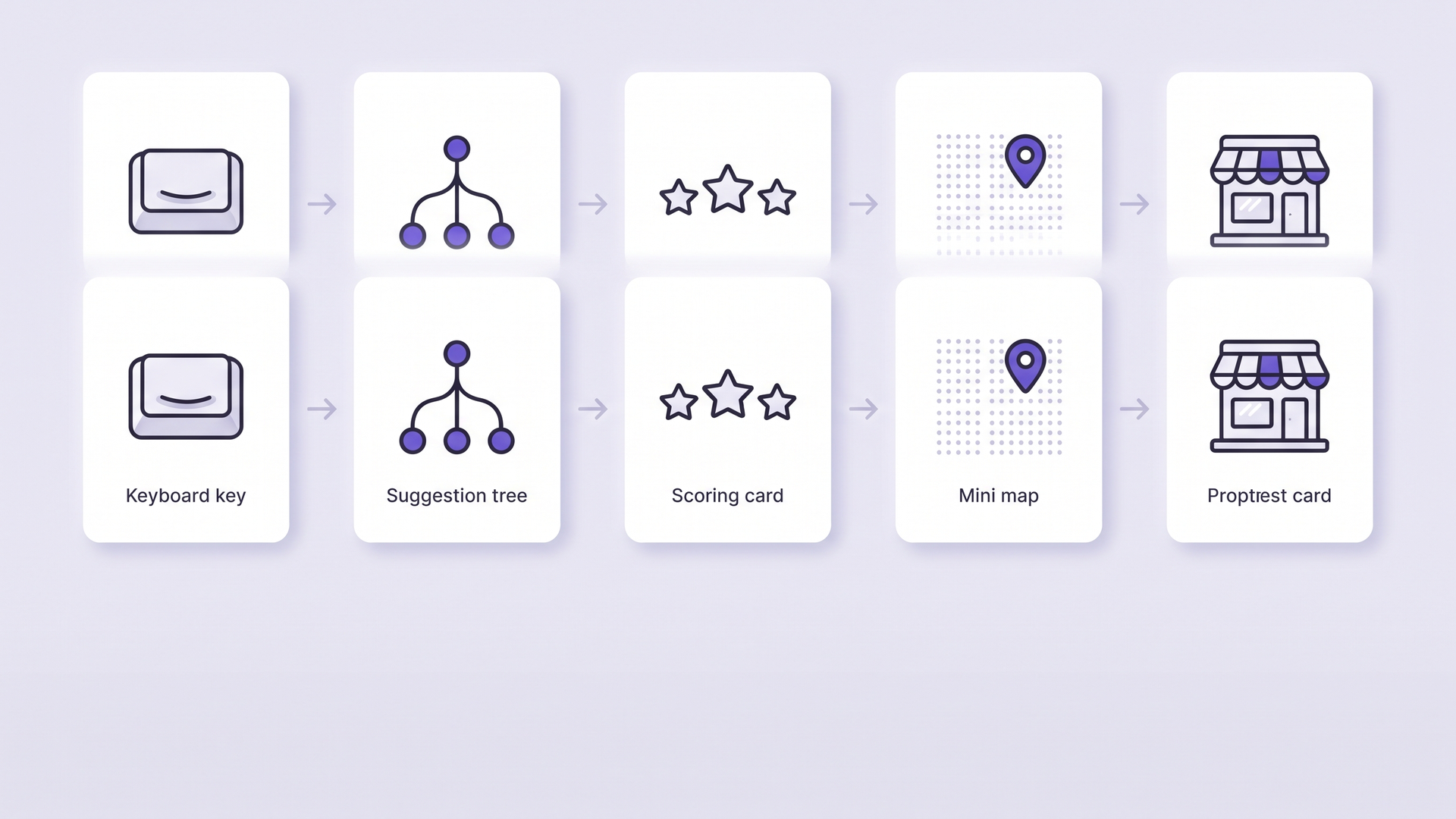
- Write down seed words in both languages. What you sell, in the words customers use, not your official menu names: "nail salon", ทำเล็บ, "eyelash extension", ต่อขนตา. One column Thai, one column English, three to five seeds each.
- Expand through autocomplete. Type each seed plus your district, plus "ใกล้ฉัน" / "near me", and record every suggestion Google offers. The suggestions are demand you can see with your own eyes; harvesting them at scale is exactly what our free-maps keyword scoring automates.
- Score each phrase on three axes. Demand: how many autocomplete variants point at it, and rough volume where available. Competition: how strong the map pack already is for it. Intent: transactional phrases ("salon near me") outrank informational ones ("what is lash lift") for map work.
- Validate with your own data, not just estimates. Volume numbers are estimates; grid scans are measurements. Run your shortlist through a grid scan and see where you already have a foothold. A phrase where you rank fifth is cheaper to win than one where you are absent.
- Map the shortlist to surfaces. Two or three phrases become services on your profile, one becomes the next post topic, one or two go into your website's service page copy. Then rescan in a month.
A real scored example
Here is the method's output for an actual Bangkok business, a Greek yogurt shop, straight from a live GBPpeak keyword analysis (October 2026):
| Keyword | Score | Autocomplete hits | Est. volume | Intent |
|---|---|---|---|---|
| กรีกโยเกิร์ตใกล้ฉัน | 70 | 17 | 320 | transactional |
| ร้านกรีกโยเกิร์ตใกล้ฉัน | 70 | 8 | 210 | transactional |
| กรีกโยเกิร์ตผลไม้ใกล้ฉัน | 70 | 6 | 40 | commercial |
| อาหาร ใกล้ฉัน | 70 | 11 | 2,400 | transactional |
Read the bottom row carefully, because it is the trap: the highest volume phrase, generic "food near me" at an estimated 2,400 searches, scores the same 70 as the shop's exact niche phrases but carries a difficulty of 72 against 20 to 22 for the niche terms. Volume without winnability is a vanity number. The shop followed the method, targeted the niche family, and its scan shows average rank 1.16 with top-3 in 100% of the grid (GBPpeak scan, October 2026). That is what a validated shortlist does.
Common failure patterns
- Chasing the head term. "อาหารใกล้ฉัน"-class phrases belong to aggregators and directories. Win your niche first; the head follows prominence, never the reverse.
- Researching in one language. In Bangkok the English phrase and the Thai phrase are two markets with two sets of competitors. Score them separately, and fold the winners into the work order in our Thai-language starter guide.
- One-and-done research. Autocomplete shifts with seasons and trends. Rerun the expansion quarterly and after any service change.
- Never validating. If no scan ever checks whether the chosen phrases moved anything, the research was theater.
Frequently Asked Questions
Is keyword research different for local SEO than normal SEO?
Yes, in what you collect and what you do with it. Normal keyword research feeds pages and blog posts ranked nationally. Local keyword research feeds your profile's services, posts, and description, and gets validated against map-pack positions per district. Volume matters less; vocabulary match and winnability within your radius matter more.
How many keywords should a local business target?
Two to five phrases actively, per location. One primary that defines the business, a couple of service-level phrases, and one campaign phrase you rotate. Fifty keywords is not a strategy for a single shop; it is a spreadsheet nobody reads.
Are autocomplete suggestions really meaningful data?
They are a live aggregation of what people type, weighted toward your language and region, which is precisely the sample a local shop competes in. Treat them as directional demand signals rather than counts, pair them with scan validation, and they outperform any national average for map work.
How often should I redo the research?
Quarterly for the full expansion, monthly for a quick check of your active phrases' scans, and immediately whenever you add or retire a service. The vocabulary of your customers drifts faster than most owners expect.
Your best keywords are the ones where demand meets a foothold you already own. Find that intersection with a free multi-point scan of your business at gbppeak.com/free-maps — no signup, no card.