Impressions Up 240%, Phone Silent: Fixing the Local Search Conversion Bridge
AI-search impressions up 240%, bookings flat. The three cracks in the conversion bridge — and why your Google profile is now the real landing page.
A Bangkok physio clinic's monthly report showed a beautiful green arrow: AI-search impressions up 240%. The phone rang exactly as often as before. The owner's digital agency called it "massive momentum." The owner called it something ruder. Six months of "visibility wins" and not one extra booking.
Both were looking at the same true number — and drawing opposite conclusions from it. An impression means a machine showed your name on a screen. It is the earliest, weakest signal in the entire funnel. 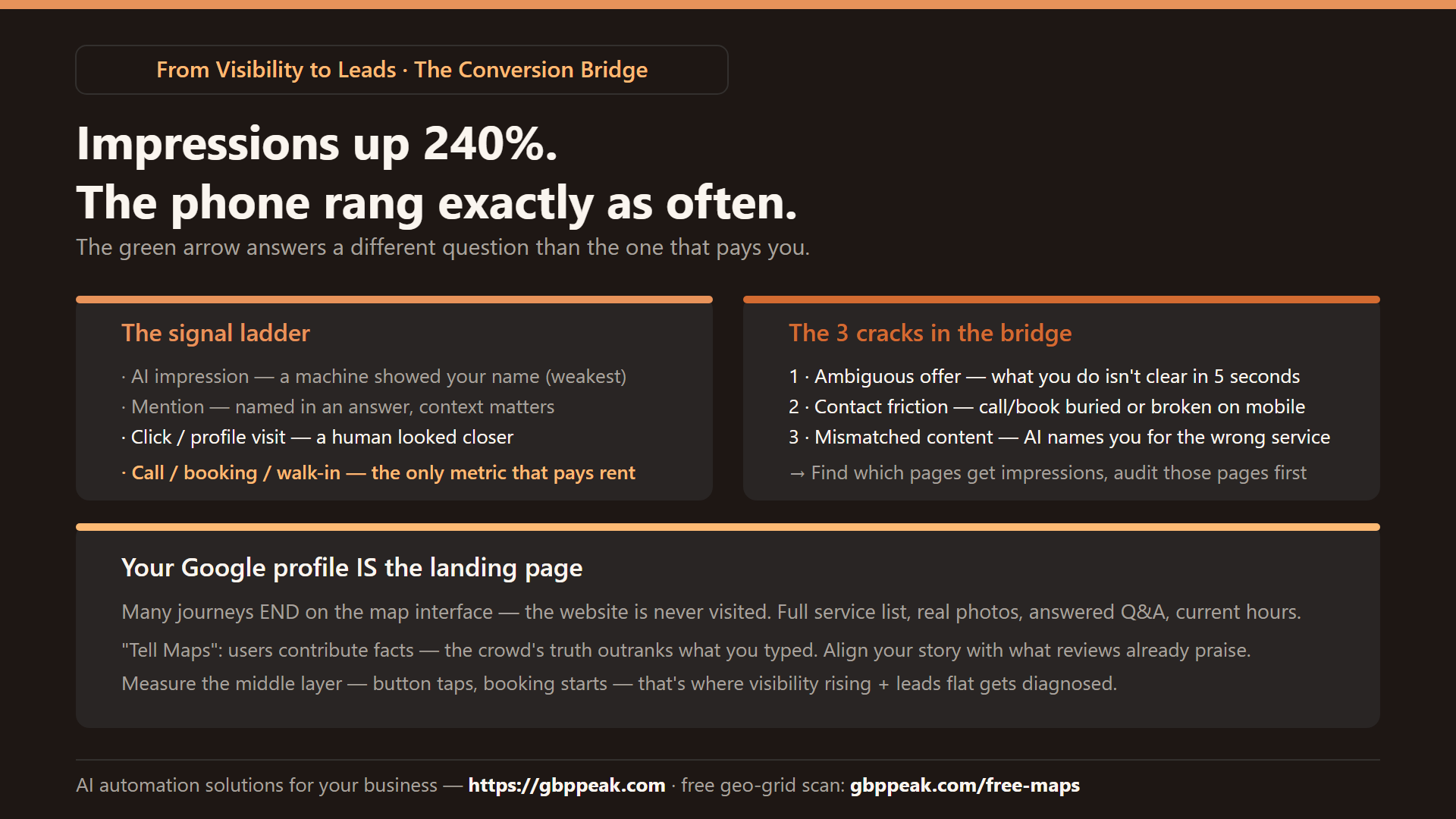
This guide is about the bridge between being seen and being chosen: where it breaks, how to find the exact crack, and what to fix on the two surfaces that now do your selling — your Google profile and your site.
Visibility converts into leads only across a "conversion bridge": a clear offer, an obvious next step, and accurate information. When AI impressions rise but calls don't, audit the pages getting the attention for three failures — an ambiguous offer (what you do isn't instantly clear), contact friction (the call/book action is buried on mobile), or content mismatch (the AI names you for a service you don't actually provide). Meanwhile, treat your Google Business Profile as your real landing page — many users never leave the Maps interface — with complete services, visual proof, and answered questions; and structure your site so plainly that both humans and AI agents can summarize it instantly. :::
Impressions are the top of a bridge, not the destination
| Metric | What it actually means | What it's worth |
|---|---|---|
| AI impression | A machine displayed your name | Early signal of relevance |
| Mention | An AI named you in an answer | Slightly stronger — context matters |
| Click / profile visit | A human chose to look closer | Real interest |
| Call, booking, walk-in | A person acted | The only metric that pays rent |
The failure pattern is consistent: visibility numbers climb, action stays flat. That's not a marketing failure — it's a conversion bridge failure, and it has three usual cracks:
- Ambiguous offer — the visitor (human or machine) can't tell in five seconds what you do, for whom, near where
- Contact friction — the Call button is below the fold, the booking link is broken on mobile, the LINE QR is a blurry photo
- Mismatched content — the AI recommends you for "sports massage" when your actual focus is post-surgery rehab, so the wrong people arrive and don't book
The diagnostic move: stop celebrating the aggregate green arrow, and use the impression data to find which specific pages are getting attention. Then audit those pages — the crack is always in one of the three places above.
VISIBILITY → LEADS AUDIT (for each page the AI is surfacing):
  1. Offer test:    can a stranger state what you do after 5 seconds?
  2. Action test:   is the next step (call/book/LINE) above the fold
                    on a phone, and does the link actually work?
  3. Match test:    does the page's main service match what the AI
                    is recommending you FOR?
  fix the first failing test; re-check in 30 days
Your Google profile IS the landing page
The mental model shift most businesses haven't made: the customer journey increasingly ends on the map interface — especially in AI-powered results, the user reads the summary, glances at the profile, and calls. Your website may never be visited. The profile has to do the heavy lifting of sales:
- Every service listed — not "physiotherapy" but the actual menu: sports rehab, post-op recovery, workplace ergonomics assessments. AI and users can only choose what they can see
- Visual proof — your team, your actual space, before/after work; stock photos read as fake to humans and add nothing for machines
- Active communication — the Q&A section answered (by you, correctly), messaging enabled with a real response time
- Current truth — hours, prices, address matching everywhere; a stale profile is a dead storefront
This is also where features like "Tell Maps" matter: users can now contribute facts about your business — "has parking," "known for sandwich platters" — and Google gradually weighs community-supplied truth over what you typed months ago. Your public reality is crowdsourced now. The countermeasure is alignment: whatever customers consistently praise you for in reviews should be shouted on your profile and site, so the crowd's story and yours are the same story.
Making your site legible to machines and humans
The same clarity serves both audiences — the goal is not "writing for robots," it's writing so plainly that anything reading it, silicon or human, gets it instantly:
- Plain-language headings that state the service and location ("Sports physiotherapy near BTS Ari"), not clever phrases
- Structured data (schema marking you as a LocalBusiness with services and area) so machines don't have to guess what the page is
- No gaps — a hidden price range or a vague service area is disqualifying: an AI with insufficient evidence simply recommends someone else
Practical conversion lifts, ranked
- Steal your headers from real conversations — mine your LINE history and community forums for the exact questions customers ask; make those the H2s of your service pages (the conversation-mining pipeline automates this)
- Test your own buttons on a phone, monthly — click-to-call, booking link, LINE QR; a broken button silently taxes every marketing baht
- Fresh reviews over old volume — two genuine reviews a week beat a pile from last year; staleness reads as decline to both algorithms and customers
- Consistency sweep — name/phone/address identical across every directory (the entity-trust foundation)
The honest measurement stack
monthly_scoreboard:
  visibility:  AI mentions (context-checked) + profile views
  bridge:      call-button taps, booking starts, LINE adds
  results:     booked appointments, "how did you hear" answers
  rule:        visibility rising + bridge flat = audit the 3 cracks
               visibility flat = content/consistency work first
That middle layer — button taps, booking starts — is the one most reports skip, and it's exactly where diagnosis happens. And for the geographic dimension of visibility, run the map audit: a free geo-grid scan at https://gbppeak.com/free-maps plots your Google Maps ranking across your whole service area, so you know where the pin carries you and where it doesn't.
Frequently Asked Questions
What's the real difference between an impression and a lead?
An impression means your name appeared on a screen; a lead is a person taking action — calling, booking, walking in. Rising impressions with flat leads points to a conversion-bridge problem (unclear offer, contact friction, or mismatched content), not a visibility problem.
Why does my Google Business Profile matter so much for AI search?
AI answers frequently pull directly from profile data — services, hours, reviews — and many users act without ever reaching your website. A complete, current, actively-managed profile is your actual landing page in the AI era.
How do I make my site friendly to AI agents?
Clear service-and-location headings, schema markup identifying your business type and services, and zero information gaps. An AI without enough evidence to verify you will simply recommend a business it can verify.
Do lots of old reviews hurt my ranking?
Not hurt — but not help as much as freshness. A stale review pile signals a less-active business. A steady stream of recent, genuine reviews maintains both algorithmic trust and the human kind.
Final note
The green arrow isn't lying — it's just answering a different question than the one that pays you. Visibility says the neighborhood notices you. The bridge decides whether anyone walks in. Audit the three cracks, treat your profile as the storefront it has become, and the phone starts catching up to the chart.