
The Ads Worked. Then the Phones Had to Explain "Concierge Medicine."
Clicks up, customers flat, the front desk explaining the ad 40 minutes a day. Traffic is the faucet; offer clarity is the filter — make it travel.
A Bangkok medical clinic advertised "concierge medicine" — a term their industry peers all understood. The ads got clicks. Then the phone calls started: "Is this luxury care?", "Do I need a membership?", "Can I use insurance?" — and the front desk spent forty minutes a day explaining what the ad should have explained. Marketing looked successful (clicks! calls!), the business was drowning in unqualified conversations, and everyone blamed the ads.
The ads were fine. The offer was vague. A vague offer attracts the curious instead of the convinced, 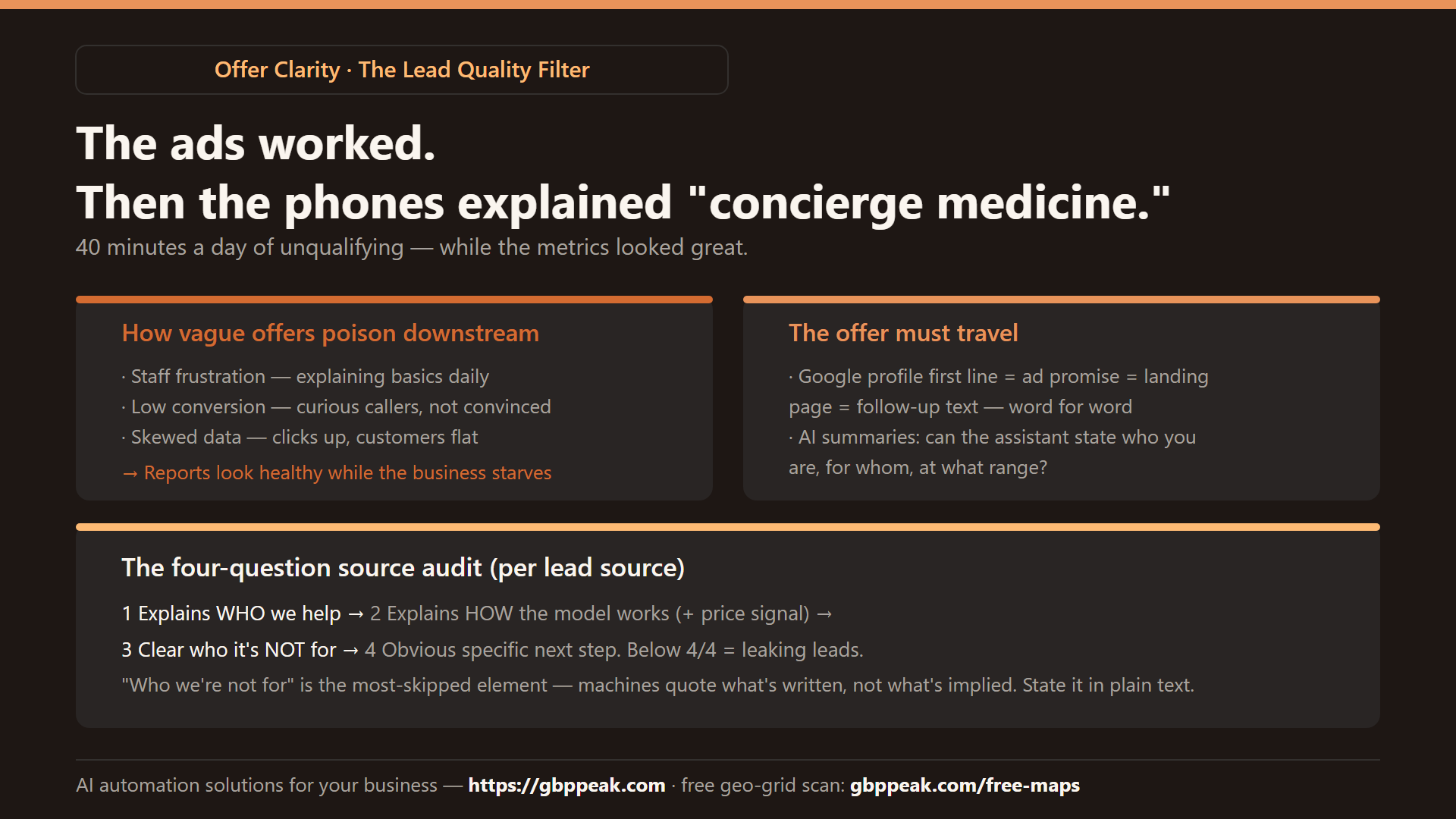
and it produces the worst kind of success: metrics that look good while the business suffers.
Lead quality problems usually come from offer vagueness, not traffic shortage. When a prospect can't understand your service model before contacting you — what it is, who it's for, who it's NOT for, what it costs — you get unqualified calls that frustrate staff and skew data. The fix: make the offer "travel" — identical clarity on your Google profile, ads, landing pages, follow-up texts, and in a form AI tools can summarize accurately. A qualified lead is someone who already knows they're a fit before they reach you. Test every lead source with four questions: does it explain who you help, how the model works, who it's not for, and the next step. :::
How a vague offer poisons everything downstream
"Offer dilution" — technically correct terms that mean nothing to a person on a phone — damages three things at once:
| Damage | What it looks like | Who feels it |
|---|---|---|
| Staff frustration | 40 min/day explaining basics | Front desk / sales |
| Low conversion | Curious callers, not convinced ones | The pipeline |
| Skewed data | Clicks and calls up, customers flat | Every decision you make from reports |
The last one is sneakiest: a vague offer makes marketing look like it's working. The reports fill with activity while the business starves for actual customers — and any optimization built on that data optimizes toward the wrong thing (the signal-quality rule again: automation amplifies whatever it can see).
The offer must "travel"
A customer's journey no longer starts on your website. It starts on Maps, in an ad, inside an AI summary — and the offer has to be equally clear at every stop, or the message breaks mid-journey:
offer_travel_check:
  google_profile: "first line states service + who it's for"
  ads: "the ad's promise = the landing page's promise,
        word for word"
  landing_page: "model explained above the fold;
                 price signal present"
  ai_summaries: "ask the assistants — can they state
                 who you are, for whom, at what range?"
  follow_up_texts: "same language as the ad that
                    earned the lead"
break_test: "Read each touchpoint cold. If a stranger
             can't say what you do + who it's for in
             10 seconds, that's where leads leak."
The "concierge medicine" clinic fixed it in one afternoon: "Personal doctor membership — ฿X/month, same-day appointments, up to 3 clinics in central Bangkok. Not insurance replacement." Clicks dipped slightly. Qualified calls doubled. The front desk got their forty minutes back.
AI summarizers punish vagueness twice
AI search tools don't read your site like a human — they index and summarize. Vague, buried, or inconsistent content produces two distinct failures:
- Generic representation — the AI describes you in the same bland terms as every competitor, so nobody chooses you specifically
- Wrong-audience recommendations — without a stated "who this is NOT for," the model sends you exactly the people who will call and be disappointed
THE AI-NOT-FOR TEST:
  ask: "is [business] right for [edge-case customer]?"
  cases: the budget-limited, the out-of-area, the
         wrong service need
  good answer: "no — they serve X area / Y model"
  bad answer: hallucinated confidence, or silence
fix: put "who we're not for" on the page in plain text.
     Models quote what's written, not what's implied.
That "not for" statement is the single most skipped clarity element — humans skip it out of fear of losing anyone; machines need it to route everyone correctly.
Don't blueprint competitor spending
Checking competitor ad spend for market context is fine; copying it is expensive. Their economics aren't yours:
- Different margins, service areas, follow-up capacity
- Possibly a deliberately vague, high-volume/low-quality offer that only works at their scale
- Budgets tuned to their lifetime value, not yours
Spend more only when you know what a qualified lead is worth to you — which requires knowing your conversion rate from qualified lead to customer, which requires the offer to be clear enough that "qualified" is measurable in the first place.
The four-question source audit
Run this against your top three lead sources (profile, main ad, main landing page):
1. Does it explain WHO we help?
2. Does it explain HOW the model works (incl. price signal)?
3. Is it clear who this is NOT for?
4. Is the next step obvious and specific?

score each 0/1 per source; anything below 4/4 is
leaking leads — fix the lowest-scoring question first
That's the entire diagnostic. Most businesses score 2/4 on at least one source, and that source is where their worst leads originate.
And while clarifying the demand side, keep sight of the geographic one: a free geo-grid scan at https://gbppeak.com/free-maps shows where your Google Maps ranking carries your newly-clear offer across the city.
Frequently Asked Questions
What's the difference between a lead and a qualified lead?
A lead is anyone who shows interest — click, follow, view. A qualified lead already understands your offer and knows they're a fit before contacting you. The gap between the two is manufactured by your messaging clarity, not your traffic volume.
Does more traffic mean more business?
Only if the marketing filters work. High traffic with a vague offer produces high-volume junk calls: staff time burned, conversion rate crushed, and reports that look healthy while the business isn't acquiring the right customers.
How does AI search change how my offer must be written?
AI summarizes what it can parse. Clear headings, consistent naming, stated prices and audience — and an explicit "who this is not for" — let the model recommend you accurately to the right people instead of generically to everyone.
Should I match a competitor's ad spend when they outspend me?
Not automatically. Their margins, capacity, and possibly deliberate volume-over-quality strategy differ from yours. Spend based on your own qualified-lead value — which you can only compute once the offer is clear enough to measure quality at all.
Final note
Traffic is a faucet; clarity is the filter. A strong filter makes even modest flow productive, and no faucet is big enough to compensate for a broken one. State what you do, who it's for, who it's not for, and what it costs — everywhere the message travels — and the phone starts ringing with people who already know they're in the right place.