
Suspended Tuesday, Back Thursday: Running Local Visibility as an Operation
Suspended Tuesday, back Thursday — the neighbor stayed dark five weeks. Four pillars: the living profile, signal-quality ads, the consistency hour, the evidence folder.
A Bangkok camera repair shop had its Google profile suspended on a Tuesday morning — an automated flag, no warning. Calls from Maps stopped instantly. Directions stopped. The appeal form asked for a business license, signage photos, and a utility bill. The owner found the license in a drawer, photographed the sign that afternoon, and — because everything was in one folder — was reinstated Thursday. A neighboring shop hit the same flag the same month and stayed dark for five weeks, hunting documents across three people's emails.
The difference wasn't luck. It was whether the business treated its digital presence as an operation (with records, routines, and evidence) or as a campaign (set up once, remembered at renewal time). 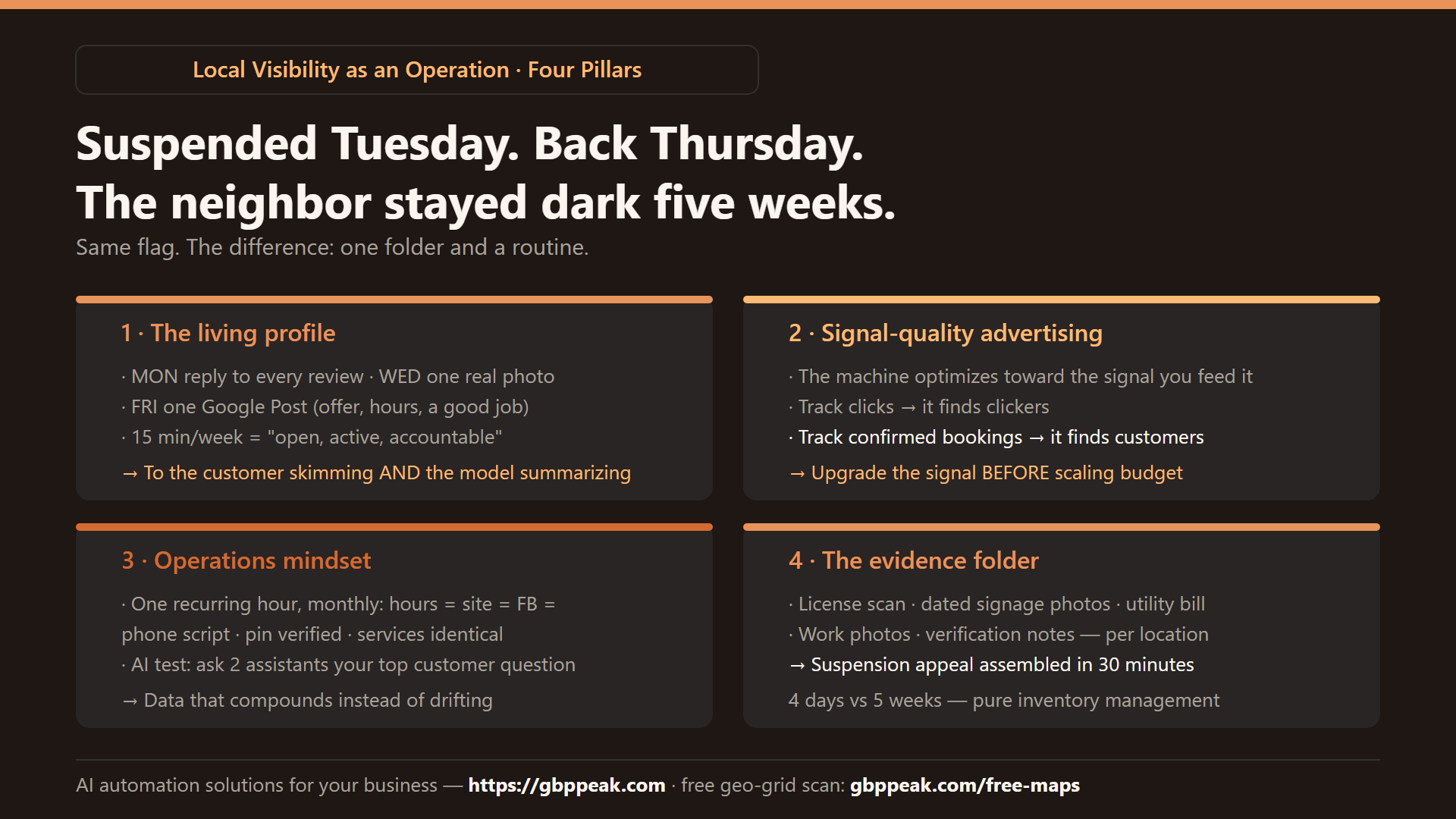
This guide covers the four pillars of the operational approach: a living profile, signal-quality advertising, consistency across touchpoints, and the evidence folder.
Optimizing local visibility now means operating, not just setting up. Treat your Google Business Profile as a living publication — weekly photo updates, review replies, and Google Posts signal activity to Google and give AI tools current structured data to summarize. In advertising, automation optimizes for whatever conversion you define: tracking clicks finds clickers; tracking booked appointments finds customers — so upgrade the signal before spending more. Maintain an operations checklist keeping hours, location, and services identical across every platform. And keep an evidence folder (license, signage photos, utility bills) per location so a suspension appeal takes days, not weeks. :::
Pillar 1: the living profile
Your Business Profile is not a digital business card — it's where the decision happens. Many customers call or don't based purely on what the profile says, never reaching the website; AI summarizers read the same profile to decide whether to name you.
A stale profile manufactures friction — every wrong hour, dated photo, or vague service line is a reason to hesitate at the exact moment of decision. The antidote is rhythm, not annual cleanup:
WEEKLY PROFILE ROUTINE (15 minutes):
  mon:  reply to every new review (specific, not templated)
  wed:  one new photo — staff, work in progress, the counter
  fri:  one Google Post: current offer, holiday hours,
        a job worth showing
monthly: hours/services/price signals cross-checked vs website
Fifteen minutes a week keeps the profile reading "open, active, accountable" — to the customer skimming, the algorithm ranking, and the model summarizing.
Pillar 2: automation finds whatever you point it at
The machine-learning logic of modern ad platforms is simple and unforgiving: they optimize toward the conversion signal you give them.
| You track | The machine finds you | Your team gets |
|---|---|---|
| Contact-page views | Thousands of clickers | Window shoppers |
| All calls (any length) | Anyone with a phone | Wrong-service callers |
| Form submissions | Curiosity fills | "Just asking" leads |
| Confirmed bookings | People who spend | Customers |
The fix is never "turn off automation" — it's refining the signal before feeding it budget:
conversion_signal_upgrade:
  events:
    - page_view_contact     # keep, but don't optimize on it
    - call_60s_plus         # qualified call floor
    - booking_confirmed     # PRIMARY optimization target
    - form_service_specific # form with service + area fields
  rule: "budget scales only after the primary signal has
         30+ conversions/month of clean data"
The same principle as judging ads by booked jobs — this is the tracking half of it. And before blaming creative for weak results, audit the plumbing: duplicate events and broken embeds make good campaigns look dead (the tracking audit).
Pillar 3: from campaign mindset to operations mindset
Local visibility now spans Google, Apple Maps, social platforms, and AI summaries — too many touchpoints for "set and forget." Small mismatches go unnoticed and quietly erode both customer trust and machine confidence.
monthly_consistency_checklist:
  hours:      "GBP = website = Facebook = phone script"
  location:   "pin verified from your real service area
               ([anchor check](https://gbppeak.com/blog/ai-trust-consistency-local-search))"
  services:   "same names, same scope, every platform"
  nap:        "name/address/phone character-matched on
               top 5 directories"
  ai_test:    "ask 2 assistants your top customer question"
One recurring hour, every month. That's the entire "operations mindset" — the difference between businesses whose data drifts and businesses whose data compounds.
Pillar 4: the evidence folder
The unglamorous pillar that saves weeks: suspensions and verification challenges still happen, and the appeal process rewards the prepared.
EVIDENCE FOLDER (per location, kept current):
  /license        business license scan
  /signage        exterior + interior sign photos (dated)
  /utility        one recent utility bill
  /photos         staff at work, vehicles, storefront context
  /notes          verification dates, account emails
rule: when the flag comes, you're assembling an appeal
      in 30 minutes — not building one from scratch
Suspension response time is pure inventory management. The camera shop had the folder; the neighbor didn't. Same flag, four days versus five weeks.
AI summaries: the "zero result" readiness test
Increasingly, users get their answer from an AI summary and act without clicking — the "zero result" search. Your readiness is testable in ten minutes:
READINESS TEST:
  1. Ask ChatGPT + Google AI Overviews: "[your service] [your area]"
  2. Named? → check every fact (hours, prices, services)
  3. Not named? → your content is either unclear, inconsistent,
     or invisible to the sources the AI cites
  4. Fix: specific service names, direct answers to real
     questions, structured formatting (headers, bullets) —
     the [GEO content bar](https://gbppeak.com/blog/geo-local-business-bangkok)
The ninety-day operational plan
- Weeks 1–2: evidence folder built; weekly profile routine started; conversion signals upgraded to bookings
- Weeks 3–6: consistency checklist run monthly; first AI readiness test; fix the top three gaps found
- Weeks 7–12: let the data accumulate — review velocity, booking-rate per source, AI mentions; scale ad budget only on the clean booking signal
And keep the geographic baseline current in the same rhythm: a free geo-grid scan at https://gbppeak.com/free-maps plots your Google Maps ranking across your service area — the visibility half of every decision above.
Frequently Asked Questions
Why update my Google Business Profile weekly?
Weekly activity — replies, photos, posts — signals to Google that the business is alive, keeps customers seeing current offers and hours, and gives AI summarizers fresh structured data. It's fifteen minutes against the friction that sends customers to a competitor.
How do I get higher-quality leads from automated ads?
Upgrade the conversion signal before touching budget: optimize on confirmed bookings or qualified calls (60s+, right service), not clicks or form fills. The machine finds whoever matches the signal you feed it — point it at customers, not clickers.
What does "ready for AI search" mean?
A model can accurately summarize you: specific service names, direct answers to common questions, structured formatting, and consistent data across platforms. Test it by asking the assistants your real customer questions and checking every fact they state.
Why keep an evidence folder for my profile?
Suspensions and verification challenges cut off calls and directions instantly, and appeals require proof — license, signage photos, utility bill. A current folder turns a five-week scramble into a same-day appeal.
Final note
Visibility used to be a setup project; now it's an operating rhythm. Feed the profile weekly, point the automation at bookings, check the data monthly, and keep the evidence filed. Businesses that run this way don't just get seen more — they're ready on the day something breaks, and confident on every day it doesn't.