Found vs Chosen: Why Clinic B at #3 Books Double the Patients of #1
Clinic A: #1, vague, silent for 8 months. Clinic B: #3, clear, answered — books double. Entity clarity, warmer AI referrals, and the paid-vs-earned split.
Two clinics side by side in a Bangkok search result. Clinic A: #1 position, 4.2 stars, 60 reviews, no prices listed, last review answered eight months ago. Clinic B: #3 position, 4.8 stars, 210 reviews, "consultation from ฿500, English-speaking staff, open Sundays" in the first line, every review answered within a week. The #1 clinic gets more views. Clinic B books more patients — roughly double, by the owner's count.
Ranking was never the finish line; it's the entry ticket. The decision happens in the evaluation seconds after the list appears — and increasingly, that evaluation is done by an AI summarizing you before a human ever reads your name. 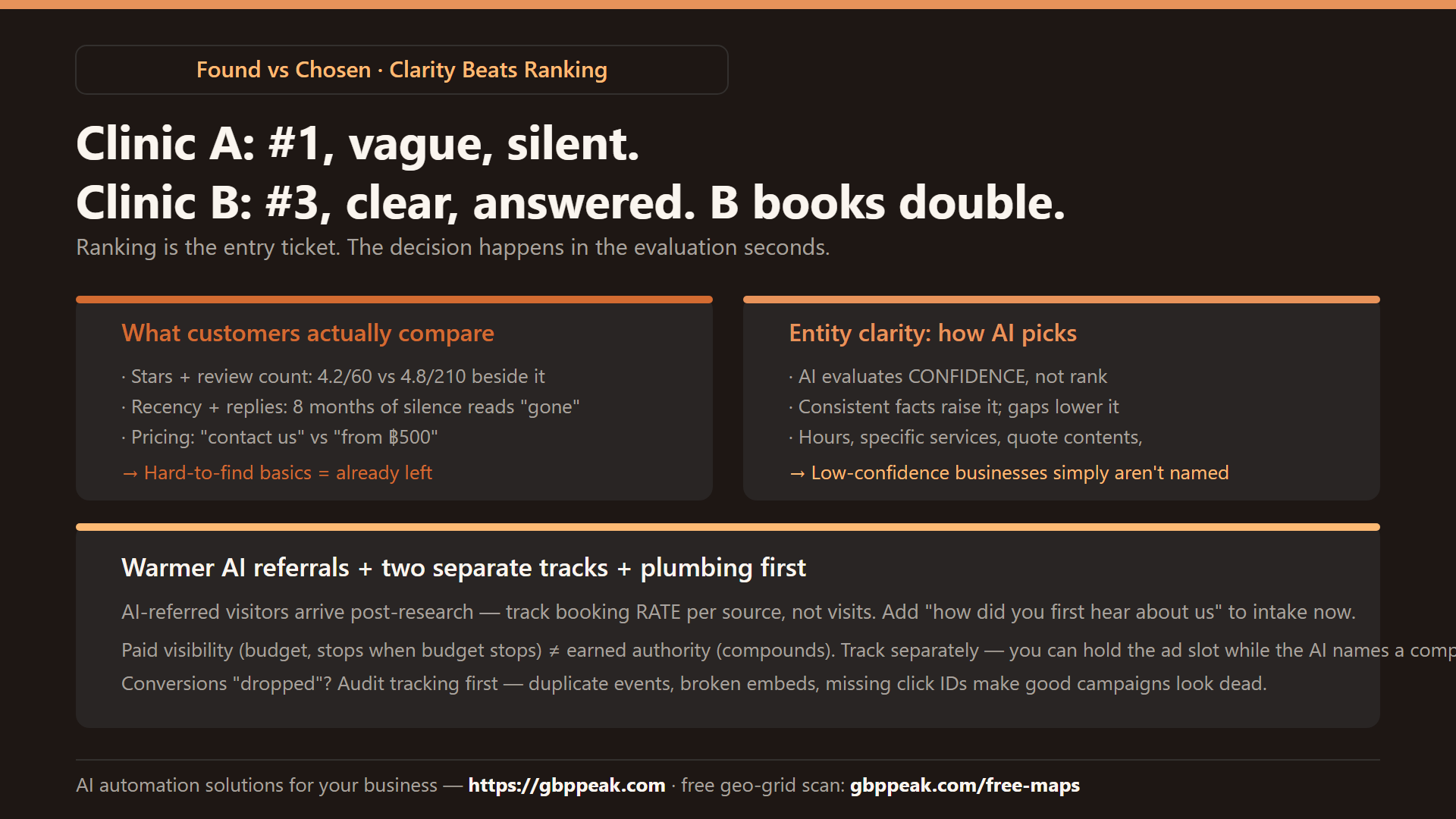
This guide is about the gap between being found and being chosen, and the specific clarity that closes it.
Ranking first only gets you seen; conversion happens in the evaluation phase, where customers compare ratings, review counts, review freshness, pricing clarity, and completeness. What wins is clarity: specific, consistent facts (hours, services, what a quote includes, answered reviews) that remove doubt for humans and give AI models "entity clarity" to recommend you confidently. Note that AI referrals are often warmer — users arriving from ChatGPT-style research are closer to booking. Also track paid visibility and earned AI authority separately (an ad does not make you the AI's recommendation), and audit your tracking plumbing before blaming creative when conversions look low. :::
What actually happens after the list appears
Very few consumers click the first result and call. Most compare — quickly, ruthlessly, across a handful of fields:
| Factor compared | What loses the customer |
|---|---|
| Star rating + review count | 4.2 with 60 vs. 4.8 with 210 next to it |
| Review recency + replies | Silence for 8 months reads "gone" |
| Pricing clarity | "Contact us" vs. "from ฿500" |
| Profile completeness | Missing hours, thin photos, no services listed |
| Path to action | No obvious next step vs. book/call in one tap |
And the weighting varies by industry — which is why copying another business's playbook fails:
- Healthcare/medical — proximity often decides; make location and access effortless
- Professional services — reviews and completeness outweigh distance
- Trades/home services — pricing clarity or a defined quote path is usually decisive
The rule underneath all three: if a prospect has to work to find your basic information, they've already left.
Entity clarity: how AI decides who to name
When an AI answers "best dentist near Ari," it doesn't rank — it evaluates confidence. Can it verify who you are, what you do, where you are? Every consistent fact raises confidence; every gap or contradiction lowers it, and low-confidence businesses simply aren't named.
entity_clarity_checklist:
  hours_location: "identical on GBP, site, directories, phone script"
  services: "specific — 'root canal, single visit' not 'dental care'"
  quote_contents: "what's included, stated plainly"
  reviews: "answered, recent — replies are data the model reads"
  photos: "real interior/team/work — not stock"
signal_test: "Ask ChatGPT 'who does [service] in [area]'.
              Named with correct facts? = clarity achieved.
              Wrong facts or absent? = fix the cited source."
This is the same evidence system as the entity-trust sweep — clarity is what trust looks like to a machine.
AI referrals are warmer — measure them separately
An emerging pattern in the data: visitors arriving from AI tools often convert at higher rates than generic organic traffic. The mechanism is simple — someone who asked ChatGPT for a recommendation has already done their research phase inside the answer. They arrive pre-sold on fit.
Volume is still small today. Quality says track it anyway:
INTAKE QUESTION SET (add to every first contact):
  "How did you first hear about us?"
  log: google_search | maps | facebook | chatgpt/ai | referral | walkby
  monthly: booking RATE per source, not just count
  → When AI volume grows, you'll have the trendline already
The attribution pipeline handles the logging; the insight is that "how many" is the wrong metric — "how often they book" is what a warmer channel reveals.
Paid visibility ≠ earned authority
Buying an ad in AI Mode or search does not make you the AI's recommendation — they're two separate tracks that need separate tracking:
| Paid visibility | Earned authority | |
|---|---|---|
| How you get it | Budget | Clarity + consistency + reviews |
| Where it appears | Ad slots | The answer's named recommendations |
| Stops when | Budget stops | It compounds |
| Measures as | Cost per click/lead | Mention rate → booking rate |
A business can hold the ad slot while the summary names a competitor (the auction-vs-answer gap). Track both, attribute separately, and know which engine is actually producing your growth.
Before you blame the marketing, check the plumbing
A classic false diagnosis: conversions drop, the team blames creative or demand, budgets get reshuffled — and the real cause was tracking. Duplicate conversion events double-count some sources, a broken form embed silently fails, a missing click ID breaks attribution — and the ad platform then optimizes toward a faulty signal, making the problem worse.
TRACKING AUDIT (before any strategy change):
  1. One test conversion per channel, end-to-end, monthly
  2. Check for duplicate/missing events in platform reports
  3. Verify form embeds + call tracking actually fire
  4. Confirm click IDs pass through to the CRM
  rule: plumbing first, strategy second
The clarity sprint
- Day 1: price ranges or quote contents on your top 3 services — plainly visible
- Day 2: every unanswered review answered; reply template for the next 30 days
- Day 3: hours/location/services cross-checked on GBP vs. site vs. top 3 directories
- Day 4: add the "how did you hear" intake question; backfill 30 days from memory if possible
- Day 5: run the AI signal test; fix any wrong facts at the source
- Day 6: baseline the map — a free geo-grid scan at https://gbppeak.com/free-maps plots your Google Maps ranking across your service area, the visibility half of the found-vs-chosen equation
Frequently Asked Questions
Does ranking #1 guarantee leads?
No — ranking wins the view, not the choice. Customers compare ratings, review counts and freshness, pricing clarity, and completeness before contacting anyone; a #1 position with a vague, stale profile loses to a #3 with a clear one.
How do AI search tools pick local businesses?
They evaluate entity clarity: consistent facts across your profile, site, and reviews that let the model confidently state who you are and what you do. Thin or contradictory data lowers confidence, and low-confidence businesses don't get recommended.
Why track AI referrals separately from other traffic?
Because they behave differently — AI-referred visitors often arrive post-research and convert at higher rates. Counting bookings per source (not raw visits) reveals this quality gap early, while volumes are still small enough to act on.
Isn't paying for ads the same as being AI-recommended?
No — paid placements and AI citations are separate systems. You can hold the ad slot while the AI's answer names a competitor. Track cost-per-lead from paid separately from mention-to-booking rates from earned authority to see which engine drives growth.
Final note
Visibility gets you into the consideration set; clarity gets you out of it — chosen. Every specific price, every answered review, every consistent fact removes a reason to hesitate, for the skimming human and the summarizing machine alike. Rank where you can. Be obvious everywhere. The second part is what doubles bookings.