Beyond the Click: When Your Paid Ad Loses to the Free AI Answer
They won the auction and lost the answer — the AI Overview named the competitor. PMax inputs, out-evidencing the summary, and chatbot ads where your data is the sales script.
A Bangkok water-heater repair company paid for the top ad slot on "emergency water heater repair Bangkok" — and lost the job anyway. Right below their pink ad sat Google's AI Overview, which named a competitor: better reviews, clearer service page, more citations. The customer read the summary, skipped the ad, and called the competitor. The company was winning the auction and losing the answer.
That's the new reality of "beyond the click": the handoff from ad to business no longer runs only through your website. It happens inside AI summaries, automated local ad engines, and now chatbot-native ads where the "landing page" is a conversation. 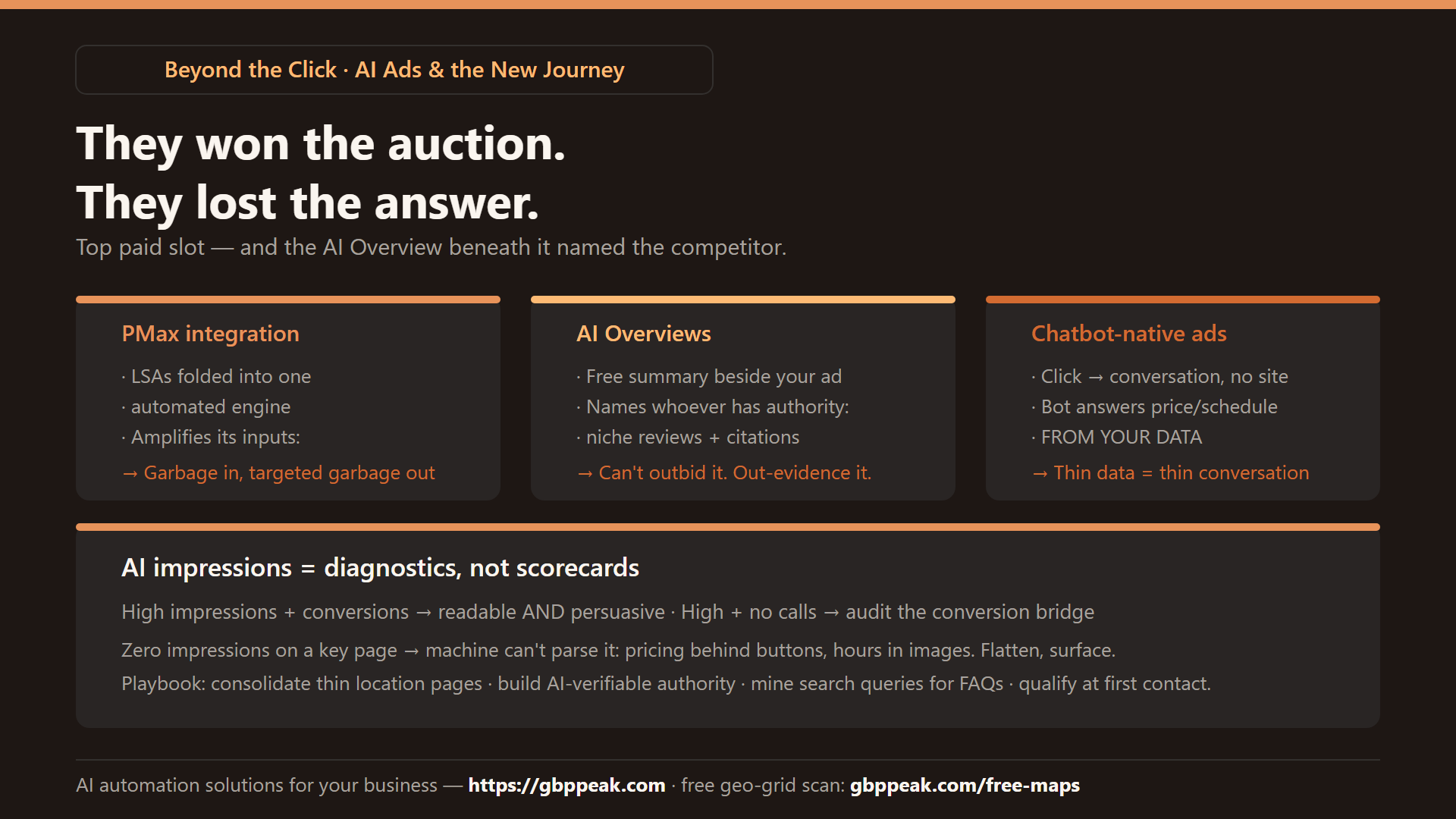
Here's what changed and what to do about each piece.
The customer handoff has moved past the website click. Local Services Ads are folding into Performance Max — one automated engine fed by your profile data, so results depend entirely on data quality (accurate service areas, categories, hours). AI Overviews can undercut your paid ad by recommending a competitor with stronger reviews and citations, so paid visibility alone no longer wins. Chatbot-native ads replace the landing page with a conversation, meaning the AI answers pricing and scheduling questions from your data — thin data, thin experience. The strategy: one consistent source of truth everywhere, authority the AI can verify, and reading the new AI-impression metrics as diagnostics, not scorecards. :::
The three fronts where the click died
| Front | What changed | What it demands |
|---|---|---|
| PMax integration | LSAs absorbed into one automated engine | Clean inputs: categories, service areas, hours |
| AI Overviews | Free summary sits beside your paid ad | Authority: reviews, citations, quotable content |
| Chatbot-native ads | Click → conversation, no website | Complete data the bot can answer from |
Front 1: Performance Max eats Local Services Ads
Google is merging Local Services Ads into Performance Max — from a business perspective, your local ads, profile data, and service info now feed a single automated engine that decides who sees you.
The uncomfortable corollary: the automation performs exactly as well as its inputs. A broad category, an outdated service radius, or wrong hours don't cause an error message — they cause the system to quietly show you to the wrong people (or the right people a wrong version of you).
pmax_input_audit:
  gbp_category:   "narrowest truthful — 'Water Heater Repair Service',
                   not 'Plumber'"
  service_areas:  "actual drive zones, updated after any change"
  hours:          "current, including holiday exceptions"
  services_list:  "matches website exactly — same names, same scope"
  rule: "automation amplifies inputs; garbage in, targeted garbage out"
One source of truth, verified quarterly — that's the whole discipline.
Front 2: the ad you paid for vs. the answer you didn't
The AI Overview conflict is real: your ad can hold the top slot while the generated summary beneath it names a competitor the model considers more authoritative for that specific query. You're renting the position; they own the answer.
You can't outbid a summary. You can out-evidence one:
- Review depth in the specific niche — for "emergency repair," models weigh review text that mentions emergency response, speed, and outcome. Generic 5-stars do less than one detailed "came at 11 p.m., fixed by midnight"
- Citations the model can verify — directories, local news, the entity-trust footprint
- A service page built to be quoted — price ranges, response times, coverage area stated plainly (GEO-style content)
Paid and organic stopped being separate games: the ad buys attention, the evidence wins the summary underneath it.
Front 3: conversation-first ads — the landing page becomes a chat
Newer platforms are testing chatbot-native ads: click the ad and you're instantly in a conversation with an AI agent — no website, no form.
OLD PATH:   ad → website → browse → lead form → maybe a call
NEW PATH:   ad → AI conversation → qualified lead

The bot answers pricing, scheduling, and capability questions
FROM YOUR DATA. If the data is thin, the conversation is thin —
and the lead qualifies itself out.
This makes your FAQ content, price transparency, and service detail the actual sales script. The businesses that win conversation-ads are the ones whose data can answer "how much," "how fast," and "do you serve my area" without hesitation — because the bot won't hesitate either; it'll just be wrong or vague.
Reading the new AI metrics honestly
Search Console now reports AI-specific impressions. Treat them as diagnostics, not scorecards:
- High AI impressions + conversions → the content is both readable and persuasive. Double down
- High AI impressions + no calls → readable but not converting: audit the conversion bridge
- Zero AI impressions on an important page → the machine can't parse it: complex formatting, key facts hidden behind tabs and toggles. Flatten the structure, surface the facts
That last pattern is common and cheap to fix: pricing behind a "Get Quote" button, hours in an image, service areas in a PDF — all invisible to a summarizer.
The practical playbook
- Consolidate location pages — replace dozens of near-identical town pages with a few genuinely useful service-zone pages; thin duplicates are spam-update targets
- Build authority the AI can find — consistent third-party mentions, current directories, review velocity in your specific niche
- Mine search data for questions — your paid search queries are a free list of what customers actually ask; answer them on the page and the profile (conversation mining automates the extraction)
- Qualify at first contact — whatever surface the lead arrives on, the qualification quality decides lead quality; the bot, the form, and the phone script need the same questions
And keep the geographic baseline current: a free geo-grid scan at https://gbppeak.com/free-maps shows where your Google Maps ranking holds across your service area — the map truth under every ad and summary above it.
Frequently Asked Questions
Can an AI Overview really name my competitor next to my own paid ad?
Yes — the ad position is bought; the summary is earned from reviews, citations, and content the model can verify. A competitor with stronger evidence in that specific niche can be recommended directly beneath your ad. The counter is authority: niche-specific reviews, verifiable citations, quotable service pages.
Do high AI impressions mean more customers?
Not by themselves. They mean your content appeared in AI summaries — a readability signal. Cross-reference the pages earning impressions with actual calls and bookings; impressions without conversions point to a conversion-bridge problem, not a visibility one.
What exactly is a chatbot-native ad?
An ad that opens a conversation instead of a webpage: the user clicks and immediately talks to an AI agent that answers pricing, scheduling, and service questions from your business data. The experience is only as good as the data — complete, transparent information becomes the sales script.
How do I prepare for Performance Max as a local business?
Audit the inputs the engine reads: narrowest truthful GBP category, exact service areas, current hours, and a services list matching your website. Automation amplifies whatever you feed it — precision in, qualified leads out.
Final note
The click was never the goal — the customer was. As the handoff scatters across summaries, automated engines, and conversations, the winning move stays constant: one precise truth about your business, published everywhere the machines look. Pay for attention if you must. Earn the answer always.