
Stateful AI Automation: Why Reliable Systems Start with a Table
The chain died on order #340 and nobody knew which 40 survived. Stateful automation — a table with a status column — turns fragile chains into resilient systems.
A Bangkok e-commerce seller ran a "simple" automation: on new order → check stock → draft thank-you message → update the sheet → notify shipping. One chain, five steps, all in a row. It worked — right up until the stock API timed out on order #340, and the chain died with the thank-you message half-sent and the shipping team never notified. The worst part: nobody knew which of the 40 orders in the backlog had made it through which step. The fix wasn't a better prompt. It was a table.
The most reliable AI automations share one architectural trait: a table at the center that remembers where everything stands. 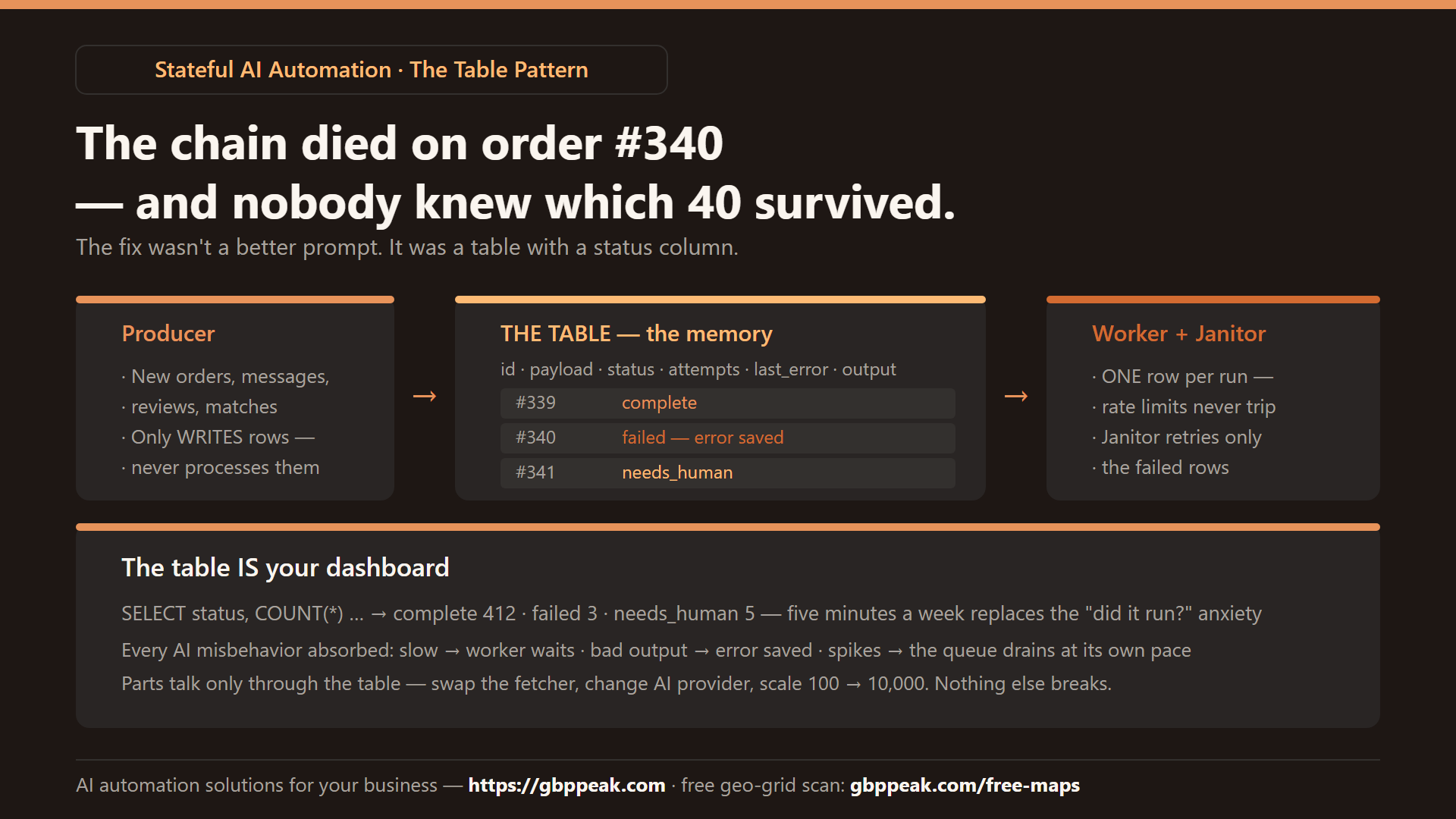
This guide shows why statefulness — memory — is what separates demos from infrastructure, and how to build it with tools you already have.
Reliable AI automation comes from making workflows stateful: a central table (database, Airtable, even a well-structured sheet) records every item and its status — pending, processing, complete, failed. Each row becomes its own thread: producers log work in, workers pick items one at a time (respecting API rate limits), failures mark only their row and a separate process retries just those. The table becomes live observability — you can see exactly where any item stopped — and decouples the parts of the system so any step can be updated without breaking the chain. :::
Stateless vs. stateful: the whole idea
A stateless workflow starts from zero every run. A stateful one remembers. That difference decides whether your automation survives contact with reality.
| Failure | Linear stateless chain | Table-based stateful |
|---|---|---|
| API times out on item 340 | Whole chain dies | Row marked failed, others proceed |
| Which items completed? | Unknown | SELECT * WHERE status=done |
| Retry | Rerun everything (duplicates risk) | Retry only failed rows |
| Rate limits | Chain blasts through, gets blocked | Worker paces one row at a time |
| Changing one step | Rebuild the chain | Hot-swap that step only |
| Explaining to a teammate | "It's somewhere in the flow" | Show them the table |
The chain isn't wrong because it's linear — it's wrong because it has no memory of where it was when things broke.
The pattern: producer, table, worker
Same skeleton we used in the conversation-mining and attribution pipelines — because it's the backbone of every reliable system:
PRODUCER (every 15 min)          TABLE (the memory)         WORKER (every 1 min)
  new orders, messages,    →     id | payload | status  →     claim ONE row:
  reviews, matches               | created | attempts          status=pending →
  INSERT a row, never             | last_error | updated        processing → do work
  process them here               | output | done_at            → complete / failed
Two rules make it work:
- The producer only writes rows. It never processes. This means a flood of input (a viral post, a Monday rush) just fills the table — nothing overloads.
- The worker does exactly one row per run. If the AI API is slow, the worker waits. If a row fails three times (
attempts >= 3), it stays markedfailedwith the error stored — a nightly janitor process retries those, or you look at them yourself.
The status column is the system
statuses:
  pending:      "row created, waiting for a worker"
  processing:   "claimed — with a claimed_at timestamp so
                 crashed workers' rows can be reclaimed"
  complete:     "output stored in output column"
  failed:       "error in last_error; attempts counted"
  needs_human:  "AI flagged low confidence — you decide"
That last status is the quiet superpower for AI workflows: instead of failing silently or guessing, low-confidence rows route to a human. (Pair it with the eval-suite mindset and you can measure how often that happens.)
Why this tames AI specifically
LLM output is variable; your architecture shouldn't be. The table absorbs every way AI misbehaves:
- Slow response → the worker waits; other rows aren't blocked because there's no "other rows in this run"
- Bad output → validation fails, row goes
failedwith the raw output saved for inspection — your error log builds itself - Rate limits → one-row-per-run pacing never trips them
- Volume spikes → 500 new rows are just 500 rows; the queue drains at its own pace
And because every hand-off is a row update, multi-agent systems become debuggable: when the classifier agent and the drafter agent both log to the same table with timestamps, the exact moment a hand-off broke is a query, not an archaeology project.
Observability: the table IS your dashboard
When a client or teammate asks "where is X?", a stateless system has no answer. A table-based one shows them:
-- this week's health check, one query
SELECT status, COUNT(*) FROM jobs
WHERE created > datetime('now','-7 days')
GROUP BY status;
--  complete 412 · failed 3 · needs_human 5 · pending 0
Five minutes a week reading that output replaces hours of "did the automation run?" anxiety. The three failed rows have their errors stored; the five needs_human rows are AI humility working as designed.
Decoupling: change one part, break nothing
Because parts communicate only through the table, they don't know about each other. Swap the fetcher from a slow scraper to an official API — the analyzer and delivery steps never notice. Switch AI providers — only the worker's prompt changes. Scale from 100 to 10,000 rows — the shape of the system doesn't change at all.
For a small business this is the difference between an automation you maintain for years and one you rebuild every quarter.
A concrete starter: the order-followup machine
table: order_followups
  order_id (key) | customer | status | draft_msg | sent_at | error

producer: on new order → INSERT row (status=pending)
worker:   pending row → AI drafts thank-you + review ask
          → status=needs_human (owner approves in 30s)
approver: sends via LINE → status=complete
janitor:  nightly retries failed rows; alerts if >3 failures
One table, three tiny automations, zero spaghetti. Every message traceable to its order. Nothing sent without human eyes — until you've built the trust to automate that too.
And when the automation earns its keep, extend the same pattern outward — including visibility monitoring: a free geo-grid scan at https://gbppeak.com/free-maps reports where your Google Maps ranking stands across your service area, a perfect fit for the producer-table-worker loop (scan → table → weekly trend report).
Frequently Asked Questions
What's a stateful workflow, exactly?
One that remembers its progress in an external table or database. Each item is a row with a status, so the system can pause, resume, retry, and report exactly where anything stands — instead of starting from zero every run like a stateless chain.
Do I need a real database, or is a spreadsheet enough?
For most small-business volumes, a structured sheet or Airtable is genuinely enough — id, status, attempts, error, output columns. Graduate to a database when you exceed a few thousand rows per day or need real concurrent workers.
How does the table help with API rate limits?
It decouples gathering from processing. The producer can dump 500 rows instantly; the worker then processes one row per run at whatever pace the API allows. You never get throttled, and nothing is lost while waiting.
Isn't this more complex than one simple chain?
More setup, dramatically less maintenance. Chains fail as a unit and hide where they broke; tables fail per-row, show the error, and let you retry precisely. The extra thirty minutes of setup repays itself the first time something breaks at 2 a.m.
Final note
"Autonomous AI" makes headlines; stateful automation makes money. Don't ask the AI to drive the whole car — build the road, give it the map, and let the table remember every mile. That's the architecture that runs for years.