
The AI Quoted Her Unanswered One-Star Review. Beside Her 4.6.
The AI Overview quoted an unanswered one-star review right beside her 4.6 — no customer ever scrolled to it. Shape the pattern the summarizer finds; defend the widened auction.
A Bangkok spa owner searched her own business name and froze. At the top of the page, Google's AI Overview had written a paragraph about her spa — and it quoted a one-star review from eight months ago, one she'd never answered, right next to her 4.6 rating. No customer had clicked through to the review page. The AI had done the selection for them.
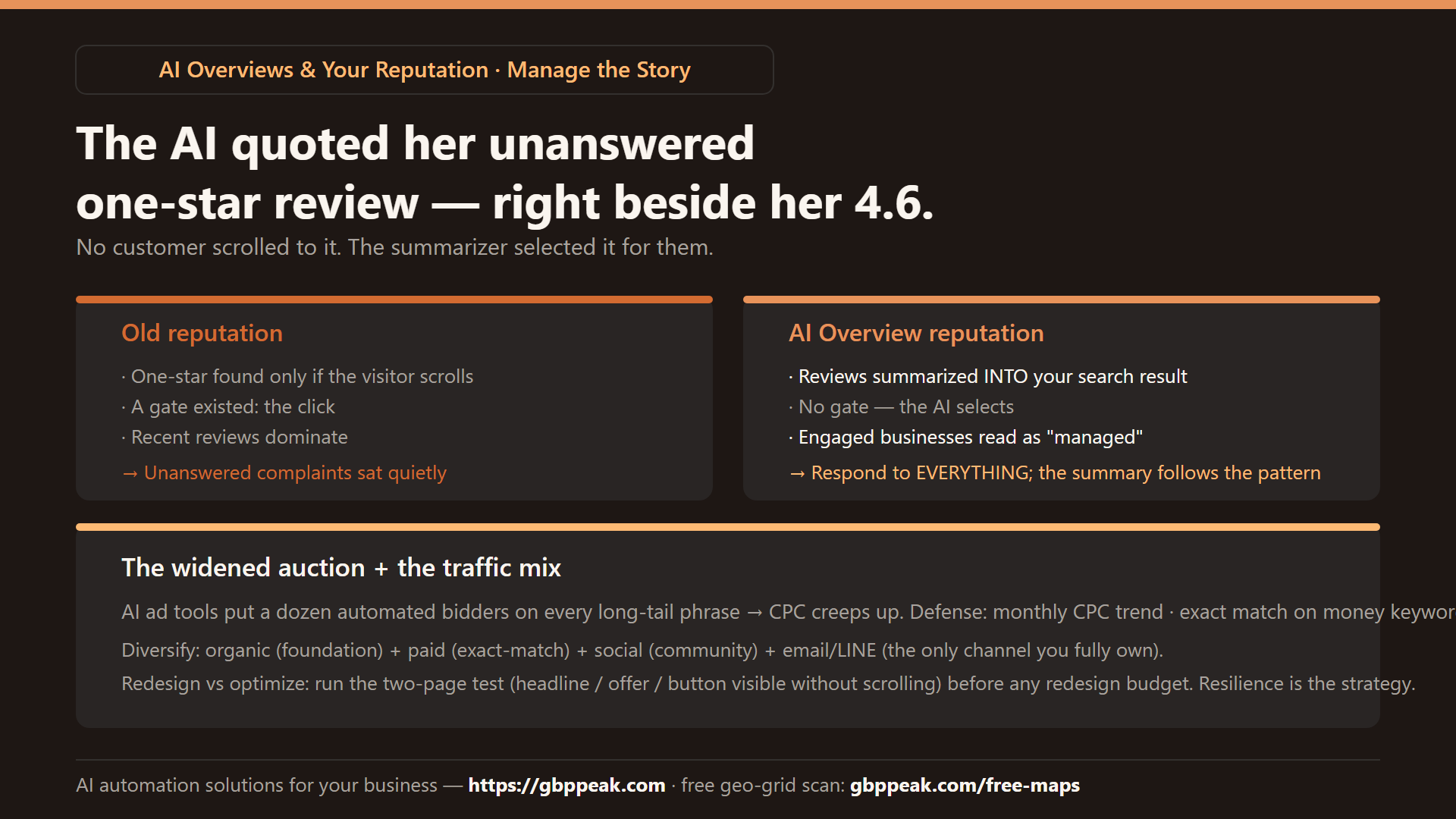
That's the new reputation reality: AI Overviews summarize reviews into your search result, and unanswered complaints are prime data points. You can't turn off what the model chooses to summarize — but you can absolutely change what data it finds.
AI Overviews now summarize reviews and web sentiment into a paragraph at the top of your search results — meaning a single unanswered one-star review can surface to every searcher without anyone clicking through. You can't control the summarizer, but you shape its data: respond publicly to every review (engagement signals show active management and balance the narrative), and keep review volume and recency healthy. In parallel, ads are costlier because AI tools widen every auction — defend with exact-match keywords, systematic negative keywords, and CPC trend monitoring. And diversify traffic beyond organic search, since algorithm-driven shifts can move demand overnight. :::
How AI Overviews changed review visibility
The old funnel had a gate: a customer had to choose to visit your review profile and scroll. The new one doesn't:
| Old reputation | AI Overview reputation | |
|---|---|---|
| One-star review | Found only if the visitor scrolls | Summarized into your search result |
| Gate | The click | None — the AI selects |
| What dominates | Your most recent reviews | The loudest patterns it finds |
| Unanswered complaints | Sit quietly | Become data points in the summary |
The model reads broad patterns. A high volume of unaddressed complaints tells it "this is part of the story of this business." Active responses to both praise and complaints tell it "this business is managed" — which balances the narrative the summary tells.
review_engagement_protocol:
  respond: "every review, positive AND negative"
  negative_formula: "acknowledge + specific fact + path to
                     resolution taken — never argue details"
  cadence: "within 48h; weekly sweep minimum"
  volume: "steady requests > old pile ([Tue–Thu timing](https://gbppeak.com/blog/ai-grounding-visibility))"
  effect: "engaged businesses read as 'managed' to the
           model — the summary follows the pattern"
This is the review triage discipline, upgraded: replies now feed the summarizer, not just the reader.
Why your CPC is climbing: the widened auction
AI ad tools let every advertiser target every conversational long-tail phrase at scale — "best spa for prenatal massage near me" now has a dozen automated bidders on it where two existed before. More competition, higher cost-per-click, and the drift is gradual enough to miss month to month.
CPC DEFENSE (monthly, 30 min):
  1. TREND: pull 30-day CPC vs prior 30 days, per campaign
     — catch drift before it compounds
  2. EXACT MATCH on money keywords: AI-broadened matching
     buys "relevant" traffic you never chose; exact keeps
     intent yours
  3. NEGATIVE KEYWORDS as strategy, not reaction: exclude
     whole categories outside your goals (careers, wholesale,
     rival brands), not just words that once failed
  4. BUDGET GUARD: raise spend only on the [true
     qualified-lead cost](https://gbppeak.com/blog/lead-quality-audit),
     never on the raw-CPC story
Also worth watching: a slice of your "traffic" is bots, and automated campaigns can pay for clicks no human made. Click-fraud filtering is a small spend that protects a larger one.
Diversify: no single source of demand
AI-driven views are still a modest slice of total traffic — but their growth means relying on one "free" organic pipeline is a strategy with a single point of failure. Different industries feel it differently:
- Answer industries (healthcare, education, information) — organic declines as AI answers directly on the page
- Visual product industries (apparel, beauty) — traditional search still growing
Whatever your category, a traffic mix cushions every algorithm shift:
traffic_mix_targets:
  organic_search: "the foundation — keep it, don't marry it"
  paid_search: "captures immediate demand; exact-match discipline"
  social: "community + direct engagement; owns no algorithm risk
           from Google specifically"
  email_line: "the only channel you fully own — build the list
               from every other channel"
rule: "when one channel wobbles (and each will), the others
       carry the month"
Redesign vs. optimization: don't buy a new house to fix a door
Before any big redesign budget, run the two-page test:
TWO-PAGE TEST (before redesign):
  pick your 2 most important service pages — check at the
  top of the page, without scrolling:
    □ headline states the service plainly?
    □ the offer is obvious?
    □ contact/booking button visible?
  any box unticked → rewrite and test first;
  significant inquiry jumps often follow copy fixes alone
redesign is for: unclear message, confusing navigation,
  outdated brand identity — not for lead shortfalls
Optimization first, redesign only for structural problems. Most "we need a new website" moments are actually "we need a clearer headline" moments.
The technical backbone
For AI to represent you accurately rather than assemble fragments:
- Schema markup — prices, hours, locations, services in machine-readable code (the grounding stack)
- Clean HTML — crawlable, standard, fast; messy code yields messy summaries
- Bot mitigation — filter automated traffic so analytics and ad spend reflect humans
And keep the map layer of your visibility honest: a free geo-grid scan at https://gbppeak.com/free-maps shows where your Google Maps ranking carries you — the geographic constant under every algorithm shift above.
Frequently Asked Questions
Why is my cost-per-click going up?
Mostly the widened auction: AI ad tools let many more advertisers target long-tail conversational phrases automatically, so more bidders compete for the same slots. Defend with exact-match keywords, systematic negatives, and month-over-month CPC trend monitoring.
Can I stop AI Overviews from showing my negative reviews?
No — you can't control what the model summarizes. But you shape its inputs: respond publicly to every review (engagement signals balance the narrative), resolve complaints so follow-up reviews improve, and keep steady review volume so single complaints are a smaller share of the pattern.
Should I redesign my website to improve rankings?
Not usually. Redesign only when the message, navigation, or brand is genuinely broken. If the site is clear but leads are short, optimize: better headlines, clearer offers, visible calls to action on your top service pages — tested one change at a time.
What is a long-tail query?
A long, specific search phrase ("best spa for prenatal massage near me" vs. "spa"). Long-tail queries usually convert better because the searcher knows exactly what they want — which is exactly why automated tools have crowded them, raising their cost.
Final note
Your online presence is no longer a list of links — it's a story an AI tells about you, assembled from your reviews, your data, and your engagement. Manage the pattern the summarizer finds, defend the auction you actually compete in, and never let one channel be your only source of customers. Resilience isn't a tactic anymore; it's the strategy.