
"World-Class Experience" Is Unusable: AI Grounding for Local Visibility
"World-class experience" — unusable. "฿2,500, 45 min, Ari branch" — quoted by three assistants. Plain facts, per-location pages, and reviews as training data.
A Bangkok skin clinic's website opened with a paragraph any clinic could own: "We provide a world-class, patient-centered experience delivering exceptional results through our commitment to excellence." Beautiful copy. To an AI model assembling an answer about "laser hair removal Bangkok," it was worthless — nothing in it to ground a statement on. The competitor's page that opened with "Laser hair removal from ฿2,500 per session, full legs in 45 minutes, 3 certified technicians, Ari branch" got named by three assistants in the same afternoon.
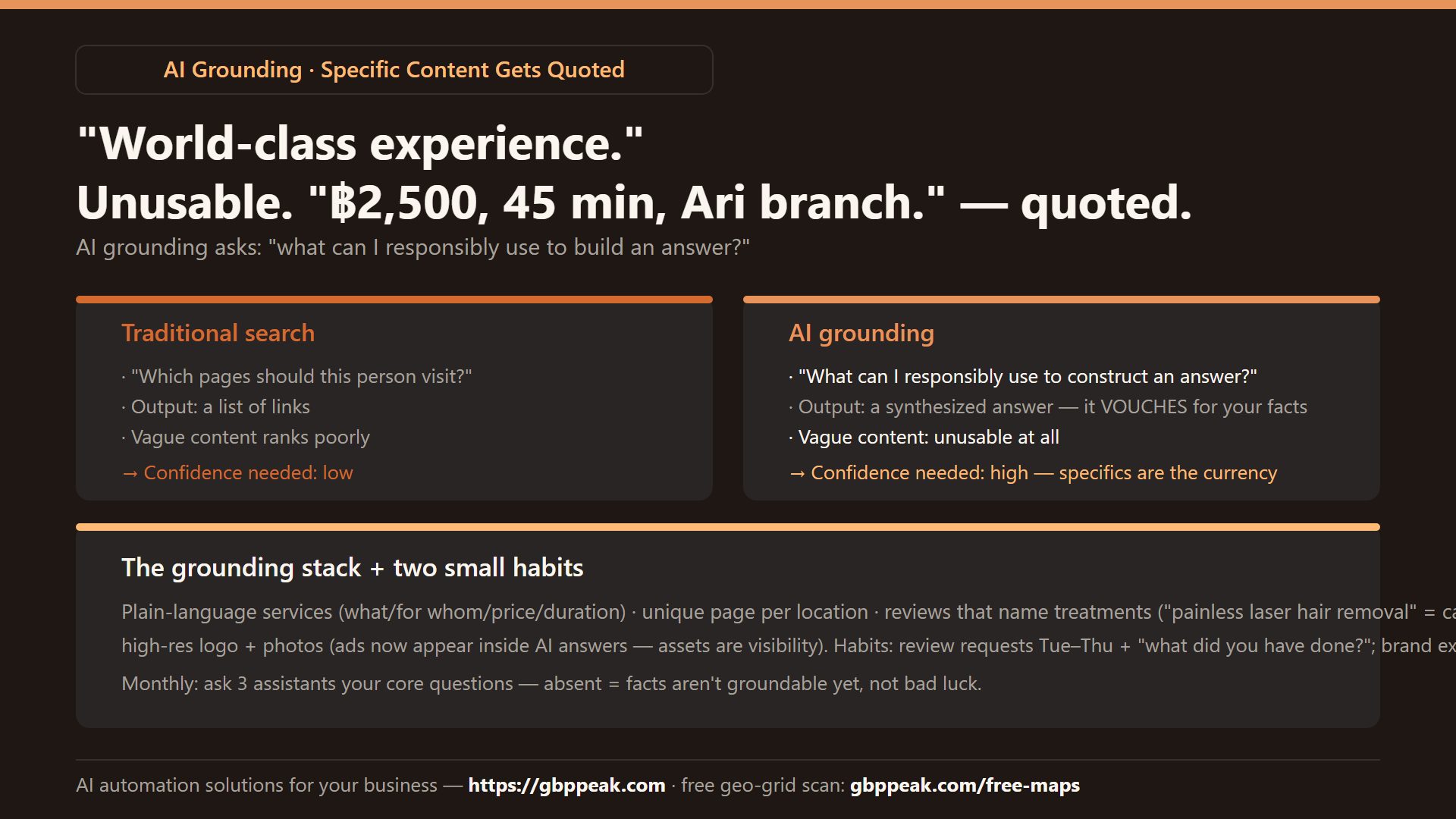
That's AI grounding: the model asks not "which page should this person visit?" but "what information can I responsibly use to build an answer?" Vague content can't be used. Specific content gets quoted.
AI search visibility comes from "groundable" information — facts specific enough that a model can confidently build its answer on them. Replace marketing language with plain-text service definitions (what, for whom, how much, how long), give each location a distinct page, and cultivate reviews that name actual treatments ("painless laser hair removal") — those mentions teach the AI what you're known for. No special software or code is needed; AI search runs on existing search infrastructure. As ads enter AI answers, high-resolution logos and photos become visibility assets, and small habits (weekday-timed review requests, brand exclusions on ads) sharpen results further. :::
The two questions search engines ask
| Traditional search | AI grounding | |
|---|---|---|
| Question | "Which pages should this person visit?" | "What can I responsibly use to construct an answer?" |
| Output | A list of links | A synthesized answer |
| What wins | Keyword relevance, links | Specific, quotable facts |
| Vague content | Ranks poorly | Cannot be used at all |
| Confidence need | Low | High — the model stakes its answer on you |
The confidence requirement is the key difference. When an AI includes you in its answer, it's effectively vouching for the facts it took from you. It can only do that with specifics — which is why "world-class experience" is invisible and "from ฿2,500, 45 minutes, Ari branch" is quotable.
Strategy 1: plain language beats marketing copy
SERVICE PAGE REWRITE TEST:
  ✗ "We provide premium wellness solutions tailored to you"
  ✓ "Laser hair removal: full legs 45 min, from ฿2,500,
     certified technicians, numbing cream included"

  structure per service:
    1. What it is (one sentence, definition-shaped)
    2. Who it's for (and who it's NOT for)
    3. How it works (steps, duration)
    4. Price signal (range at minimum)
    5. Real outcome notes

  fluff test: could a competitor publish this by swapping
  their name in? If yes → rewrite
The model rewards clarity because its user rewards directness — when someone asks an assistant a question, it looks for the fastest accurate answer. You want your page to be that answer's raw material.
Strategy 2: local context per location
Multi-location businesses hit a specific AI failure: indistinguishable branches. If all three pages carry the same generic copy, the model can't decide which branch to recommend to which user — and often recommends none of them. Each location page needs its own neighborhood, landmarks, transit access, staff, and local reviews. The anchor lesson applies to content too: uniqueness is what makes a branch selectable.
Strategy 3: reviews as training data
Reviews do double duty — trust for humans, categorization data for machines:
| Review | Human effect | AI effect |
|---|---|---|
| "Great service!" | Mild positive | Nothing — too vague to use |
| "Painless laser hair removal, done in 30 min" | Strong positive | Categorizes you for "laser hair removal" + "painless" |
The practical move: when requesting reviews, prompt the memory. "What did you have done?" naturally produces specific text. A stream of treatment-naming reviews teaches every engine what you're "known for" in your market — the evidence layer working through your customers' own words.
Ads are entering the answers — bring your assets
AI search is now a monetized surface: sponsored units appearing inside generated responses, often with visual formatting. Two consequences:
- Your brand assets are visibility assets — a high-resolution logo and quality profile photos decide whether a featured slot makes you look professional or pixelated. This is the cheapest upgrade in this entire guide
- Placement follows grounding — even paid units will favor businesses whose data the system can represent accurately; the content work above is the entry ticket (the auction-vs-answer pattern)
Two small habits with outsized returns
Weekday review timing. Weekend-requested reviews skew slightly lower — weekend reviewers are less engaged, often reviewing from distraction. Schedule automated SMS/email requests to land Tuesday–Thursday:
review_request_automation:
  send_window: "Tue–Thu, 10:00–19:00 local"
  avoid: "Fri evening–Sun (lower-rating skew)"
  prompt: "What did you have done?"   # → specific reviews
Brand exclusions on ads. Stop paying to reach people who already searched your name — that's your demand arriving for free. Add brand-keyword exclusions so budget goes to new customer acquisition only, and watch your true cost per new lead drop.
The monthly grounding check
ASK THREE ASSISTANTS (10 min/month):
  "[your core service] [your area]"
  "who does [specific treatment] near [neighborhood]?"
per engine: named? facts correct? quoted verbatim?
absent → your facts aren't groundable yet, not bad luck
Pair it with the map layer: a free geo-grid scan at https://gbppeak.com/free-maps plots where your Google Maps ranking carries you across the service area — visibility in both dimensions, checked monthly.
Frequently Asked Questions
Do I need special software or code to appear in AI Overviews?
No. AI search is built on top of existing search infrastructure — clear service pages, a complete Google Business Profile, consistent data, and structured formatting are the whole requirement. Anything sold as "AI-ready" code is solving a problem you don't have.
Why doesn't my business show up in AI Overviews?
Usually a lack of groundable information: marketing-heavy content gives the model no specific facts it can responsibly use. Rewrite key pages as plain definitions with prices, durations, and audiences, add FAQs, and cultivate reviews that name your actual services.
How do I get AI to mention my specific services?
Put the service names in your copy plainly, and — just as powerfully — get them into customer reviews. A review saying "the laser hair removal was quick and painless" teaches every engine to associate your business with that treatment in your market.
Should I change how I ask for reviews?
Yes, twice: time the automated request to land Tuesday–Thursday (weekend reviews skew lower), and prompt customers to mention what they had done — specific reviews build trust with humans and categorization data with machines.
Final note
Traditional search isn't going away — the bar for information has just been raised. Vague marketing used to rank poorly; now it's unusable. The businesses AI recommends are simply the ones that stated their truth plainly: what you do, for whom, at what price, with what result. Say it that way everywhere, and every engine — human or otherwise — can finally use you.