
89 Leads, ฿210 Each, Eleven Booked: The Lead Quality Audit
89 leads at a record-low ฿210 — eleven booked. True cost: ฿1,700. Count intent, not actions: the conversion hierarchy, the 20-lead audit, and evidence-based AI discovery.
A Bangkok dental clinic's monthly ad report showed 89 leads at a record-low ฿210 per lead. The receptionist's notebook showed something else: of those 89, eleven booked. Thirty-one were out-of-area callers the clinic doesn't serve, nineteen were price shoppers who vanished at the mention of premium materials, and the rest were wrong numbers and one very persistent telemarketer. True cost per booked patient: ฿1,700 — nearly triple the "cheap" number the dashboard celebrated.
The report wasn't lying; it was answering the wrong question. It counted actions, not intent. 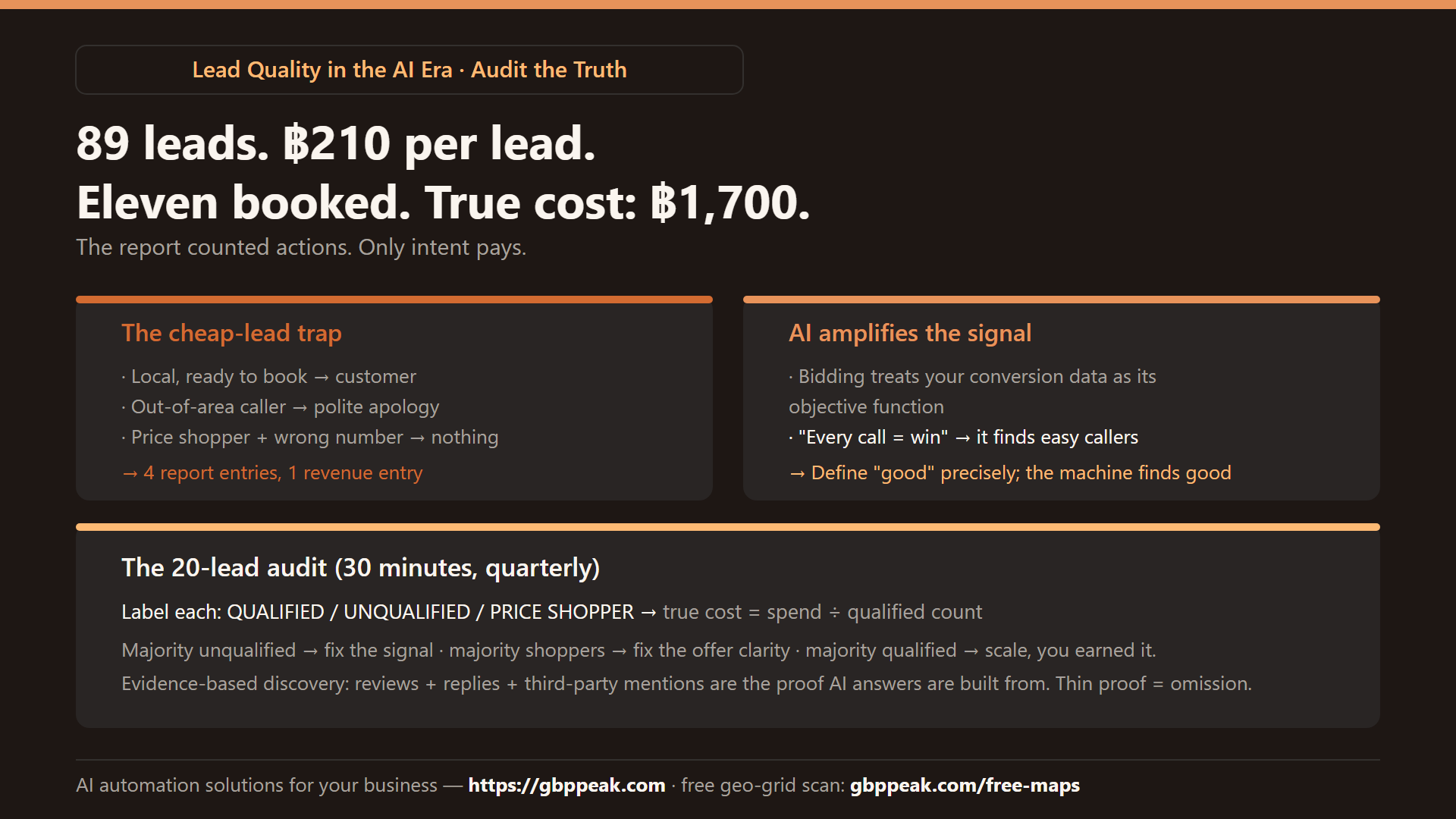
And in the AI era, that error compounds: the ad platform learns from whatever you call a win, then finds you more of it.
Lead quality problems usually come from teaching the ad platform the wrong definition of success. Most systems count actions (calls, form fills), not intent — so they can't distinguish a ready-to-book local customer from an out-of-area caller or price shopper, and "cheap leads" mask expensive emptiness. The fix: define a hierarchy of outcomes with only confirmed bookings or qualified in-area leads as the primary optimization target, audit your last 20 leads by hand to see what you're really buying, and build the reputation infrastructure (steady reviews, active replies, third-party mentions) that AI-driven discovery now uses as evidence. Clean signal in, qualified customers out. :::
The cheap-lead trap, mechanically
| Caller type | Dashboard says | Your business gets |
|---|---|---|
| Local, ready to book | Lead ✅ | A customer |
| Out-of-area caller | Lead ✅ | A polite apology |
| Price shopper | Lead ✅ | A quote they shop elsewhere |
| Wrong number / spam | Lead ✅ | Nothing |
Four entries in the report, one entry in revenue. The "cost per lead ฿210" headline divides spend by all four; your actual cost per customer divides by one. Most platforms count the action because intent is invisible to them — unless you make it visible through what you feed back.
The AI amplification: automated bidding treats your conversion data as its objective function. Tell it every call is a win, and it optimizes toward whoever calls easiest — which is precisely the out-of-area, wrong-number, and price-shopping population. You get progressively better at reaching people you'll never serve.
Signal quality: the fix before the bid
The highest-leverage marketing work now happens before anything spends:
conversion_hierarchy:
  primary:      # optimize ONLY on these
    - booking_confirmed
    - qualified_lead_in_service_area   # 60s+ call, right area
  secondary:    # measure for insight, never optimize
    - call_any_duration
    - form_submission
    - page_view_contact
  hygiene:
    - spam/robocall filtering on call tracking
    - area code / service-area exclusion rules
    - monthly test conversion per channel end-to-end
This is the same signal-quality discipline applied to its root: define "good" precisely, then let the machine find good, rather than letting it define good for you.
The 20-lead audit: know what you're buying
Before changing any targeting or budget, run the human audit the platforms can't:
THE 20-LEAD AUDIT (30 minutes, quarterly):
  pull: last 20 leads from your highest-spend campaign
  label each:
    QUALIFIED     → local, high interest, booked or bookable
    UNQUALIFIED   → out of area, wrong number, spam
    PRICE SHOPPER → bargain-hunting against your positioning
  compute: true cost per QUALIFIED lead = spend ÷ qualified count
  decision rules:
    majority unqualified  → fix the signal (conversion hierarchy)
    majority price shopper→ fix the offer clarity ([who it's not for](https://gbppeak.com/blog/offer-clarity-lead-quality))
    majority qualified    → scale budget; you've earned it
That true-cost number — spend divided by qualified count — is the only per-lead figure that should ever influence a budget decision. The dashboard's version is marketing's weight with the scale zeroed out.
The two AI shifts behind all this
Ads inside the AI answer
Google is testing ads directly inside AI Mode's conversational results — for categories like healthcare, your visibility will sit inside the AI's response. Same rule as every automated surface: the machine represents whatever your data supports. Clean signals and complete profiles become the placement criteria, not just the ranking ones.
Evidence-based discovery
AI-built "lists" and recommendations are assembled from web-wide evidence — reviews, social mentions, third-party "best of" articles, photos — not from your claims. Your digital footprint is proof, and thin proof means omission:
- Review stream — steady quantity beats old volume; recent activity signals a living business
- Active replies — the engagement trail models read as reliability
- Third-party mentions — the citations that make synthesized answers richer than your own adjectives (the entity layer)
The quarterly quality ritual
- Audit — 20-lead labeling + true cost per qualified lead
- Refine — conversion hierarchy enforced; spam filters current
- Reputation — review velocity checked; every review answered; one genuine third-party mention pursued
- Verify plumbing — one test conversion per channel, end-to-end
- Then scale — budget moves only on the true-cost number
And keep the demand-side baseline honest too: a free geo-grid scan at https://gbppeak.com/free-maps plots where your Google Maps ranking actually carries you — qualified demand starts with being findable in the right places.
Frequently Asked Questions
Why do my ad reports look great while real customers stay flat?
Because the platform optimizes toward whatever conversion you've defined — and a "lead" defined as any call or click gets you maximum calls, including out-of-area, wrong-number, and price-shopping ones. Redefine the primary conversion as a confirmed booking and the same budget starts finding a different population.
How is AI search different from traditional search for lead quality?
Traditional search matched keywords on your pages; AI search verifies evidence — reviews, location data, third-party mentions — to decide whether you're a good answer to a specific question. Quality signals (specific content, active reputation, consistent data) now drive both visibility and the caliber of people who find you.
Does my website need more content to appear in AI answers?
Depth beats volume. Models prefer fewer pages that specifically answer real customer questions — services, local expertise, proof — over many thin ones. Every generic page is content the AI summarizes into sameness; every specific page is something quotable.
What's the fastest way to test if my leads are actually good?
The 20-lead audit: pull the last 20 leads from your top campaign, label each qualified / unqualified / price-shopper by hand, and compute spend divided by qualified count. If the majority are unqualified, your tracking — not your creative — is the campaign's real problem.
Final note
We've moved from the quantity era to the quality era, and the machines have moved with us: they no longer reward whoever shouts most, they reward whoever feeds them the truest definition of a good customer. Clean your signal. Audit your leads by hand. Keep the evidence current. The spreadsheet line that matters was never "leads" — it was always "booked."