The Address Updated. The Pin Never Moved: AI-Era Trust for Local Search
Six months ranking in the wrong neighborhood — the dashboard said "updated." Hidden map anchors, Yelp as AI training data, and the quarterly trust audit.
A Bangkok HVAC company moved offices last year — a real move, 4 kilometers east. They updated the address in their Google Business Profile dashboard the same afternoon and thought nothing more of it. Six months later they discovered the problem: the map pin never really moved. Google had "anchored" them near the old location, so they were still surfacing for searches near the old neighborhood — and invisible in the new one, where their actual customers were searching.
Their rankings hadn't dropped. They had just stayed in the wrong place. And nobody told them, because the dashboard said "updated."
That's the hidden half of local trust: what the form says and what the map believes are two different systems — and there are several such hidden gaps now that AI reads your reputation from everywhere. 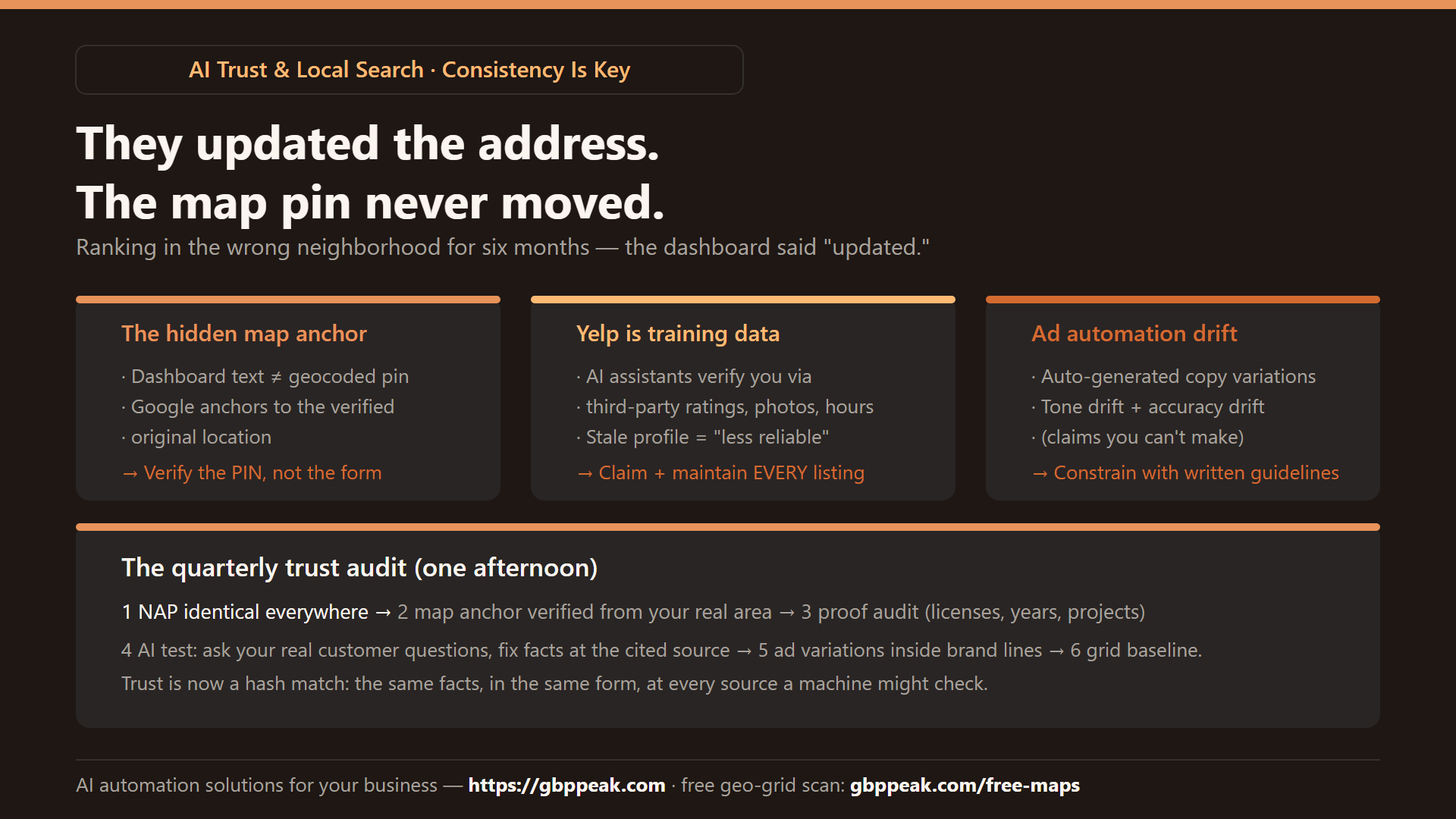
This guide covers the ones that quietly cost you customers.
Local trust in the AI era rests on one consistent source of truth — identical name, address, phone, services, and review story across Google, Yelp, directories, and your site. The hidden traps: your GBP dashboard address and the map's geocoded anchor can silently disagree after a move (verify the pin, not the form); AI assistants now pull Yelp and third-party data to verify recommendations, so stale third-party profiles make you "less reliable" to machines; and ad automation can generate copy that drifts from your brand or legal claims unless constrained by explicit guidelines. Audit the full entity footprint — specific services, proof of capability, consistent identity — and test what the AIs actually say about you. :::
The map anchor: why your address "update" didn't update
Most business owners assume the GBP address field controls where they appear. It doesn't, fully. Google separately maintains a geocoded anchor — the physical map position tied to where the business was originally verified. Update the dashboard without shifting the anchor, and you get the HVAC company's situation: correct info displayed, wrong neighborhood ranked.
| Symptom | What's actually happening |
|---|---|
| Rankings unchanged after a move | The anchor stayed at the old location |
| Not appearing near the new office | Search radius still centered on the old pin |
| Dashboard shows correct address | Display layer updated; map layer didn't |
| Weird ranking "border" in the city | You're ranking around a pin you left years ago |
The safe move protocol:
RELOCATION CHECKLIST (before touching the GBP):
  1. Update website + social + directories FIRST — build the
     consistent evidence trail pointing at the new address
  2. Then update the GBP address
  3. VERIFY THE PIN: search yourself from the new neighborhood,
     check where the map marker actually sits
  4. If the pin is wrong → use GBP "report a problem" /
     support to correct the geocode, not just the text
  5. Re-scan for 4 weeks: [grid scan](https://gbppeak.com/blog/daily-geo-grid-scans-bangkok)
     before vs after confirms the anchor actually moved
The same caution applies to switching to a service-area model (hiding the storefront): it changes how you surface, not just what's displayed.
Yelp is training data now
The second quiet shift: AI assistants answer "best plumber near me" using third-party data — Yelp ratings and photos, hours, categories, your review responses. A stale or thin Yelp profile doesn't just lose Yelp customers anymore; it makes you read as less reliable to the machine, which costs you every AI recommendation built on that source.
- Claim everything — every directory where you exist, even the ones nobody "uses"; the AI reads them regardless
- Hours and photos current — the machine cross-checks; contradictions = uncertainty = someone else gets named
- Review responses count as data — your replies teach the model your tone, your policies, your specificity
The audit question isn't "is my Yelp page nice?" It's "if a machine summarized my business from this page, would it be right?"
Your entity footprint: the proof layer
Consistency gets you verified; specificity gets you recommended. The information-gain bar from our signals guide applies to the whole footprint:
entity_footprint_audit:
  services: "specific — 'Emergency Pipe Repair', 'Water Heater
             Installation' — never just 'Home Repairs'"
  proof_of_capability:
    - certifications and licenses listed
    - years in business, stated
    - 2-3 named project examples with outcomes
  identity:
    business_name: "identical everywhere — no keyword stuffing"
    category: "same narrowest-truthful category on every platform"
  gap_test: "could a competitor copy this profile by swapping
             their name in? if yes → add proof they can't"
Ad automation drift: the quiet brand risk
Meta and Google now auto-generate ad copy variations — headline after headline from the same image and brief. Useful reach; two risks:
- Tone drift — generated text that doesn't sound like you (or sounds like a chain, not a local shop)
- Accuracy drift — claims your licenses don't cover, services you don't offer, areas you don't serve
The containment is boring and effective:
BRAND GUIDELINES BLOCK (paste into every ad platform):
  tone: "plain, local, no hype — we're the neighborhood shop"
  banned_words: ["cheapest", "guaranteed", "#1", "best in Bangkok"]
  never_claim: ["24/7 service", "licensed for commercial gas"]
  service_area: "Bangkok: Ari, Lad Prao, Rama 9 ONLY"
review_cadence: "check generated variations weekly for the
                 first month, monthly after"
Automation writes better ads when it's constrained by truth — the same rule the PMax engine follows.
The full local trust audit (one afternoon, quarterly)
- Coverage check — NAP identical across site, Google, Yelp, Facebook, top directories
- Map anchor verify — search yourself from your real service area; is the pin where your customers are?
- Proof audit — licenses, certifications, specific services visible on profile + site
- AI test — ask ChatGPT/Perplexity your real customer questions; wrong facts → fix at the cited source
- Ad variations review — generated copy still inside brand + legal lines
- Grid baseline — a free geo-grid scan at https://gbppeak.com/free-maps plots your actual Maps ranking across your service area, so anchor problems can never hide again
Frequently Asked Questions
Can changing my GBP address hurt my ranking?
Yes, if the map's geocoded anchor doesn't move with the dashboard text — you keep ranking around the old location while invisible near the new one. Update your site and directories first, then the profile, then verify the actual pin moved via local searches or a grid scan.
Does AI search really look at my Yelp page?
Yes — assistants draw on third-party platforms like Yelp to verify and answer local questions. A stale or incomplete profile reads as lower reliability to the model, which costs you recommendations beyond Yelp itself. Claim and maintain every listing the machines might read.
What is an "entity footprint"?
The total evidence trail of your business across the web: your specific services, proof of capability (licenses, years, projects), and identical identity (name, category) everywhere. AI verifies your business against this footprint before recommending you — gaps and generics make you unverifiable.
How do I stop ad automation from embarrassing my brand?
Constrain it with written guidelines inside the platform: tone, banned words, prohibited claims, exact service area. Then review the generated variations weekly at first. Automation amplifies inputs — including your rules.
Final note
Trust used to be a handshake; now it's also a hash match — the same facts, in the same form, at every source a machine might check. Verify the pin, not the form. Feed the third parties, not just Google. Constrain the automation with your truth. Do that quarterly, and both the algorithm and the neighborhood keep choosing you.