Bad Reviews, Entity Trust, and Ad Control: Managing Local Search Without Panic
A one-star at 9 p.m., two "guaranteed removal" agencies by Saturday — neither could. Review triage, the entity record under your profile, and keeping ad automation on a leash.
A one-star review hit a Bangkok dental clinic at 9 p.m. Friday. By Saturday the owner had called two "reputation management" agencies, both promising guaranteed removal for a fee. Neither delivered — because neither can. What actually saved the clinic's rating wasn't removal: it was a calm public reply Monday morning, a resolved patient by Tuesday, and the review quietly edited to three stars by Wednesday. The one-star did less damage than the panic almost did.
Local search management is three skills that look separate and aren't: handling bad reviews, understanding what Google actually verifies underneath your profile, and keeping ad automation from quietly spending your budget. 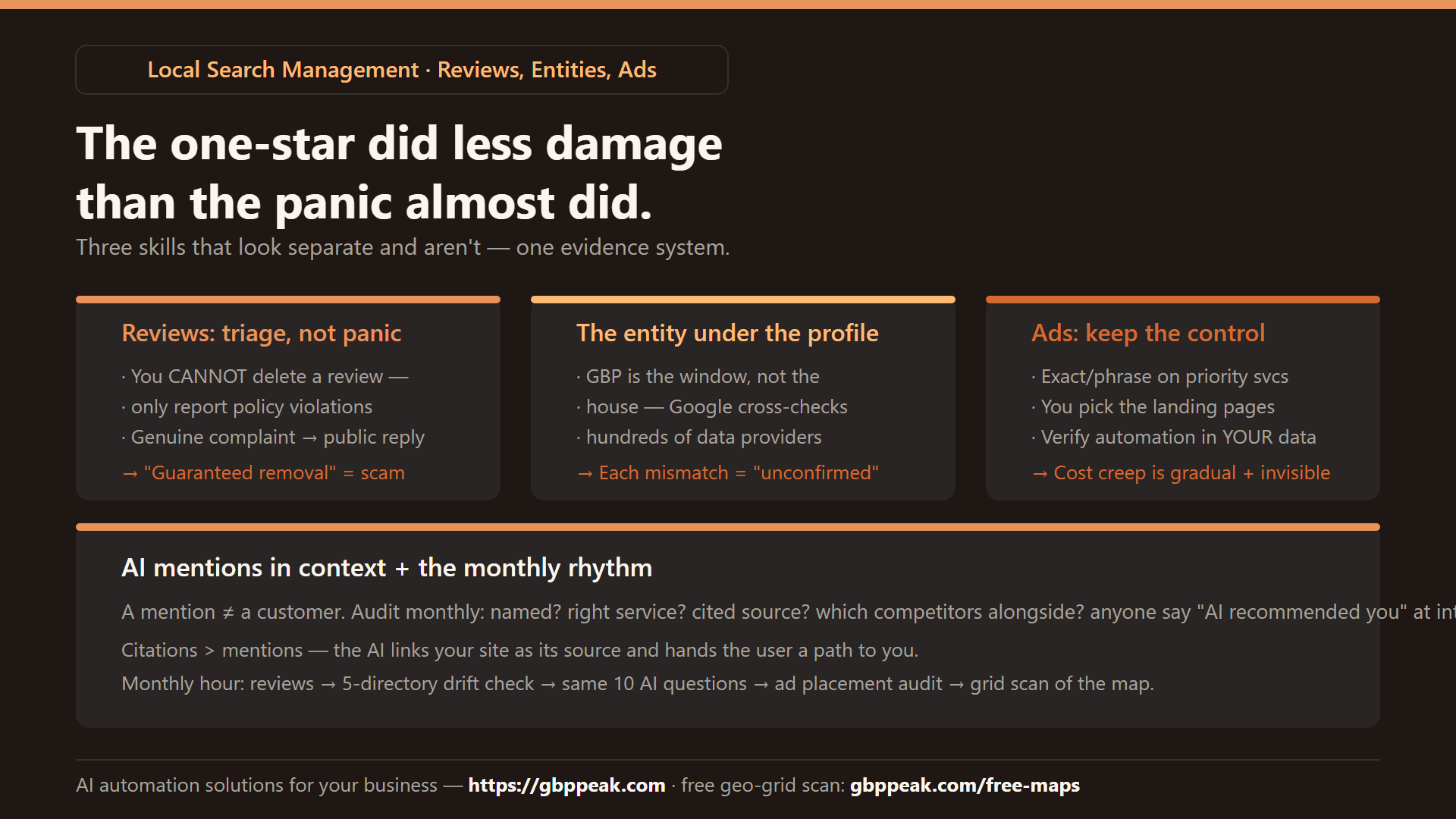
This guide covers all three, plus how to read AI-visibility numbers without fooling yourself.
Local search success rests on entity authority: consistent, verifiable information across every source Google and AI systems check. You cannot delete a Google review — you can only report policy violations (spam, fake content, harassment); for genuine complaints, a professional public response plus private resolution is the play, and "guaranteed removal" services are scams. Underneath your Business Profile, Google builds an entity record from hundreds of data providers, so inconsistencies anywhere erode its confidence in you. For ads, keep exact/phrase match control on priority services and verify automated features against your own reporting. Treat reviews, listings, and ads as one evidence system proving you're a trusted local entity. :::
Bad reviews: evidence, not panic
First, the mechanics nobody can sell you around: a business cannot delete a review. Removal happens only when Google's own policies are violated — spam, fake content, off-topic rants, harassment. Genuine complaints, however unfair they feel, stay. So the triage that works:
TRIAGE on new negative review:
  1. CLASSIFY:
     policy violation  → report via GBP "Report review" + screenshot evidence
     genuine customer  → public reply + private resolution path
     misunderstanding  → correct the facts calmly, once, publicly
  2. DOCUMENT: screenshot the review, date, internal records of the
     interaction (booking history, LINE thread) — before anything else
  3. RESPOND within 48h: brief, professional, specific; offer a private
     channel. Never argue details publicly.
  4. FOLLOW UP: resolved customers often upgrade or edit the review —
     the only "removal" you can actually influence
Two truths about response dynamics: future customers read your reply, not just the attack — a calm, specific answer converts a one-star into evidence of good service. And the review you resolve privately is the one most likely to be revised. The agencies selling "guaranteed removal" are selling the one thing Google gives nobody.
| Review type | Your move | Timeframe |
|---|---|---|
| Policy violation (spam/fake) | Report with evidence | Same day |
| Genuine bad experience | Public reply + private fix | Within 48h |
| Misunderstanding of facts | One calm public correction | Within 48h |
| Competitor sabotage | Report + document pattern | Same day |
The knowledge graph under your profile
The second misconception: that your Google Business Profile is the thing. It's the window. Underneath, Google maintains an entity record of your business — assembled and cross-checked from hundreds of data providers: directories, your website, maps data, government listings, your reviews, even mentions across the web.
What it verifies: your location, phone numbers, service areas, brand relationships (this branch belongs to that company), and whether the web agrees with itself about you.
The failure mode is quiet: one directory listing your old address, your website saying "Sukhumvit 33" and the profile "Sukhumvit Soi 33" — each mismatch a small vote of "unconfirmed." Enough of them and Google's confidence in your data drops, and with it your visibility. Your GBP ranking fluctuating week to week is often this entity-layer noise, not a penalty.
The maintenance is unglamorous and once: a NAP consistency sweep — every listing, character-matched to the profile — plus a quarterly re-check of the top ten directories in your category.
AI visibility numbers in context
AI-visibility dashboards ("your brand was mentioned 14 times by AI assistants this month!") are seductive and misleading in isolation. A mention is not a customer. The metrics that matter need context:
AI MENTION AUDIT (monthly, same 10 questions):
  named?          → yes/no per assistant
  context right?  → named for the RIGHT service? (a mention as
                    "also nearby" ≠ a recommendation)
  source quality  → what is the AI citing? your site, or a thin
                    directory you never claimed?
  alongside whom? → which competitors share the answer
  → customers?    → intake answers: did anyone say "AI recommended"?
That last line closes the loop. A rising mention count with zero "the AI sent me" intake answers means the metric is vanity; the fix is usually content specificity (the GEO playbook), not more listings. A citation — where the AI links your site as its source — is worth more than a bare mention, because it hands the user a path to you.
Ads: automate the reach, never the control
Google keeps blending AI features into local ads. Some automation earns its keep; some quietly swaps your keywords, broadens your matches, and points budget at "alternative" landing pages you never chose. For precision businesses — clinics, law firms, home services — that drift is where margin dies.
The control checklist:
ad_control_policy:
  priority_services: "exact + phrase match campaigns only"
  match_types_banned: "broad match on high-CPC services"
  landing_pages: "you pick them; review what automation changed monthly"
  placement_report: "where are ads actually showing? weekly glance"
  new_ai_features: "try in a capped test budget; verify in YOUR
                    reporting before scaling — 'free advantage' is
                    a claim, not a fact"
One pattern recurs across every audit we've seen: the business that "suddenly" paid 30% more per lead almost always has an automated feature enabled months earlier, unmonitored, slowly broadening. Verify through your own data, monthly.
The monthly rhythm
Everything above compresses into one recurring hour:
- Reviews — reply to everything new; check reports status; note resolved-and-revised wins
- Entity — spot-check five top directories for drift
- AI audit — same ten questions, same assistants, log the answers
- Ads — placement + landing-page report; reverse unwanted automation
- Map reality — where does the pin actually carry you? A free geo-grid scan at https://gbppeak.com/free-maps plots your Google Maps ranking across your whole service area, point by point
Frequently Asked Questions
Can I pay to get a bad Google review removed?
No. No third party can force removal of a policy-compliant review — "guaranteed removal" services are scams. You can report genuine policy violations (spam, fake, harassment) yourself for free; for honest complaints, a professional public response plus private resolution is the effective path, and resolved customers often revise their review voluntarily.
What's the difference between an AI mention and a citation?
A mention is your brand name appearing in an AI's answer; a citation is the AI referencing your website as its source. Citations are more valuable — they give the user a direct path to you and signal the model trusts your content enough to build on it.
Why does my Business Profile ranking keep changing?
Google evaluates you as a geographic entity using hundreds of signals beyond your profile — directories, website data, web-wide consistency. Fluctuation often reflects entity-confidence noise (e.g., inconsistent listings) rather than penalties; a consistency sweep usually stabilizes it.
Should I let Google's automated ad features run my local campaigns?
Let automation expand reach only where you've capped the risk. Keep exact and phrase match on high-priority services, choose landing pages yourself, and verify every automated feature against your own reporting monthly — the cost creep is gradual and invisible until you audit it.
Final note
There are no quick fixes left in local search — there's evidence. Every review reply, every consistent listing, every verified ad setting is a brick in the same structure: proof that you are exactly who you claim to be, exactly where you claim to be. Humans reward that trust with bookings. Machines reward it with visibility. Build the evidence system once, maintain it monthly, and both keep paying.