
#1 on Google, Invisible to ChatGPT: Why AI Reads Passages, Not Pages
#1 on Google, invisible to every AI answer — the facts were buried mid-paragraph on line forty. Passage-style writing, the trust layer, and research-phase landing pages.
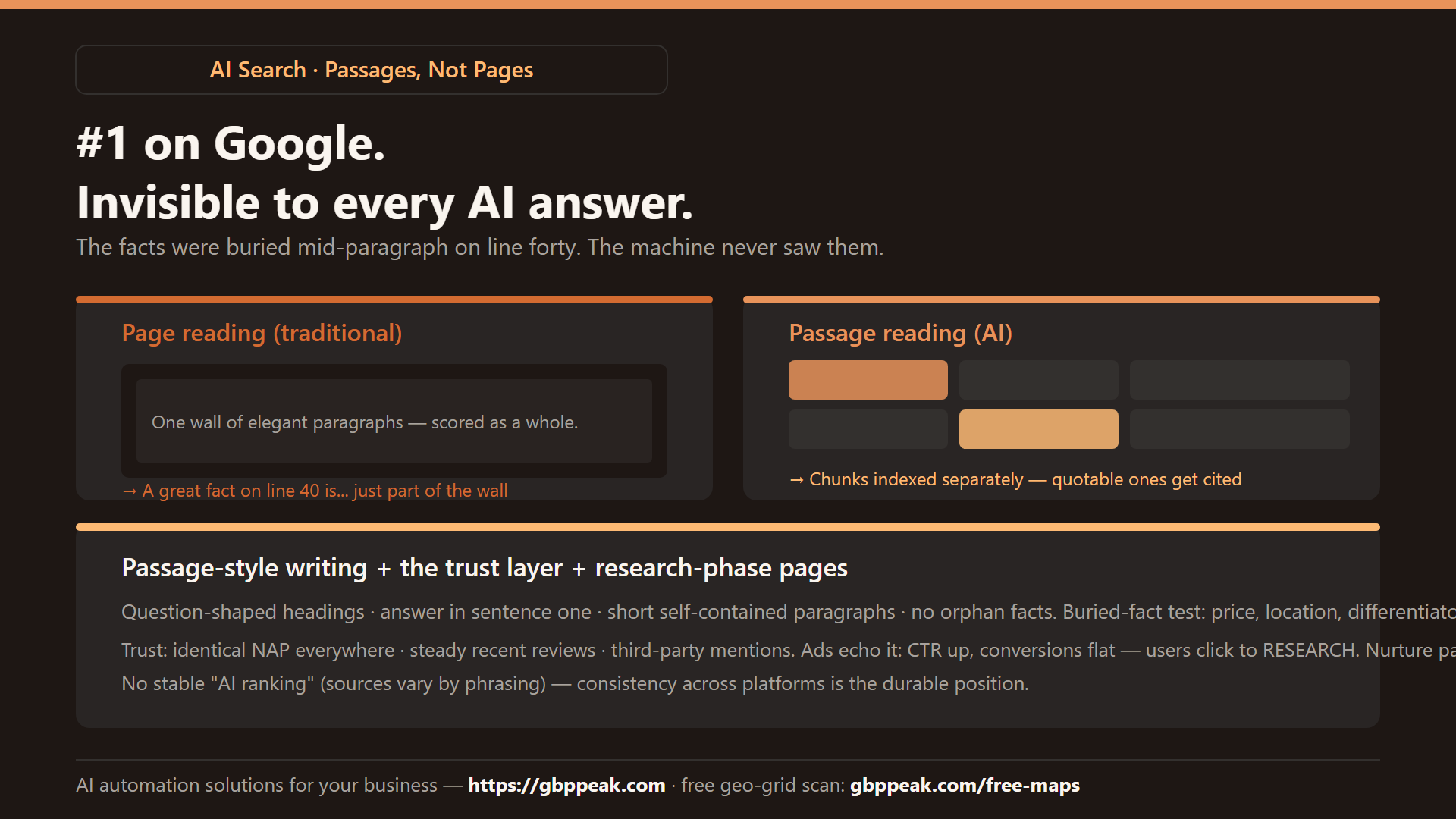
A Bangkok med spa ranked #1 on Google for "botox clinic Bangkok" — and never appeared in a single AI answer. The owner asked why, and the honest autopsy was uncomfortable: their page was a wall of elegant paragraphs. Beautiful, brand-building, and invisible to the machines. Because AI systems don't read pages — they read passages: small, standalone chunks your page gets broken into. The spa's key facts were buried mid-paragraph on line forty; the AI never saw them.
Ranking well and being quotable are two different skills now. This guide is about the second one.
AI search tools (ChatGPT, Perplexity, AI Overviews) don't read whole pages — they index passages: small standalone chunks your content is broken into. If your key facts are buried in long paragraphs, the AI may never see them regardless of your ranking. Optimize for extraction: clear question-shaped headings, the answer in the first sentence of each section, short self-contained paragraphs. Then build the trust layer the model cross-checks — identical NAP everywhere, steady recent reviews, third-party mentions. And note that ad click-throughs are rising while conversions stay flat: users are researching, so landing pages must nurture with information, not just a "Book Now" button. :::
Match the keyword → answer the question
The traditional engine matched strings: "med spa" in, pages containing "med spa" out. The AI model processes the entire question — "who is the best clinic for natural-looking Botox in my area?" — and looks for evidence of quality, location, and specific expertise. Vague content fails not because it ranks poorly but because the model cannot understand your value clearly enough to recommend it.
| Traditional search | AI search | |
|---|---|---|
| Unit of matching | The keyword | The whole question's intent |
| How it reads | The page | Passages — standalone chunks |
| Vague content | Ranks poorly | Skipped entirely |
| What wins | Relevance + links | Quotable facts + verified trust |
| Stable ranking? | Somewhat | Different sources per phrasing |
That last row matters: users phrase questions differently, and the model may pick different sources for each phrasing. "Ranking #1 in AI" isn't a stable position — which is why the goal shifts to being extractable and consistent everywhere, not winning one slot.
Writing for passage extraction
The passage mechanic changes how good content is shaped:
PASSAGE-STYLE WRITING RULES:
  1. Question-shaped headings
     "How much do dermal fillers cost?" not "Pricing Information"
  2. Answer-first sentences — the key fact lands in sentence one,
     context follows (inverted pyramid per paragraph)
  3. Short, self-contained paragraphs — each one a complete
     thought that survives being cut from the page
  4. No orphan facts — a price buried in paragraph four of a
     brand story is a fact the machine will never cite

THE BURIED-FACT TEST: for each service page, can a stranger
find your price, location, and differentiator in the first
sentence of some section? If not, your facts are buried.
This is why the med spa's #1 ranking didn't transfer: the facts existed but were structurally invisible. Same content, reshaped for extraction, becomes citable (the grounding bar again — clarity is the constant).
The trust layer: what the model cross-checks
Your site is one input. The model verifies against the web of information around you:
ai_trust_layer:
  nap: "name/address/phone identical on site, GBP, every
        directory — a mismatch is doubt about your location
        or legitimacy"
  reviews:
    velocity: "recent + steady — signals an active business"
    sentiment: "detailed, specific ([treatment-naming](https://gbppeak.com/blog/ai-overviews-reputation))
               reviews teach the model your specialties"
  third_party:
    - local news and community blog mentions
    - industry directories
    - "best of" lists
  effect: "each consistent mention is a verification the model
           can act on; thin coverage = unverifiable"
No single item is decisive — the model is looking for a pattern of consistency. Your job is to make the pattern boring: same facts, everywhere, all current.
The advertising echo: clicking to research
A quiet trend in the data: ad click-through rates are rising while conversion rates hold flat. Translation — users click ads to gather information during their research phase, not necessarily to book. The ad is doing education, not just capture.
For landing pages, this flips the design brief:
RESEARCH-PHASE LANDING PAGE:
  ✗ a headline, a stock photo, and a lone "Book Now" button
  ✓ enough information to build trust mid-research:
    - price ranges or clear quote path
    - credentials and experience, stated specifically
    - 3-5 real FAQ answers
    - proof: photos of actual work, review excerpts
    - the booking button — present but not the only content
  measure: research-page conversion, not just CTR
The click was never the goal — the informed decision was. Pages that feed the research phase convert it; pages that rush it leak it.
The 4-step extraction sprint
- Audit content — main service pages: generic, or detailing exactly what you do and why you're the expert? (the fluff test)
- Build the FAQ — top 10 questions you hear weekly, one clear paragraph each, on the site (mine them from calls and LINE)
- Refresh the GBP — hours, photos, services current; every recent review answered
- Reshape for passages — apply the writing rules above to your three most valuable pages
And check the map half monthly: a free geo-grid scan at https://gbppeak.com/free-maps shows where your Google Maps ranking carries you across the service area — the geographic foundation under the AI layer.
Frequently Asked Questions
Does traditional SEO still matter for AI search?
Yes — AI Overviews and assistants still lean on traditional signals (content quality, location data, authoritative links) to decide what's reliable enough to share. AI search sits on top of classic search infrastructure; keep the foundation, then add extraction-friendly structure.
What is "keyword fragmentation"?
The shift from short keyword searches to natural-language questions: "dental implants" becomes "how much do dental implants cost in Bangkok for seniors?" Each nuanced sub-question needs content that answers it — which is why FAQ sections covering real phrasings outperform keyword pages.
Why do AI results differ between users?
The model picks different sources depending on how each question is phrased, so there's no stable "AI ranking." The counter is consistency: the same verified information across many platforms, so whichever phrasing wins, your facts are the ones the model finds.
How is passage reading different from page ranking?
Page ranking scores the whole document; passage indexing breaks it into chunks and evaluates each independently. A perfect fact buried in paragraph four may never be seen — so answers must sit in first sentences under clear headings, in paragraphs that stand alone.
Final note
Keyword stuffing is dead; information clarity won. The businesses AI recommends are the ones whose facts are extractable, whose pattern across the web is consistent, and whose pages respect the research phase. Write in passages the machine can lift, verify everywhere it looks, and both the human and the algorithm will find you the obvious answer.