One Business, One Identity: Citations and NAP Consistency for Local SEO
Search engines cross-check your name, address, and phone everywhere. One conflicting listing dilutes trust more than ten matching ones build it.
A customer calls the phone number on a directory listing and reaches a different business. The address on a second site points to the old location, three years out of date. Neither error was the business's doing — both were scraped, mutated, and republished by data aggregators. But to the search engine cross-checking dozens of listings, the conclusion is simple: this business's identity is unreliable. And unreliable businesses do not get the map pack.
Citations — mentions of your name, address, and phone (NAP) anywhere on the web — are how a local business proves it exists as a single, consistent entity. Here is how they work, why consistency beats volume, and how to manage them without losing your mind.
Citations are mentions of your business's Name, Address, and Phone number (NAP) on directories, maps, apps, and social platforms. They matter because search engines cross-check them to verify that your business is real, physically located where claimed, and actively maintained — consistency directly influences local map rankings. Manage them with a master "source of truth" document, automated distribution to directories, and periodic cleanup of scraped or outdated listings, because one conflicting listing dilutes trust more than ten matching ones build it.
What a Citation Actually Is
Think of citations as digital footprints. Every directory listing, map entry, and mention that carries your NAP is a footprint — and search engines follow footprints to decide whether a business is a credible physical entity worth showing to someone searching "near me."
A citation does not need to link to your website (though links help, as covered in offsite SEO and domain authority). The data itself is the signal:
citation_anatomy:
  name:      "exactly as registered — no variants"
  address:   "the verified physical location, full format"
  phone:     "one primary number, everywhere"
  extras:    "hours, website, categories — same story everywhere"
  rule:      "identical on platform #1 and platform #100"
Why NAP consistency is the cornerstone
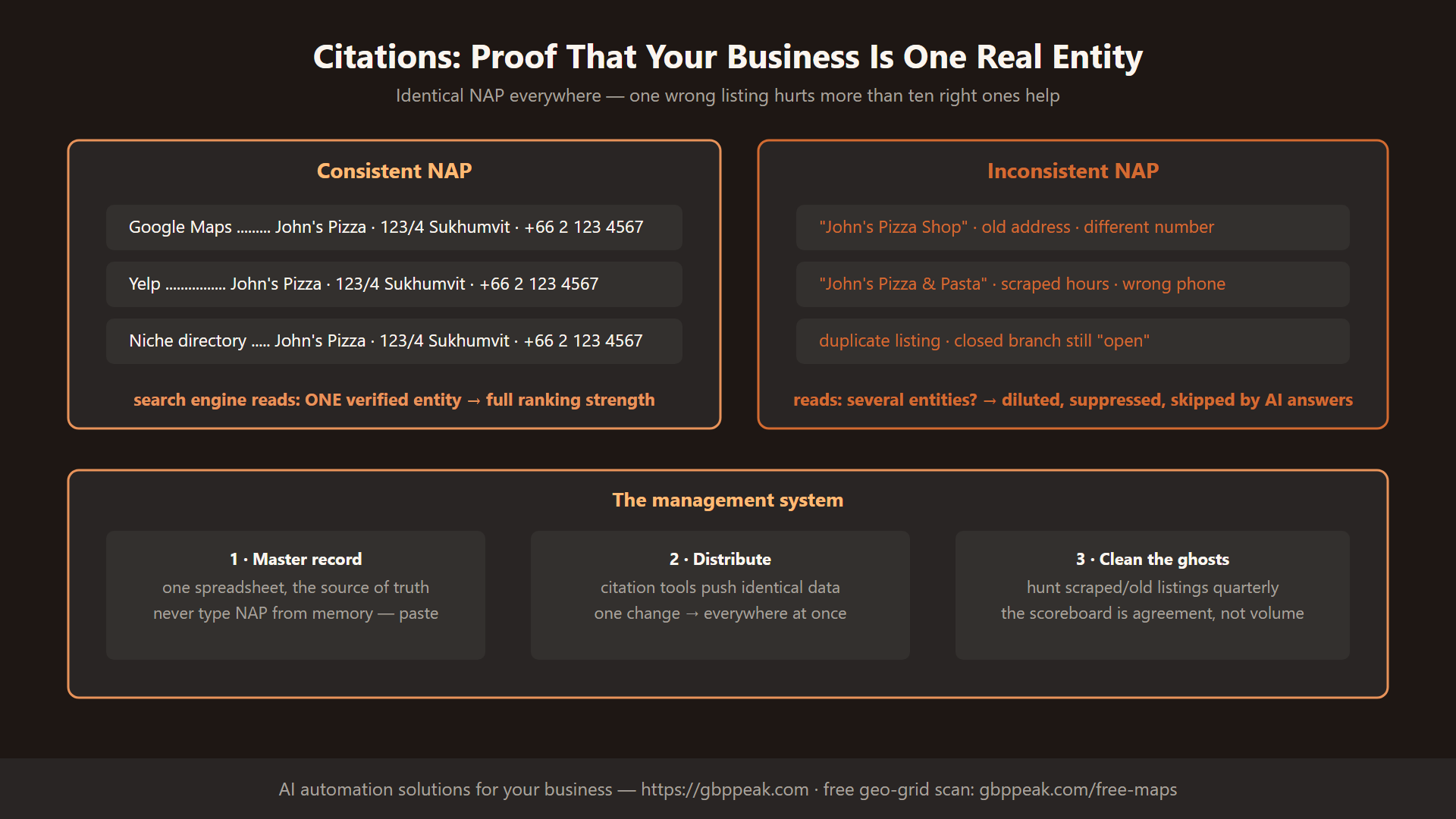
Picture the search engine as a librarian checking whether three books belong to the same author. "John's Pizza," "John's Pizza Shop," and "John's Pizza & Pasta" at two different phone numbers look like different businesses. When the librarian is unsure, the safe move is to shelve you lower — or not show you at all.
| Consistent NAP | Inconsistent NAP | |
|---|---|---|
| Search engine reads | One verified entity | Possibly several entities |
| Map pack result | Full ranking strength | Diluted or suppressed |
| Customer experience | Correct info everywhere | Calls to wrong numbers, trips to old addresses |
| Update propagation | One change, pushed everywhere | Each listing drifts independently |
| AI search engines | Confident brand facts | Contradictory data → skipped in answers |
That last row is increasingly important: when an AI answer engine recommends "a plumber near Sukhumvit," it needs confident facts — and contradictions are disqualifying, the same clarity principle from the accurate search engine guide.
Technical Authority vs Brand Authority
Traditional SEO weighed the technical side — backlinks, keywords. Modern search, especially AI-driven discovery, also weighs brand authority: is this brand talked about, verified, and consistently presented across the web?
Consistent citations are brand authority in its purest form. Each matching listing is one more witness confirming the same identity, hours, and location. Fifty directories agreeing that you exist where you say you exist is a form of proof that no single website — however beautiful — can provide alone.
Managing Citations Without Losing Your Mind
Hundreds of listings, dozens of platforms, eternal maintenance. The system that survives has three parts.
1. The master data document (source of truth)
Before touching any directory, write the canonical record once:
MASTER RECORD (one spreadsheet, owner-maintained)
  legal name ............ John's Pizza Co., Ltd.
  display name .......... John's Pizza
  address ............... 123/4 Sukhumvit Rd, Wattana, Bangkok 10110
  primary phone ......... +66 2 123 4567
  website ............... https://johnspizza.example
  hours / categories .... [exact strings to copy-paste]
rule: never type NAP from memory — always paste from this sheet
Every submission starts from this sheet, which eliminates "drift" — the slow mutation of details as each site gets a slightly different version typed by a slightly different person.
2. Automated distribution
Manual submission to a hundred directories is a full-time job. Citation tools push your master record to the major aggregators and directories at once, which means:
- New listings are populated quickly and identically.
- Missing fields on existing platforms get filled.
- A change — new phone number, new hours — propagates across the web in one update instead of a hundred logins.
citation_workflow:
  once:    "build master record → distribute via tool/aggregators"
  monthly: "review tool's mismatch report"
  on_change: "update master first → push everywhere → spot-check top 10"
  quarterly: "manual audit: search name+old phone to catch stragglers"
3. Cleaning dirty data
Not all citations are gifts. Directories scrape each other, so an old phone number or a previous address can replicate across sites you never signed up for. These ghosts actively hurt: they are contradictory signals about your identity.
Cleanup is unglamorous and necessary: search for your old numbers and addresses, claim or contact each listing, and correct it to match the master record. Deleting a wrong listing helps as much as adding a correct one — the scoreboard is agreement, not volume.
Where Citations Sit in the Local Stack
Citations are one layer of local visibility, not the whole thing:
local visibility stack:
  1. Google Business Profile ... the storefront itself (complete, posted, reviewed)
  2. On-site service pages ..... what you do + where (one page, one keyword)
  3. Citations / NAP ........... proof you are one real, verifiable entity
  4. Reviews ................... social proof with specifics
  5. Local links / media ....... the authority moat
Layer 3 is what makes layers 1, 2, and 5 verifiable — skip it and everything else stands on unconfirmed data. And to know whether the stack is working, measure rank across your actual service area: a free geo-grid scan at gbppeak.com/free-maps shows district-by-district visibility, so citation work gets judged by map movement, not by listing counts.
FAQs
What is NAP in local SEO?
NAP stands for Name, Address, and Phone number — the core identity data search engines use to verify a local business. When NAP is identical across your website, Google Business Profile, and directories, the business reads as one verified entity; when it varies, the signals conflict and rankings dilute.
Does every directory really matter?
The big platforms (Google, Yelp, the major aggregators) matter most, but consistency across smaller niche directories still builds the across-the-board agreement that search engines reward. The goal is not presence on every site — it is zero contradictions on the sites you are on.
What happens if my citations are inconsistent?
Ranking dilution. If search engines are not fully confident that several listings belong to the same business, they may rank it lower or exclude it from the map pack — and customers following bad data call wrong numbers or visit old addresses. Inconsistency is worse than absence.
How often should citations be reviewed?
Automated tools monitor continuously, but run a manual audit quarterly: search for your business name plus old phone numbers and addresses to catch scraped errors, confirm new listings match the master record, and correct or delete anything that contradicts it.
Consistency Is the Strategy
Citations are not glamorous link-building — they are identity maintenance, and identity maintenance is what earns local trust. Build the master record, distribute it cleanly, audit quarterly, and hunt down ghosts. Do that, and every other layer of your local presence — profile, pages, reviews, links — stands on data the whole web agrees on. Start by seeing where you stand: a free geo-grid scan at gbppeak.com/free-maps shows exactly which districts can find you today.