The Invisible Layer: Offsite SEO and Domain Authority for Local Search
Complete profiles tie; local endorsements win. How hyper-local backlinks from blogs, news, and associations build the authority moat behind map-pack rankings.
Two dental clinics open in the same Bangkok district the same year. Both claim their Google Business Profile, post photos weekly, and collect reviews at a healthy clip. A year later, one owns the map pack and the other is on page two. The difference is invisible from the profiles: the first clinic got featured in a neighborhood blog's "best clinics in Ari" list, joined the local business association, and was mentioned twice in community news. The second did none of that.
That invisible layer is offsite SEO — the endorsements your business collects from other websites — and for local search it is often the tiebreaker between businesses whose profiles look equally complete.
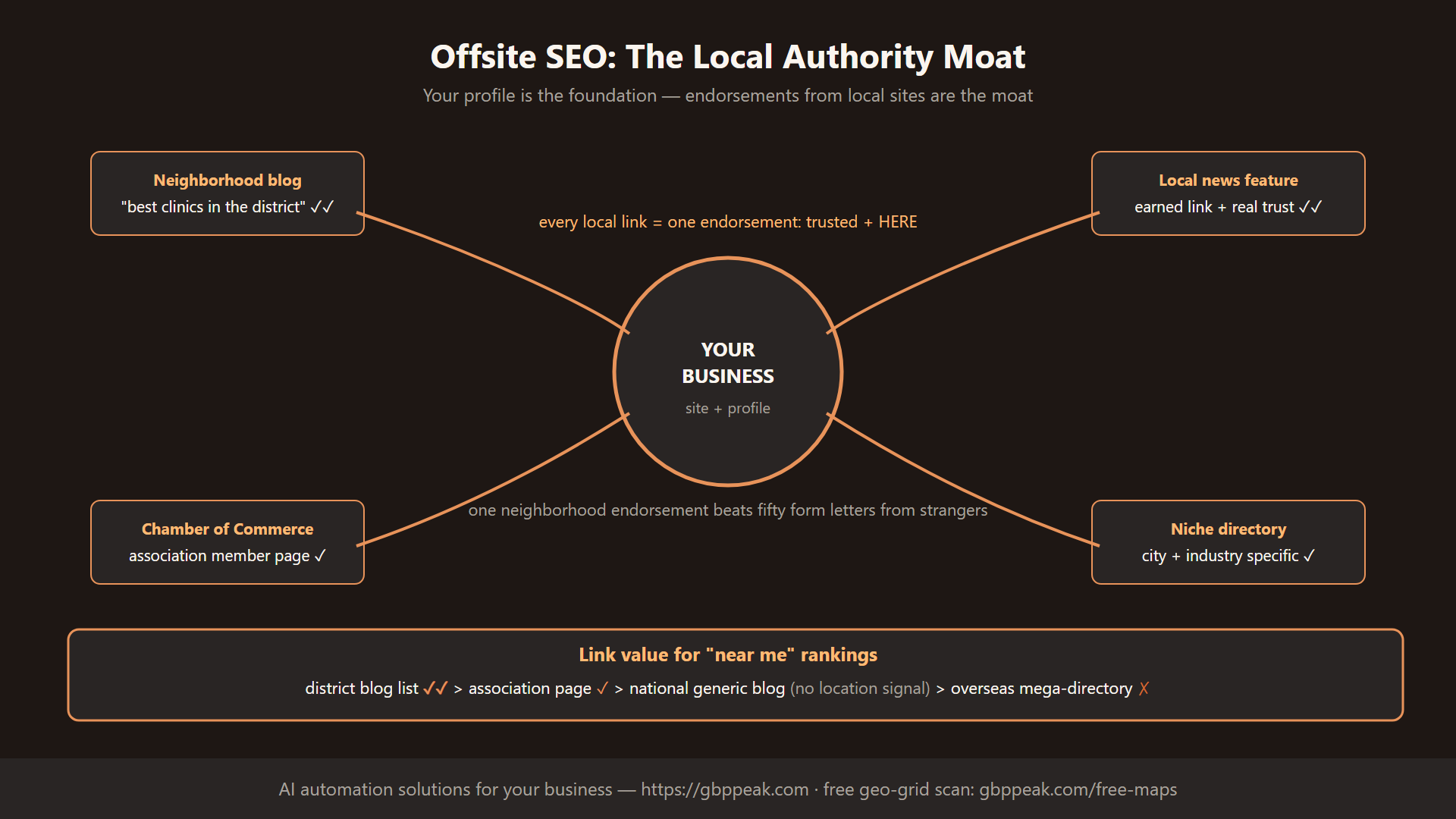
Offsite SEO builds the "digital trust" that lifts local rankings. When local websites — community blogs, neighborhood news, city directories, the Chamber of Commerce — link to or mention your business, search engines read each link as an endorsement that is geographically relevant to your area. A handful of hyper-local links usually beats dozens of generic global ones for "near me" rankings. Combine a complete Google Business Profile with steady, locally relevant link building, and authority compounds into map-pack dominance over months.
On-Site vs Off-Site: The Two Halves
On-site SEO is everything you control on your own pages: content, structure, speed, the service-page discipline we covered in building an inbound lead engine. Off-site SEO is what the rest of the web says about you — backlinks, mentions, citations.
| On-site SEO | Off-site SEO | |
|---|---|---|
| What it is | Your pages and profile | Other sites endorsing you |
| You control | All of it | Only the earning of it |
| Signal sent | "Here is what I do" | "Others vouch for me" |
| Speed | Weeks to show | Months to compound |
| Analogy | Your shop and its signage | Neighbors recommending you |
A search engine ranking a local business is essentially asking two questions: is this business what it claims? (on-site) and does anyone around here actually vouch for it? (off-site). Most businesses stop after question one — which is exactly why question two is the tiebreaker.
Domain Authority, in Plain Terms
Domain authority is an estimate of how much a search engine trusts a website, built from its history, its content, and — mostly — its backlink profile. It is not a number Google publishes or a direct ranking factor, but it tracks closely with reality: sites with deep, relevant link profiles rank; sites without them fight for scraps.
The part that matters for local business: when your authoritative website is linked to your Google Business Profile, that credibility flows into the local result. Strong website + strong profile reinforce each other; weak website caps even a good profile.
Think of backlinks as endorsements at a town meeting. One endorsement from the district's community leader counts for more than fifty form letters from strangers — which is the next point.
Local Relevance Beats General Popularity
The common misconception: any link from a "big" site is good. For local rankings, where the link comes from matters as much as how big the source is.
link value for "near me" rankings:

national fitness blog, generic article
  → authority: moderate   location signal: none

city business association member page
  → authority: moderate   location signal: strong ✓

"Best clinics in [district]" neighborhood blog list
  → authority: modest    location signal: exact ✓✓

random overseas directory, 10,000 listings
  → authority: negligible  location signal: none ✗
A hyper-local link tells the algorithm two things at once: trusted and here. That double signal is what moves map-pack rankings.
Where to Win Local Links
Read Your Competitors' Endorsements First
The businesses already topping your local results have public backlink profiles. Every local news site, directory, and blog that links to them has already been validated as relevant to your market by the ranking system itself — those are your highest-value targets, because getting listed there is proven to correlate with ranking.
# competitor link audit (any backlink tool works)
1. list the top 3 map-pack competitors per your core keyword
2. pull each one's referring domains
3. keep links that are local (city/district) or industry-specific
4. tag each: directory | news | blog | association | sponsor
5. your target list = sources linking to 2+ competitors
Choose Directories by Niche, Not Size
Directories still matter — as citations (name/address/phone mentions) and as links. But the value concentrates in specificity:
- High value: Chamber of Commerce, city business associations, industry-specific directories ("Bangkok veterinary clinics").
- Low value: massive global directories listing ten thousand businesses with no local structure.
One association page outperforms a hundred generic submissions — and keeps performing for years, the same compounding logic as AI search visibility: authority assets, once earned, keep paying.
Earn Local Media
A feature in neighborhood news or a community newsletter is the strongest local endorsement there is — an "earned" link plus real-world trust in one. The reliable routes: sponsoring a local event, offering expertise for a story ("how businesses should prepare for flood season"), and community involvement that is genuinely worth covering.
Link Building Is Community Building
The reframe that makes this sustainable: link building is not a technical chore, it is community engagement with a paper trail. Relationships with local bloggers, organizers, and business owners produce mentions naturally; a presence at local events produces coverage; targeted outreach to organizations your service genuinely helps produces links that stick.
local_authority_quarter:
  month_1: "competitor link audit → target list of 15"
  month_2: "join 1 association, submit to 5 niche directories"
  month_3: "1 local press angle pitched, 1 event sponsored/attended"
  ongoing: "1 genuine local relationship per month — links follow"
  measure: "map-pack rank by district (geo-grid), not raw link count"
Note the measurement line. The outcome that matters is rank movement across your service area — which a geo-grid scan shows directly (free at gbppeak.com/free-maps) — not the vanity number of total backlinks.
FAQs
What is the difference between on-site and off-site SEO?
On-site SEO covers everything on your own pages — content, keywords, structure, speed — and is fully under your control. Off-site SEO is authority built elsewhere: backlinks, mentions, and citations from other websites. On-site says what you are; off-site proves others vouch for you. Local rankings need both.
Are some backlinks better than others for local search?
Yes — relevance and geography decide. One link from a neighborhood blog, a city association, or local news usually moves "near me" rankings more than dozens of links from unrelated international sites, because it sends both a trust signal and a location signal at once.
How long does off-site SEO take to work?
Expect several months of consistent activity before meaningful rank movement. Authority compounds — each earned link strengthens the effect of the next — so early months feel quiet, then results accelerate. That compounding is also why off-site authority is a durable moat: competitors cannot copy it quickly.
Do I still need off-site SEO if my Google Business Profile is complete?
A complete profile gets you into the game; authority decides placement. When several businesses have similarly complete profiles — which is common in competitive niches — search engines break the tie with signals like website authority and local links. Off-site work is how you win that tiebreak.
Build the Moat
Your profile is the foundation; off-site authority is the moat around it. Foundations are copied in a weekend — moats take months and cannot be bought quickly, which is precisely what makes them defensible. Start this month with the competitor audit: the sources already endorsing your local winners are a proven target list, waiting. Then track whether the moat is working where it counts, with a free geo-grid scan at gbppeak.com/free-maps — rank by neighborhood, month over month.