Stop Chasing Leads: Build an Inbound Engine with Local Search
Replace cold outreach with an inbound engine: Google Business Profile, one page per keyword, and a small content loop that brings warm leads to you.
Cold outreach is a treadmill. You send fifty messages, book three calls, and the moment you stop sending, the leads stop coming. Meanwhile a plumbing company in your city gets a call every week from someone who typed "water leak repair near me" into Google and picked the first name they saw — no outreach, no chasing.
That is the difference between pushing and pulling. This post walks through how a small service business in a city like Bangkok (or anywhere) builds an inbound lead generation engine: local search first, a website structured around one keyword per page, and a small content loop that keeps the engine warm.
An inbound lead generation engine positions your business where customers are already searching for help. Instead of cold-calling strangers, you optimize your Google Business Profile for local map results, build one focused landing page per high-intent service keyword, and publish consistent answers to the questions your customers actually ask. The result: prospects arrive already knowing who you are, so sales conversations start warm instead of from zero.
Why Inbound Leads Are Different
The difference between outbound and inbound is intent.
With outbound, you interrupt someone who may not know they need you yet. With inbound, the customer has a problem right now, is actively searching, and is choosing between the few businesses they can find. These are high-intent leads — fewer of them, but each one is worth many cold contacts.
A useful analogy: outbound is knocking on doors in a random neighborhood. Inbound is setting up a shop on the street where people are already walking around asking "does anyone here fix this?"
| Cold outreach | Inbound engine | |
|---|---|---|
| Customer intent | Unknown, often none | Actively searching for a fix |
| Volume needed | High (50+ touches per deal) | Low (they contact you) |
| When leads stop | The moment you stop sending | Compounds as rankings grow |
| Sales conversation | Starts from skepticism | Starts from trust |
| Best proof it works | Reply rates | Your own visibility |
That last row matters more than people think. If you sell marketing services, ranking in local search yourself is the portfolio. A prospect who found you through Google has already received a demonstration.
Step 1: Win Local Search First
For a local service business, the fastest authority win is not the website — it is the Google Business Profile (GBP). It puts you into Maps results and the local "3-pack" exactly when someone nearby searches for your service.
Three things move the needle:
- Completeness: real service list, accurate hours, current photos. Thin profiles rank thin.
- Reviews with specifics: a review that says "fixed our restaurant's cold room same day" teaches Google (and AI search tools) what you are known for. "Great service!" teaches nothing.
- Consistent NAP: your Name, Address, and Phone identical on your site, your GBP, and every directory. Inconsistency makes both humans and algorithms doubt you.
If you serve multiple areas, check where you actually rank across the city, not just at your office pin. A geo-grid scan (we run them free at gbppeak.com/free-maps) shows rank by neighborhood — often you are strong near the office and invisible three kilometers away, which tells you exactly where to focus.
Step 2: One Page, One Keyword
The most common website mistake service businesses make is trying to rank one homepage for everything. Search engines reward specificity.
Pick one high-converting service term — for example "commercial aircon maintenance Bangkok" — and build a single page around it:
- Title tag: service + location, plainly stated.
- H1: the same promise in human words.
- URL:
yoursite.com/commercial-aircon-maintenance— clean, readable, no junk parameters. - First paragraph: what you do, for whom, and where. Answer before you elaborate.
<title>Commercial Aircon Maintenance Bangkok | Same-Week Service</title>
<h1>Commercial Aircon Maintenance in Bangkok</h1>
<p>We service and repair commercial air conditioning systems for
restaurants, offices, and retail in central Bangkok. Same-week
appointments, chemical cleaning, and annual contracts.</p>
That structure works for humans first — a visitor can confirm within five seconds that they are in the right place — and search engines read the same signals. It is the same clarity principle we covered in accurate search engine guide: the easier your page is to understand, the easier it is to recommend.
Step 3: Structure Beats Redesign
You do not need a new website. You need the pages you have to be legible.
A quick structure audit:
page_audit:
  homepage:
    title_tag: "states primary service + city"
    h1: "one only, matches title"
    above_fold: "what / who / where within 5 seconds"
  service_pages:
    one_keyword_each: true
    contact_visible: "top of page, not buried in footer"
  urls:
    readable: "no dates, no tag soup"
Most small-business sites fail two or three of these, and fixing them costs a weekend — not a redesign budget. This pairs with the conversion side covered in offer clarity and lead quality: traffic that lands on a page with a clear offer converts; traffic that lands on a vague page bounces no matter how well it ranks.
Step 4: Keep the Engine Warm with a Small Media Loop
Search brings people to your front door. A small content loop keeps them around until they are ready to buy — because most visitors are not ready on day one.
Keep it genuinely small:
- Answer real questions — take the top ten questions customers ask every week and write one clear answer each. These become FAQ content and, increasingly, the passages that AI search tools quote.
- A simple newsletter — one email a month with something useful. It converts one-time visitors into long-term leads who come back when the need becomes urgent.
- Social proof of work — short posts showing finished jobs. Not viral content; evidence.
{
  "weekly_loop": {
    "monday": "answer one customer question as a page or FAQ",
    "wednesday": "share one finished job with a photo and one sentence",
    "monthly": "send one newsletter with the best answer of the month"
  }
}
That is the whole ecosystem. Businesses get in trouble when the content system needs more maintenance than the service business itself — the simplicity trap we walked through in the power of simplicity in business growth.
The Engine, Assembled
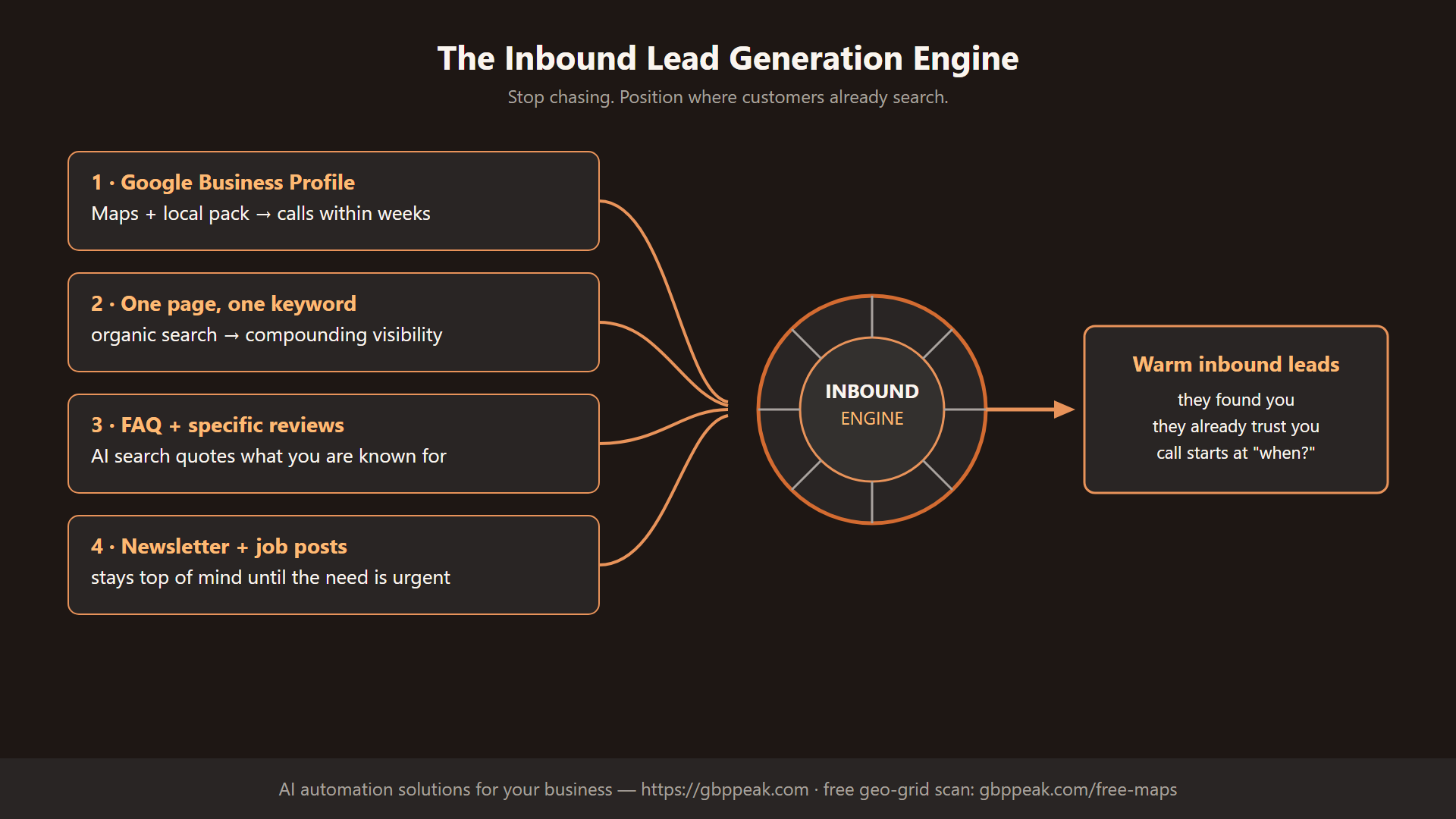
Here is the full system on one page:
Google Business Profile ──► Maps + local pack (immediate visibility)
        │
One page, one keyword ────► organic search (compounding visibility)
        │
FAQ + review specifics ───► AI search answers (emerging visibility)
        │
Newsletter + job posts ───► stays top of mind until the need is urgent
        ▼
Warm inbound leads calling you
Each layer feeds the next. Specific reviews teach search tools what you do, focused pages give them somewhere to send people, and the content loop catches the ones who are not ready today.
FAQs
What is the difference between outbound and inbound marketing?
Outbound pushes your message to a broad audience who may not be looking for you — cold calls, generic ads. Inbound creates content and local visibility so customers find you when they are actively searching for help. Outbound stops working the moment you stop; inbound compounds.
Why focus on high-intent keywords instead of broad terms?
Broad terms bring traffic; high-intent terms bring decisions. A page targeting "commercial aircon maintenance Bangkok" attracts fewer visitors than "aircon," but the visitors are comparing suppliers for a job they need done now — which is the only traffic that becomes signed contracts.
How does a Google Business Profile help sales?
It acts as automatic proof. When you rank well in Maps and carry specific, recent reviews, the customer has effectively pre-qualified you before the first phone call. The sales conversation starts at "how much and when," not "who are you."
How long before an inbound engine produces leads?
Local search moves fastest — a completed profile with steady reviews can produce calls within weeks. Organic pages typically take a few months to rank. The newsletter loop pays off on the delay between first visit and buying decision, which for most local services is longer than owners expect.
Where to Start This Week
Stop measuring outreach volume for a moment and check your visibility instead. Run a free geo-grid scan at gbppeak.com/free-maps to see where you rank across your city, pick the one service term worth owning, and build that single focused page. One profile, one page, one answered question per week — that is an engine, and unlike cold outreach, it keeps running while you sleep.