
Eight Months Building a Platform. The Consulting Paid From Month One.
Eight months building a platform nobody needed — eleven clients, and the consulting had been profitable from month one. The false-need test and the simplicity audit.
A Bangkok marketing consultant spent eight months and most of her savings building a "proper platform": a membership site, a community forum, a custom dashboard, an internal ticketing system. She had eleven paying clients. When a mentor asked why a business with eleven clients needed a ticketing system, the honest answer was: because a consultant she admired on LinkedIn had one. The platform folded within a year. The consulting — the part she'd neglected to build — had been profitable from month one.
Complexity feels like success because successful businesses look complex. But the causation runs backward: they became complex serving scale they'd already earned. 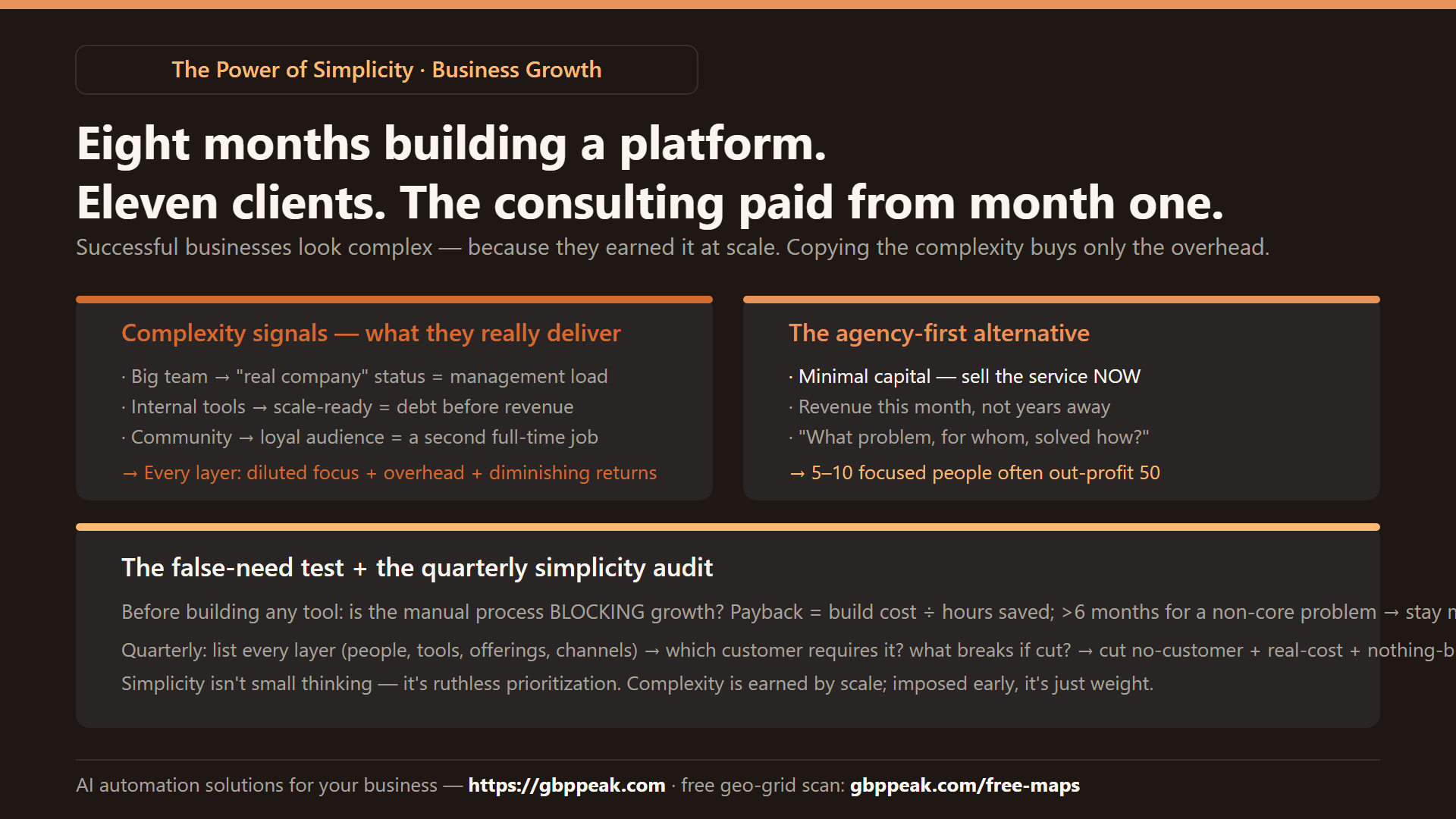
Copying the complexity without the scale just buys the overhead.
The core growth mistake is overcomplicating by imitation — building communities, internal systems, or extra business branches because successful peers have them, not because customers require them. Strip to what generates value: a specific problem, solved directly, for a specific person. Service-based ("agency-first") models usually beat platform dreams — lower capital, immediate revenue, and a lean team of 5–10 often out-profiting one of 50. Test every feature against "must-have vs nice-to-have": a manual process that works is often smarter than months building automation for a minor inconvenience. Define your actual goal — profit, freedom, lifestyle — and cut everything that doesn't serve it. :::
Why complexity is so tempting
The trap is emotional, not logical:
| Complexity signal | What it promises | What it delivers |
|---|---|---|
| Big team | "Real company" status | Management load, payroll weight |
| Internal tools/platforms | Scale-ready infrastructure | Technical debt before revenue |
| Community/forum | Loyal audience | A second full-time job |
| Extra business branches | Diversification | Diluted focus, split capital |
The pattern behind all four: comparison. Someone visible is doing it, so it must be the path. But you're seeing their infrastructure at their scale — not the decade of earned revenue that made it rational.
The three costs every unnecessary layer adds:
- Diluted focus — every new department steals hours from the thing that actually pays
- Increased overhead — more moving parts, more failure points, more management
- Diminishing returns — a minor inconvenience rarely justifies a high-tech solution (the automation bar: frequency × pain, not novelty)
The three classic pitfalls
1. Communities nobody asked for
Communities are valuable — and enormously expensive to maintain. If the goal is selling a course or a service, a community is not a requirement. Forcing one in because "creators need a community" produces a ghost town and an owner moderating it at midnight. An email list answers the same need at a fraction of the cost.
2. Vanity features
THE FALSE-NEED TEST (before building any internal tool):
  1. Is the manual process actively BLOCKING growth?
     (lost customers, hard caps — not just annoyance)
  2. How many hours/month does the problem actually cost?
  3. Build cost ÷ hours saved = payback period.
     Payback > 6 months for a non-core problem → stay manual.
  rule: a boring process that works beats a smart
        one that causes headaches
The consultant's ticketing system failed this test before day one: eleven clients email her directly, and that worked fine.
3. Expansion out of jealousy
A service business opens a call center, an internal ad team, a product line — because a competitor did. The honest filter: did a customer ask for this? If expansion isn't demanded by the people paying you, it's a bet placed to impress people who aren't.
The agency-first alternative
| Platform-first thinking | Agency-first thinking | |
|---|---|---|
| Upfront capital | Heavy (build it all first) | Minimal (sell the service now) |
| First revenue | Years away | This month |
| Core question | "What could this become?" | "What problem, for whom, solved how?" |
| Team math | Headcount as progress | 5–10 focused people often out-profit 50 |
| Failure mode | Burn capital pre-revenue | Out of energy before out of clients |
The goal isn't a global corporation — it's a business that works for your life. Travel, family, hobbies: a "boring" but efficient business is usually the fastest route there. The profit-per-client lens applies to the whole company, not just the ad account.
simplicity_audit (quarterly):
  list_every_layer: "team members, tools, offerings, channels"
  per_layer_ask:
    - "which customer requires this?"
    - "what does it cost in money + attention?"
    - "what would break if we cut it tomorrow?"
  cut_candidates: "no customer + real cost + nothing breaks"
  refocus: "hours freed → the one thing that pays"
What simplicity is not
Simplicity isn't laziness or small thinking — it's ruthless prioritization. Master one service, one market, one channel before adding the second. The masters of any craft (including the automation craft) got there by narrowing, not sprawling. Complexity is earned by scale; imposed early, it's just weight.
And when your one thing involves local customers, simplicity extends to visibility: know exactly where you stand with a free geo-grid scan at https://gbppeak.com/free-maps — one map, one decision, no dashboard sprawl.
Frequently Asked Questions
What's the biggest mistake new business owners make?
Overcomplication driven by comparison. Founders build complex infrastructures, large teams, and unnecessary features because visible successes have them — when those successes built that complexity only after earning the scale to justify it. The simpler path to the customer's problem is almost always faster.
Is a small team or a large team better?
Depends on the goal. Large teams enable complex organizations but demand heavy management and resources. A lean team of 5–10 focused people is frequently more profitable and far less stressful, letting owners stay close to strategy and the core service.
How do I know if a feature or tool is worth building?
Run the false-need test: is the manual process actually blocking growth (not merely annoying)? What's the realistic payback period of building versus the hours it saves? For non-core problems with payback beyond six months, staying manual is usually the smarter business decision.
Isn't building a platform more scalable than services?
Eventually, maybe — but services generate revenue and learning now, funding any platform later with real customer knowledge. Platform-first usually means burning capital on guesses; agency-first means selling solutions from month one and letting genuine scale problems tell you what to build.
Final note
The businesses that last aren't the most impressive on paper — they're the ones that found the simplest path to value and defended it. Define the goal — profit, freedom, a life you actually like — then strip every layer that doesn't serve it. Stop building someone else's dream. A boring business that works, in the hands of an owner with time, is the most underrated success there is.