
The Practical Side of AI: From Demo to Daily Tool Without the Hype
"Everything was a miracle story or a research paper. Nobody showed the work." The content-bucket map and the honest six-week sequence to a daily-use AI tool.
A Bangkok distribution company assigned "AI transformation" to its operations manager — with a budget, a deadline, and a LinkedIn feed full of posts claiming forty hours saved per week. Six weeks later he had a folder of abandoned demos and a skeptical boss. His summary was sharper than most consultant reports: "Everything I read was either a miracle story or a research paper. Nobody showed the actual work."
That's the information gap this entire blog exists to fill. 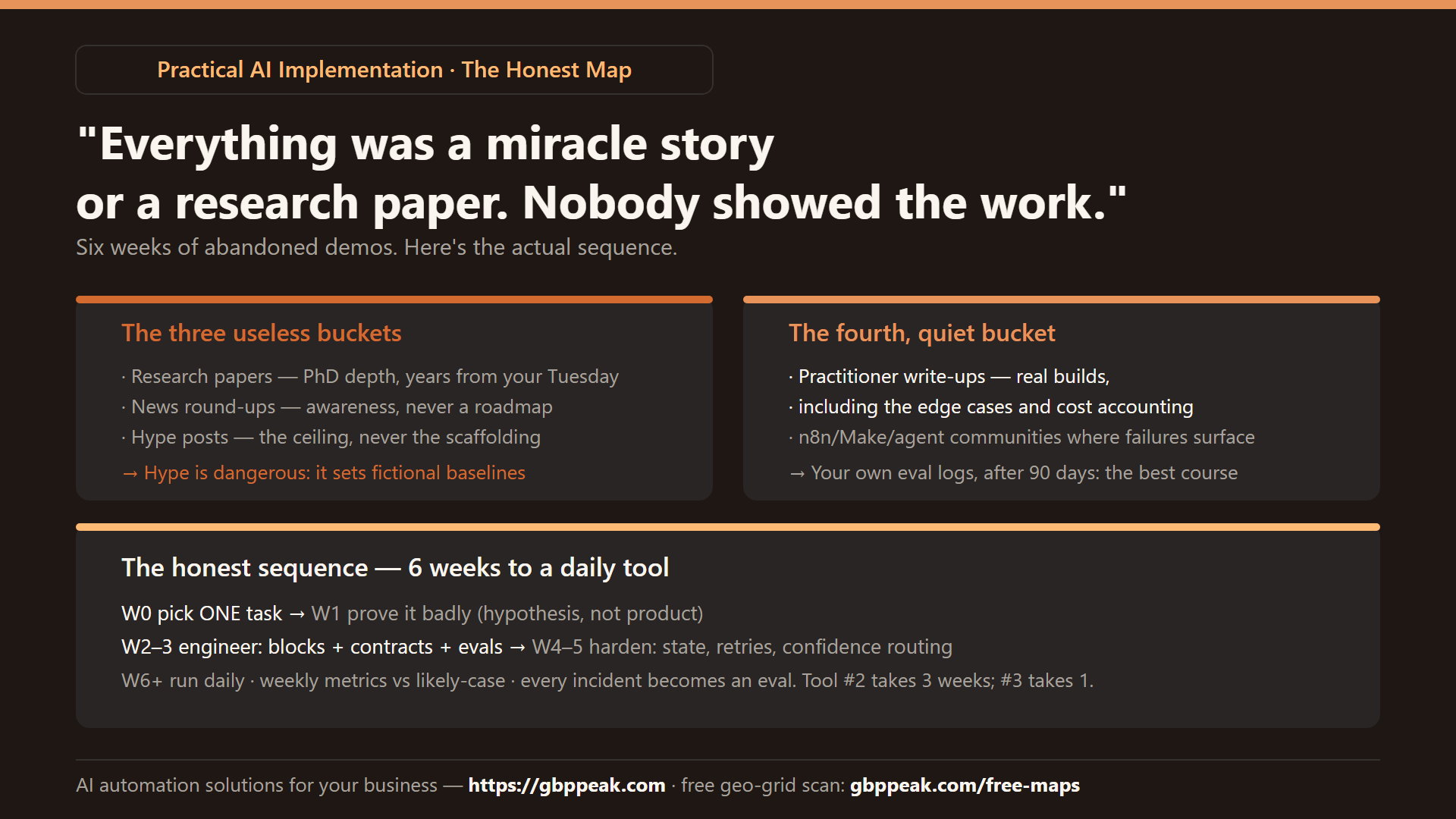
This post is the map: what practical AI implementation actually involves, why most content fails to help, and the honest sequence that takes a business from demo to daily tool.
Practical AI implementation means designing, testing, and scaling AI inside real workflows — work that happens between the hype posts and the research papers. The honest reality: a demo proves possibility under ideal conditions; an internal tool must survive messy data, deliver consistent output, and run without supervision. The proven sequence is unglamorous — pick one repetitive task, design the workflow around it, test against edge cases with an eval suite, add failure handling and state, then scale to more users. Learning from practitioners' documented builds beats news round-ups and miracle claims, which mainly create unrealistic expectations that erode credibility when demos meet reality. :::
Why most AI content can't help you
Almost everything published about AI falls into three buckets, and none of them contain what an implementer needs:
| Bucket | What it offers | Why it fails you |
|---|---|---|
| Research papers | Depth, novelty | PhD-oriented, years from your Tuesday |
| News round-ups | "X released model Y" | Awareness, not a roadmap |
| Hype posts | "We saved 4,000 hours!" | Shows the ceiling, hides the scaffolding |
The hype bucket is the dangerous one. It sets stakeholder expectations at "magic button," and every real implementation then "fails" by comparison. The operations manager above didn't fail technically — he failed against a fictional baseline nobody could have met.
The knowledge that actually helps lives in a fourth, quieter bucket: practitioner write-ups — people documenting real builds, including the boring parts: the edge cases, the failure handling, the cost accounting. This series is deliberately that bucket.
The demo-to-tool gap
A prototype works when a human is watching, with clean data, once. A production-grade internal tool works for a non-technical employee at 9 a.m. on a Monday with messy input, every day, without supervision. The distance between those two is where projects die — and it's crossed with plain engineering, not smarter models:
- Design — the workflow the AI inhabits: defined inputs, single-purpose steps, structured outputs
- Testing — eval scenarios covering the edge cases where the model is wrong, run on every change
- Resilience — stateful queues, graceful failures, retries that don't duplicate work
- Trust layer — hallucination defenses, confidence routing, human review on anything irreversible
- Scale — pacing, rate limits, and the boring observation that a tool five people use daily has different failure economics than a demo
None of that is AI research. It's the same discipline that made marketing automation platforms reliable a decade ago — LLMs are the next step in a long automation evolution, not a break from it.
The practical sequence (what "the work" actually is)
For a business starting from zero, the sequence that reliably produces a daily-use tool:
PHASE 0 — pick the target (week 0)
  one repetitive, file-shaped, high-frequency task
  ❌ "automate the whole sales process"  ✅ "draft reply to every quote request"

PHASE 1 — prove it badly (week 1)
  manual run-through with AI assistance; measure the time
  this is the demo — treat it as a hypothesis, not a product

PHASE 2 — engineer it (weeks 2–3)
  blocks with contracts · eval scenarios · failure states
  [two-layer pattern: intake + runbook](https://gbppeak.com/blog/two-layer-ai-automation-system)

PHASE 3 — harden it (weeks 4–5)
  stateful table · retries · confidence routing to a human
  [creator + critic roles](https://gbppeak.com/blog/multi-agent-ai-role-separation) on quality-critical output

PHASE 4 — run it (week 6+)
  daily use by real people · weekly metrics vs likely-case
  every incident becomes an eval · every eval prevents its repeat
Total elapsed time: about six weeks for the first tool. The second takes three; the third, one — the machinery is reusable, which is the compounding part nobody's hype post mentions.
The honest scorecard
Set expectations before you start, so reality can't ambush you later:
realistic_expectations:
  first_tool: "6 weeks to reliable daily use"
  time_saved: "30-60% on the targeted task — not 95%"
  failures: "will happen; the design goal is 'caught', not 'zero'"
  maintainer: "half a day per month once stable"
  credibilty_rule: "show stakeholders the failure queue,
                    not just the wins — trust survives surprises"
That last line is the quiet differentiator between AI programs that grow and ones that get cancelled: the ones that survive are run by people who showed the failure queue from day one, so the first production surprise confirmed their honesty instead of breaking their credibility.
Where to keep learning (and from whom)
The practical knowledge in this field is being written right now, by practitioners, in public:
- Build logs and post-mortems from people shipping internal tools (not product marketing)
- Workflow communities around n8n, Make, and agent frameworks — where the edge cases surface in real threads
- Your own eval logs — after ninety days, your failure queue is the best AI course ever written
And measure the outside world with the same honesty you apply internally. A free geo-grid scan at https://gbppeak.com/free-maps shows where your Google Maps ranking actually stands across your service area — reality, mapped, no hype.
Frequently Asked Questions
What's the difference between an AI demo and an internal AI tool?
A demo shows possibility under ideal conditions — clean data, a watching human, one run. An internal tool must handle messy input, produce consistent output daily, and fail safely without supervision. Crossing that gap is design, testing, and failure handling — ordinary engineering, not model upgrades.
What does "agentic" actually mean, practically?
A system given a goal rather than a single prompt — "research this lead and draft the email" — that performs several steps toward it. Practically: powerful for exploration, risky unsupervised; the production pattern is agents to prototype the path, deterministic blocks to run it.
Why does AI hype cause real damage?
It sets stakeholder expectations at miracle level, so every honest implementation "underperforms" a fictional baseline. Demo-then-fail in front of leadership burns credibility that a slower, evidence-based rollout would have kept.
How long does a first practical implementation take?
About six weeks end-to-end for a first tool: target selection, a manual proof, engineered blocks with evals, then hardening. The machinery is reusable — the second tool takes half the time, and the pattern keeps compounding.
Final note
The gap between "talking about AI" and "running on AI" is not intelligence — it's the unglamorous middle: design, tests, retries, and honest metrics. Skip the miracle posts, follow the practitioners, and build the first boring tool that simply works every day. Everything else compounds from there.