
Past the 80% Wall: Memory, Stability, and ROI for Reliable AI Agents
"Brilliant 80% of the time, random the rest — we can’t use that." Three disciplines that turn an AI demo into a production tool: memory, software-grade stability, scenario ROI.
A Bangkok law firm piloted an AI assistant for client intake. In the demo, flawless. In week three, it forgot which client it was talking about mid-conversation, invented a document requirement, and worked perfectly again on Thursday. The partners' verdict: "We can't use something that's brilliant 80% of the time and random the rest." The project was shelved — not because the model was bad, but because nobody engineered for memory, stability, and proof.
That 80% wall is where most business AI projects die. 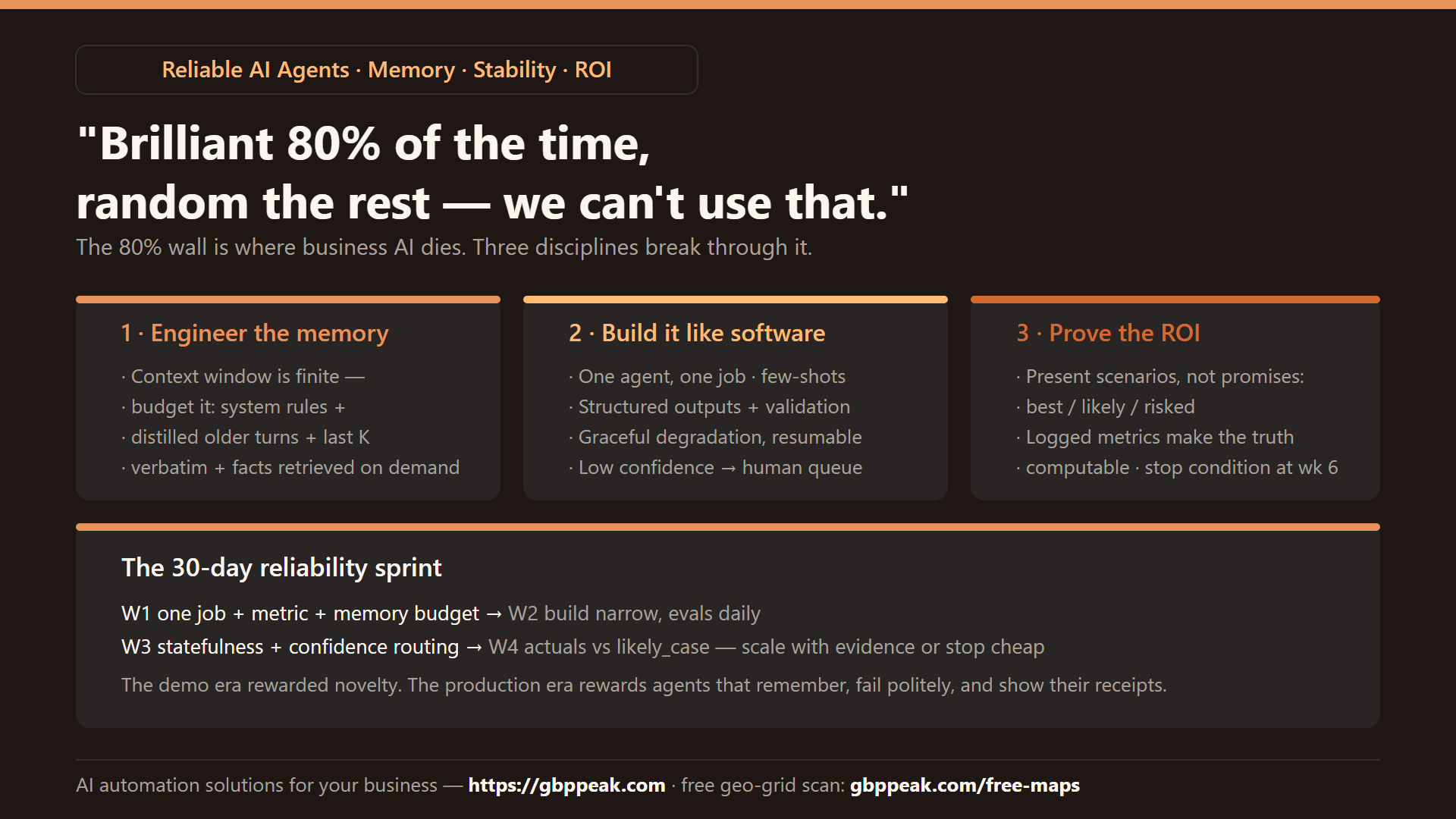
This guide is about the three things that break through it: managing what the agent remembers, building it like real software, and proving value before the skeptics vote.
Reliable AI agents need three disciplines. Memory: the context window is finite, so engineer what stays in it — recent messages, distilled summaries of older ones, and retrieved facts — rather than hoping everything fits. Stability: apply ordinary software principles — narrow scoped goals, graceful error handling, consistent outputs verified by checks — to push past the "80% success" threshold where users lose trust. ROI validation: present best / likely / risked scenarios instead of a single rosy projection, so stakeholders commit based on reality, not hype. Together these turn a demo into a tool the business can rely on daily. :::
The 80% wall
Raw LLM capability has never been the bottleneck — an off-the-shelf model handles most tasks impressively on a good day. The wall is everything around it:
| Failure | What the user sees | The engineering fix |
|---|---|---|
| Context loss | Forgets the client mid-thread | Managed memory (below) |
| Run-to-run variance | Different answer to same question | Narrow scope + few-shot examples + checks |
| Silent errors | Confident nonsense, no warning | Validation gates, confidence routing |
| Total collapse | One API hiccup kills the whole run | Graceful degradation, stateful retries |
| Unproven value | "Seems nice, what's it worth?" | Scenario-based ROI (below) |
Each row is ordinary engineering. The failure mode of AI projects is treating them as prompts rather than as software.
Discipline 1: engineer the memory
An LLM without context management is an encyclopedia with amnesia — brilliant, but it forgets your name between sentences. The context window (how much the model can hold at once) is finite, so "just include everything" quietly fails as conversations and data grow.
The practical memory stack for a business agent:
CONTEXT BUDGET (per call):
  ├─ system prompt + role rules          (fixed, always)
  ├─ distilled summary of older turns    (rebuilt every N messages)
  ├─ last K messages, verbatim           (recent flow)
  └─ retrieved facts only when relevant  (customer record, price sheet)

NOT in context: everything else. Retrieval pulls facts in on demand —
a full history dump is how agents start "hallucinating order."
Two rules of thumb:
- Summarize down, quote up — old conversation gets compressed to decisions and facts; the recent few turns stay verbatim
- Retrieve, don't stuff — the agent looks up the customer record when needed instead of carrying every customer in its head (the in-context vs RAG trade-off: small stable data goes in the prompt; big volatile data gets retrieved)
The payoff: the tenth conversation feels as coherent as the first, and costs stay flat instead of ballooning with history.
Discipline 2: build it like software
"Consistency" isn't a prompt adjective — it's a design outcome. The patterns that get an agent past 80%:
- Narrow the role — one agent, one job; the intake agent doesn't also draft contracts (the blobs-to-blocks rule)
- Few-shot examples — 3–5 samples of correct behavior, including one where the right answer is "I don't know"
- Structured outputs — JSON with a schema, validated before anything downstream runs (evals catch drift)
- Graceful degradation — the API times out → the row waits, the user sees "one moment," nothing is lost; stateful tables make the system resumable
- Confidence routing — low-confidence outputs go to a human queue, not straight to the client
None of this is AI-specific — it's the boring checklist that made regular software reliable for fifty years. AI just made skipping it possible to ship.
Discipline 3: prove the ROI before the vote
Most AI projects die in the budget meeting, killed by a projection nobody believed. The fix is presenting scenarios, not promises:
intake_assistant_roi:
  best_case:
    accuracy: 95%+   time_saved: 22 min/intake
    → 1.8 staff-months/year freed
  likely_case:
    accuracy: 85% w/ human review of flagged items (12%)
    time_saved: 14 min/intake
    → 1.1 staff-months/year + reviewer overhead
  risked_case:
    accuracy: 70%, Thai/English mix degrades structured fields
    → pilot stopped at week 6, sunk cost ≈ setup only
  measurement_plan:
    - log every intake: AI draft vs final (edit distance)
    - weekly: % routed to human, avg turnaround time
    - decision gate at week 6: likely_case ≥ plan → scale, else stop
Three things this format buys you:
- Credibility — the room trusts a presenter who names the failure mode
- A stop condition — "we stop at week 6 if X" prevents zombie projects
- Measured truth — the log fields make the actual result computable, ending the "is it helping?" debate with data
The projects that survive are rarely the flashiest — they're the ones whose owners could say, honestly, "here's what happens if it underperforms."
The 30-day reliability sprint
For a business ready to move past pilot:
- Week 1: define the ONE job + success metric; write the memory budget; draft the three scenarios
- Week 2: build narrow — role prompt, few-shots, structured output, validation; run the eval scenarios daily
- Week 3: add statefulness (retry, confidence routing, human queue); measure accuracy + time on real volume
- Week 4: compare actuals to likely_case; present, and either scale with evidence or stop cheap
And when the internal agent earns its keep, extend the same measured discipline outward — starting with where you stand on the map: a free geo-grid scan at https://gbppeak.com/free-maps reports your Google Maps ranking across your service area, structured data for whatever you decide to automate next.
Frequently Asked Questions
What is "context" for an AI agent?
Everything the model can see when generating a reply: the system prompt defining its role, the recent message history, and any external facts injected or retrieved. Good context engineering decides what stays in that finite window — recent detail stays verbatim, older history is summarized, facts are retrieved on demand.
Why do so many AI projects get canceled?
They stay experiments: technically impressive but unpredictable in daily use, and never tied to a measurable saving. Projects survive when they're engineered for consistency (narrow scope, validation, graceful failures) and measured against pre-agreed scenarios with a stop condition.
How do I keep an agent's responses consistent?
Narrow its job to one role, give 3–5 few-shot examples including a "don't know" case, require structured JSON output validated against a schema, and run a small eval suite on every prompt change. Consistency is a design outcome, not a personality trait of the model.
What if we can't measure ROI precisely at the start?
You don't need precision — you need scenarios and logs. Best/likely/risked projections set expectations, and simple logged metrics (turnaround time, % needing human help) make the true number computable within weeks. Uncertainty honestly framed beats a confident guess nobody believes.
Final note
The demo era rewarded novelty. The production era rewards agents that remember, fail politely, and can show their receipts. Memory, stability, proof — engineer those three, and 80% becomes a floor, not a ceiling.