
From Freelancer to Business Owner: Building the Team That Replaces You
Hire before you drown, hire competence over years, train once with SOPs and recordings, coach instead of rescue — and make yourself obsolete.
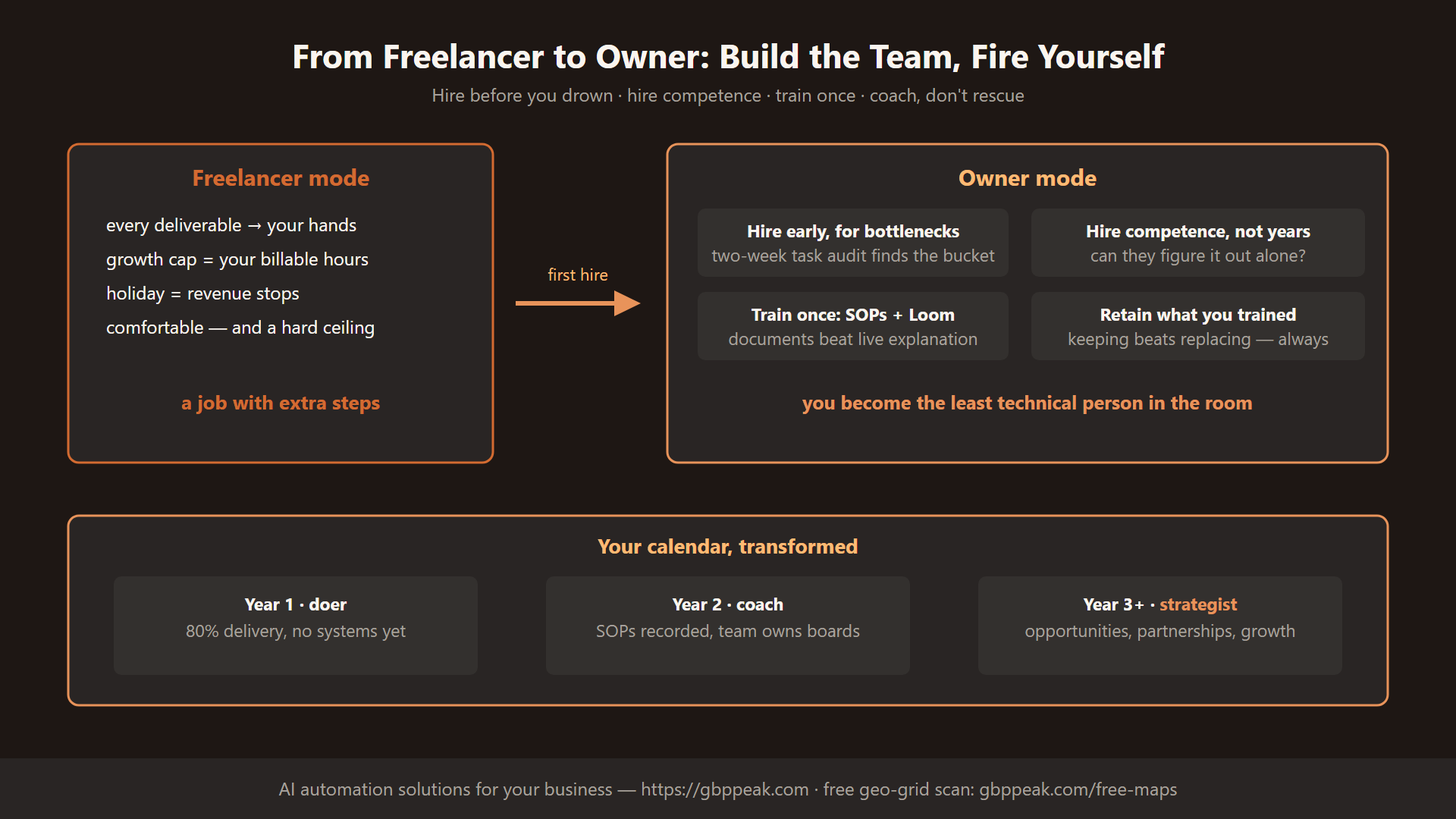
Ask a overwhelmed freelancer what stops them growing and the answer is usually "not enough hours." But the hours were never the problem. The problem is that every deliverable passes through one pair of hands — theirs. A business where all work must route through the owner is not a business yet; it is a job with extra steps.
The bridge between the two is a team plus the systems that let it run. This post walks through the transition: when to hire, what to actually hire for, how to train without living in meetings, and how to keep the people you trained.
Moving from freelancer to business owner means shifting from doing the work to building the system that does the work. Hire before you are drowning — for bottlenecks, not emergencies. Hire for competence and problem-solving ability over years of experience, train through documented SOPs and recorded walkthroughs instead of live explanation, coach rather than do, and invest in retention because keeping a trained teammate costs far less than replacing one. The end state: you become the least technical person in daily operations, free to focus on strategy, sales, and new opportunities.
Freelancer Mode vs Owner Mode
Freelancer mode feels safe because you control everything. It is also a hard ceiling: revenue is capped at your billable hours, and a two-week holiday shows up on the next invoice run.
| Freelancer mode | Owner mode | |
|---|---|---|
| Work flows through | You, always | The team, with you as escalations |
| Growth limit | Your hours | The system's capacity |
| Training cost | None (nobody to train) | High — but paid once per process |
| A bad month | You deliver less | The team still delivers |
| Your job | The work | Strategy, sales, coaching |
| Holiday | Revenue stops | Revenue continues |
The identity shift is the hard part. Doing the work is comfortable; building the machine that replaces you at each task is not. But that replacement, task by task, is literally what scalability means — the same principle we applied to the back office in the lean operations stack.
Hire Before You Drown
The most common hiring mistake is timing: waiting until you are overwhelmed, then hiring whoever is available, fast. Desperation hires get no onboarding because you have no time to give one — so they shadow you badly for a month and both of you conclude hiring "doesn't work."
The fix is to hire against bottlenecks while things are calm:
bottleneck_audit:
  track_two_weeks:
    - "every task I did"
    - "hours each took"
    - "could someone else do this after training? (y/n)"
  result:
    recurring_bucket: "report drafts, review monitoring, onboarding checklists"
    decision: "first hire owns the recurring bucket"
  rule: "hire when the pattern is visible — not when the panic is"
A first hire made from a calm audit arrives into a system. One made in panic arrives into chaos and inherits it.
What to Actually Hire For: Competence
Résumés sell years of experience. What actually predicts performance in a small team is competence — the ability to take an unclear problem, think it through, and get to a working answer.
Why competence wins in a small business:
- Your processes do not exist anywhere else; nobody has "five years of experience" in them. Everyone learns on arrival — the competent learn faster.
- Small teams constantly meet problems nobody anticipated. The person who can figure it out unblocks themselves; the person who waits for instructions blocks everyone.
- Competent hires compound. Each solved-unsupervised problem is one you never hear about.
Interview for it directly:
competence probes:
  "Walk me through something you fixed that nobody asked you to fix."
  "Here is a broken report and a client deadline — what do you do first?"
  "Tell me about a time you had no instructions. What did you do?"
listen_for: ownership, sequencing, asking good questions
not_listening_for: tool names, years, buzzwords
Train Once: SOPs and Recorded Walkthroughs
Your new job after the first hire is teacher, and the failure mode is teaching live, forever — explaining the same thing in chat or on calls until it is burned into your calendar.
Document instead. An SOP — standard operating procedure — is just the instructions for a task written or recorded once:
SOP anatomy (keep it boring):
  1. when to run this (trigger)
  2. where everything lives (links to drive folder / board)
  3. steps, in order, with screenshots or a 3-min Loom
  4. what "done" looks like (the finished example)
  5. what to do if something looks wrong (escalation)
The recording habit from the lean operations stack pays double here: every walkthrough you record while working becomes next month's training material. Ten SOPs cover most of a first hire's first quarter.
Then coach rather than do. When they hit a problem you could solve in five minutes, resist. Solving it teaches them to bring you problems; guiding them ("what have you tried, what would you check next?") teaches them to bring you solutions. Let tasks stretch slightly beyond their comfort — that gap is where growth happens, and it only works if you do not rescue them out of it.
Keep the People You Trained
A trained teammate is an asset with compounding value: they know your clients, your systems, and your standards. Every departure resets months of investment, so retention is a financial strategy, not a soft one.
- Performance incentives — a bonus tied to client results or delivery quality, however simple, signals that doing well matters here.
- Visible growth paths — people stay where the next role is imaginable. Name the next step for each person.
- Connection to the mission — explain why the work matters, not just what to do. A team that understands the customer keeps making good decisions when you are not in the room.
replacement math:
  cost to replace a trained hire = recruiting + onboarding +
    months of reduced output + lost client knowledge
  cost to retain = fair pay + recognition + growth path
  the second number is always smaller
The Endgame: Make Yourself Obsolete
A scalable business is one where the owner is the least technical person in daily operations. That sounds like losing control; it is actually the scoreboard. When your team handles their roles better than you could:
- Opportunities — you have the attention to spot the next service, niche, or market.
- Strategy — you work on the system, not in it.
- Partnerships — relationships are the one thing that compounds only with your face on it.
This is the same practitioner → operator → owner progression embedded in the agency-directory-media flywheel: the delivery layer is the foundation, but the model only becomes wealth when it no longer requires your hands.
FAQs
What is the main benefit of hiring a team?
Scalability. A team converts your business from a system capped by your personal hours into one that grows with the systems and people you build. Work continues without your daily input, and your attention is freed for sales, strategy, and the improvements only an owner can make.
Should I hire for experience or potential?
Favor competence and potential. In a small business, nobody has prior experience with your specific processes, so everyone learns on arrival — and capable learners get productive faster. Someone who solves problems independently beats someone with years of experience who needs direction for every exception.
How do I reduce the risk of a bad hire?
Hire for competence, verify it with problem-solving questions, then de-risk the ramp with documented SOPs and recorded walkthroughs. When expectations live in documents instead of memory, mismatches surface in week one rather than month three — and correction is a process fix, not a personality crisis.
When is the right time to make my first hire?
Before you are drowning. Track your tasks for two weeks, identify the recurring work someone else could own after training, and hire against that list while you still have the time to onboard properly. Calm hires get systems; panic hires get chaos.
From Job to System
The freelancer ceiling is real, but the door out of it is boring and buildable: hire early for bottlenecks, hire competence, train through documents and recordings, coach instead of rescue, and keep the people who grow. Every task you hand off permanently is a brick in a business that finally runs without you. And with the delivery side systemized, the growth side earns your full attention — start by seeing where you stand in your market with a free geo-grid scan at gbppeak.com/free-maps.