
The Agency, Directory, and Media Model: One Flywheel, Three Assets
Wire an agency, a niche directory, and media into one flywheel: cash flow funds the directory, the directory self-qualifies clients, media compounds it.
Most service businesses hit the same ceiling: the owner is the machine. Sell a project, deliver the project, invoice, repeat. Take a week off and revenue stops. The question that separates a self-employed operator from an owner is simple — can the business generate cash and attention when you are not in the room?
The Agency-Directory-Media (ADM) model answers it by building three components that feed each other: a service business for immediate cash flow, a directory asset for high-intent traffic, and a media arm for compounding authority. None of the three is exotic on its own. Wired together, they become a flywheel.
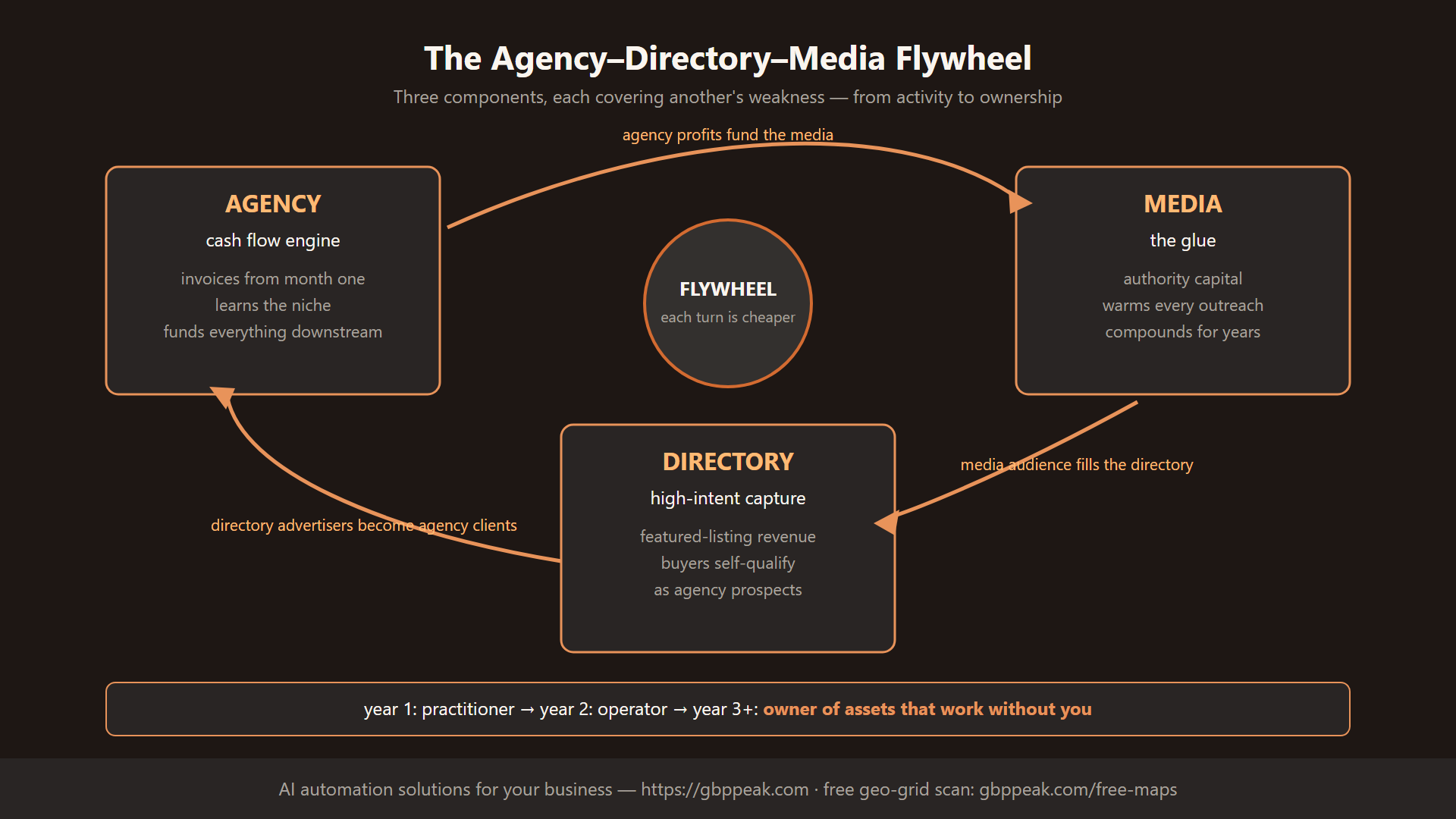
The Agency-Directory-Media model combines three complementary businesses: an agency generates immediate cash flow through client services, a directory captures high-intent local search traffic and monetizes through featured listings, and media (newsletters, videos, guides) builds authority and feeds both. Each part sells for the others — directory advertisers become agency clients, media audiences become directory users — so the owner gradually shifts from performing work to owning a portfolio of assets that produce revenue and attention independently.
Component 1: The Agency — Cash Flow Engine
An agency, in this framework, is any service business where you solve a specific problem for a specific client: local SEO services, accounting, consulting, even a cleaning operation. We covered why these service models are such durable foundations in five boring business models.
Its job in the ADM model is not scale. Its job is liquidity:
- Immediate revenue — services invoice from month one, no build phase.
- Market intelligence — every client engagement teaches you which problems are worth systematizing.
- Capital — the profit funds the directory and the media arm, which are slower to pay back.
| Agency | Directory | Media | |
|---|---|---|---|
| Time to revenue | Weeks | Months | Quarters |
| Margin profile | Medium, labor-bound | High, listing-based | High, compounding |
| Scalability | Linear with team | Near-linear, software-like | Exponential, content |
| Role in ADM | Cash flow + learning | Lead capture + ad revenue | Authority + inbound |
| Fails without | Nothing (it is the start) | Agency to serve overflow | Agency revenue to fund it |
The agency is the first domino. Everything downstream is funded by it.
Component 2: The Directory — High-Intent Capture
A directory is a curated list of businesses in one niche or city: clinics, workshops, suppliers. It works because of intent. Someone browsing "English-speaking vet clinics in Bangkok" is not scrolling for entertainment — they have a pet problem today.
Two revenue streams, one hidden:
directory_revenue:
  visible:
    featured_listings: "monthly fee for top placement"
    enhanced_profiles: "photos, hours, booking link"
  hidden_the_synergy:
    - "a business owner buying a listing has self-identified
       as someone who cares about being found"
    - "that is a pre-qualified agency prospect — they just
       told you their problem is visibility"
That second stream is the one people miss. A directory is not just an ads business; it is a lead-generation machine for your own agency. The owner who asks "how do I get more customers from this listing?" is asking the exact question your agency sells the answer to — the same serving-not-selling entry point we described in agency growth from content to sales.
Component 3: Media — The Glue
Media is the content layer: newsletter, YouTube channel, city guides, LinkedIn posts. In the flywheel it does three jobs:
- Authority capital — before a call, the prospect has already learned from you. Trust arrives pre-installed.
- Warm pipeline — outreach to a reader is not cold outreach; the reply rate is a different sport.
- Compounding reach — a good guide keeps ranking and referring for years, unlike an ad that stops the day you stop paying.
media flywheel:
  publish a specific, useful answer
    → ranks in search (and increasingly gets quoted by AI answers)
      → readers join the newsletter
        → newsletter readers become agency clients
          → client stories become new content → repeat
This is the same compounding logic as the inbound engine in building an inbound lead generation engine — media is that engine, pointed at your whole ecosystem instead of one service page.
The Flywheel, Assembled
Here is how the three components actually pass value to each other:
        ┌──────────────────────────────────────────┐
        │                                          │
        ▼                                          │
   [ MEDIA ]  ──builds trust──►  [ AGENCY ]  ──funds──┤
        │                          ▲               │
   attracts audience               │ serves        │
        │                          │ overflow      │
        ▼                          │               │
  [ DIRECTORY ] ──self-qualified──-┘               │
        │  prospects                               │
        └──listing revenue reinvested into media ───┘
- Media attracts an audience by teaching.
- Audience members with hard problems become agency clients.
- Directory traffic captures buyers further down the funnel — and its advertisers self-qualify as agency leads.
- Revenue from both flows back into more media and more directory coverage.
The owner's role changes each year. Year one: practitioner, delivering the agency work. Year two: operator, systematizing delivery and growing the directory. Year three onward: owner — a portfolio manager of assets that produce cash and attention whether or not you deliver anything yourself.
Starting Sequences
You can start from any component, but the integration is the point:
{
  "start_agency": {
    "pro": "cash from month one funds everything",
    "gap": "no scalable lead source — you are the machine",
    "next": "launch the directory in your best-performing niche"
  },
  "start_directory": {
    "pro": "high-intent traffic, low delivery obligation",
    "gap": "advertisers ask for help you cannot yet give",
    "next": "add agency services for the overflow demand"
  },
  "start_media": {
    "pro": "cheapest to begin, compounding forever",
    "gap": "no revenue for quarters — risk of content treadmill",
    "next": "convert the first real audience question into a paid service"
  }
}
Whichever you start with, the discipline is the same as the power of simplicity in business growth: add the next component only when the current one runs without daily rescue.
A Local-Search Concrete Example
The whole model compresses into one city and one niche. Bangkok, dental clinics:
- Agency: offer Google Business Profile optimization to three clinics. Cash flow, plus you learn exactly what moves a clinic's visibility.
- Directory: launch a small, verified directory of English-speaking dental clinics. Structure it cleanly — consistent NAP, real reviews, clear categories — so it earns trust from both humans and search engines, the way we describe in accurate search engine guide.
- Media: publish the guides patients actually need — prices, what a procedure involves, which district has what. Rank, collect the newsletter, refer to the directory and the agency.
Each layer makes the next cheaper. And if local visibility is where you want to start, see the actual landscape first with a free geo-grid scan at gbppeak.com/free-maps.
FAQs
What is the difference between an agency and a directory?
An agency delivers custom services directly to clients — depth, billed by project or retainer. A directory is a platform that helps users find businesses — breadth, monetized by listings and ads. In the ADM model the agency serves the high-value needs a directory surfaces but cannot itself fulfill.
Why include a media component at all?
Media builds authority capital: prospects arrive already educated and trusting, which lowers acquisition cost over time and makes every outreach warm. A single agency sale pays once; a useful guide keeps selling for years and increasingly gets cited by AI search tools when they recommend local businesses.
Can I start with just one component?
Yes, and most people start with the agency because it produces cash fastest. But each alone has a structural gap — an agency has no scalable lead source, a directory has no high-margin service behind it, media has no near-term revenue. The model's strength is the integration, so plan the second component from day one.
How do the three components feed each other?
Media audiences become agency clients; directory advertisers self-identify as businesses that need marketing help and become agency leads; agency profits fund more media and directory expansion; and agency client wins produce the case studies that make the media credible. Growth in any one lowers the cost of growth in the other two.
From Activity to Ownership
The ADM model is not three businesses stapled together — it is one system where each part covers another's weakness. Start with whichever component matches what you can sell today, let it fund the second, and let media make the whole thing easier to sell every quarter. The endpoint is the whole point: a portfolio that generates cash flow and attention without demanding your hours in exchange.