
Skill Is the Craft. Sales Is the Engine.
Why agencies plateau hiding behind content — and the warm-network, local-evidence selling rhythm that builds consistent cash flow instead.
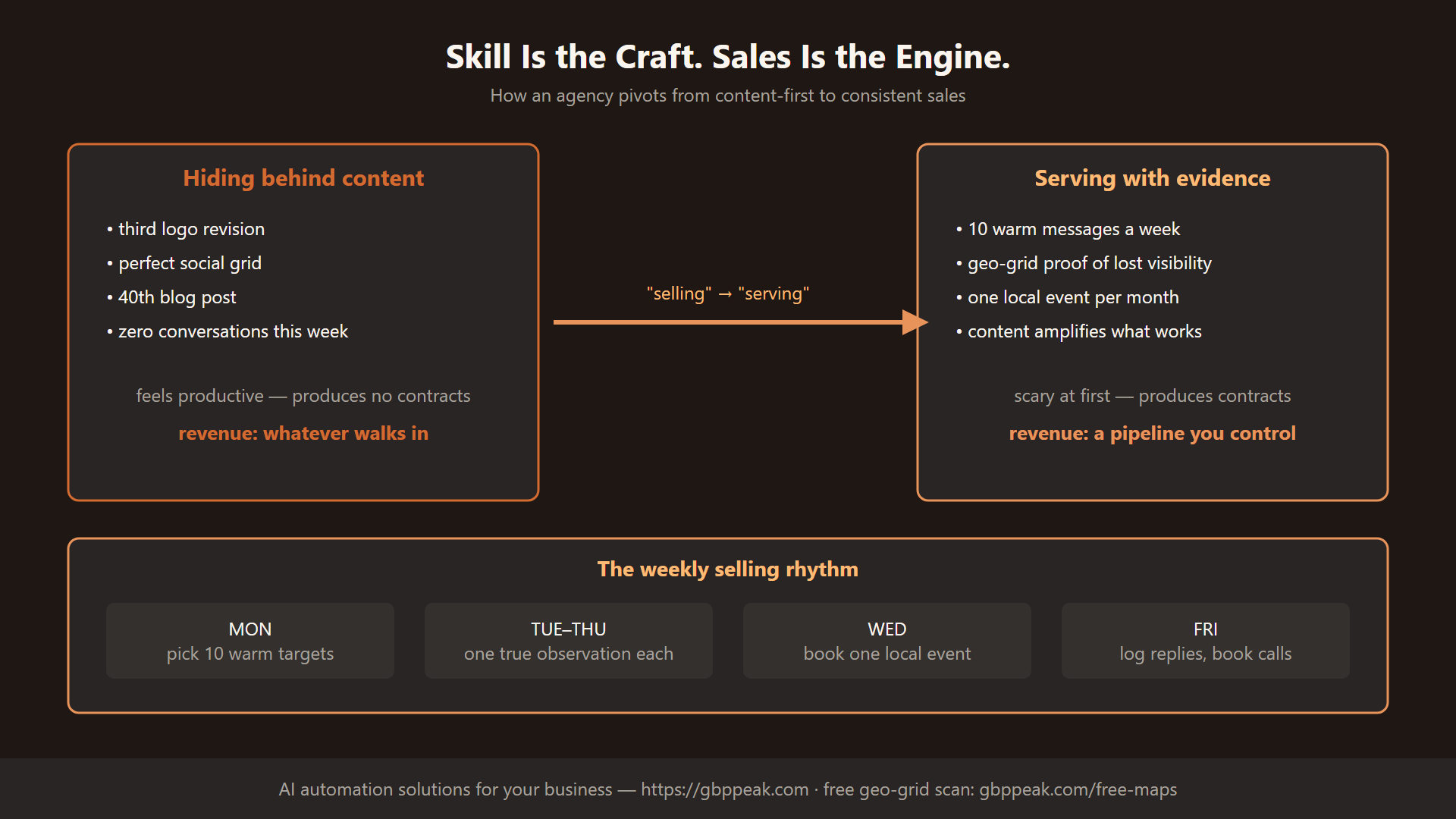
Here is a pattern that kills agencies quietly: a freelancer who is genuinely excellent at SEO, video, or design spends forty hours a month making content, polishing the logo, and posting consistently. The work is good. The portfolio is beautiful. And eighteen months in, revenue is still whatever walks in the door — because the owner never built the thing that actually pays: a sales process.
Skill is the craft. Sales is the engine. An agency with average craft and a working engine out-earns a brilliant craft with no engine every single time, because cash flow buys the time to perfect the craft. This post is about making that pivot.
Most agencies plateau not because the service is weak but because the owner hides behind content creation instead of selling. To build a sustainable agency, flip the priority: consistent sales activity first — warm outreach to your existing network, focused local targeting, and in-person networking — with content supporting it rather than replacing it. Reframing outreach as "serving" instead of "selling" lowers the fear of rejection, and steady revenue then funds the polish and content that make the business look professional.
Why Cash Flow Is the Foundation
Early-stage service businesses drown in vanity metrics: the third logo revision, the perfect Instagram grid, the fortieth blog post. All of it feels productive. None of it is a contract.
The distinction is simple:
- Content builds awareness. It is a long-term asset — genuinely valuable, and it is exactly how the inbound engine we described in building an inbound lead generation engine works.
- Sales builds revenue. Revenue pays the operations, hires the first staff, and buys you the time to do content properly later.
| Activity | Feels like | Actually produces | When to prioritize |
|---|---|---|---|
| Logo / brand polish | Progress | Nothing billable | After revenue |
| Social graphics | Visibility | Occasional awareness | A slice, not the job |
| Blog posts / videos | Authority | Compounding trust | 20% of week, ongoing |
| Direct outreach | Scary | Signed contracts | Now, first |
| Local networking | Slow | Warm relationships → deals | Now, weekly |
If the agency is struggling to grow, the most direct fix is almost never "better content." It is a more consistent sales process. Revenue first, then use it to fund the polish.
The Real Barrier: Fear of Rejection
Here is the uncomfortable truth about why agency owners over-produce content: writing a blog post is safer than calling a potential client. The content calendar becomes a place to hide from the phone.
The mindset fix is small but real. Stop framing outreach as selling and start framing it as serving. If you specialize in local search, you are not pushing a package — you are telling a business owner, with evidence, that customers in their area cannot find them and that the problem is fixable. A "no" to that is not a rejection of you; it is a business decision you offered for free.
A practical script for the warm call:
"Hi [name] — I've been helping [type of business] show up when
people nearby search for [service]. I looked at [their business]
and noticed [one specific, true observation].

Not pitching anything today — want me to send over what I found?"
One specific, true observation does the selling. It proves competence before any invoice exists — and it makes the conversation a service, not an interruption.
Strategy 1: Mine the Warm Network First
A warm lead is someone who already knows you or has a reason to trust you. It is the fastest, highest-converting channel an early agency owns, and most owners never touch it.
Your warm network is bigger than you think:
- Phone contacts and chat apps — suppliers, former colleagues, past clients.
- LinkedIn and industry groups — people who saw your work years ago.
- Other agencies — shops that don't offer your specialty refer work out constantly.
The ask is modest: "who do you know who runs a [type of business] and worries about where customers come from?" You are not closing anyone; you are starting conversations.
{
  "warm_outreach_week": {
    "monday": "list 30 contacts, note what each does",
    "tuesday_wednesday": "message 10 — genuine check-in + one question",
    "thursday": "follow up the interested ones with the free observation",
    "friday": "log results, book calls for next week"
  }
}
Ten messages a week is fifty conversations a quarter. Even a modest hit rate produces more pipeline than a year of silent posting.
Strategy 2: Target Local Search Results You Can Actually See
Selling local-search services has one unfair advantage: the prospect's problem is publicly visible. You do not have to convince a plumber they need customers — you can show them they are invisible in the exact neighborhoods their customers search from.
The playbook:
# pick a trade + district combo, then verify the gap is real
1. search the trade + district ("aircon repair Ari")
2. note who owns the map pack and who is missing
3. run a geo-grid scan of the prospect's profile
4. screenshot the grid — rank 1 next to their rank 14
5. lead the conversation with that picture
A geo-grid map (free to run at gbppeak.com/free-maps) turns an abstract pitch into a photograph of a lost market. That is the difference between "buy marketing" and "look what your competitors are taking from you every week." We use the same evidence-first logic in local search visibility to leads.
Strategy 3: Show Up in Person
Digital reach is wide; local trust is deep. For a service agency selling to nearby businesses, one chamber-of-commerce breakfast often outperforms a month of posts, because business owners hire people they have met.
Where the compounding happens:
- Chamber of commerce and industry associations — rooms full of your exact buyer.
- Local volunteer and community events — trust built sideways, without a pitch.
- Niche meetups — one evening among ten ideal clients beats a thousand impressions.
Nobody in that room needs you today. That is fine. You are becoming the known face for your specialty, so that when the need arrives — and in local business it always arrives — you are the first call, not a search result. It is the human version of the visibility flywheel from business growth concepts.
This Week: Three Moves
The pivot from creator to seller is a calendar change, not a personality change:
week_one:
  monday: "review phone + LinkedIn contacts; pick 10 warm targets"
  tuesday_thursday: "one specific observation sent to each (no pitch)"
  wednesday: "book one local event for this month; put it in the calendar"
  friday: "30 min: log replies, schedule calls, repeat list next week"
None of this requires better branding. It requires a quiet hour a day pointed at conversations instead of content — and it stacks with the simplicity discipline from the power of simplicity in business growth: one offer, one niche, one weekly rhythm.
FAQs
Why is it so hard to start selling my services?
Usually fear of rejection — outreach feels like bothering people. In practice, most business owners have problems they want solved and are open to a professional who offers a concrete fix. Reframing outreach as serving (leading with a real observation about their business) makes a "no" feel like their decision, not your failure.
What is the difference between cold and warm leads?
A warm lead already knows you or trusts someone who does, so the conversation starts with credibility and converts far more often. A cold lead has no prior connection and must be won entirely by the strength of the first message or the evidence you show. Warm networks convert fastest for a new agency.
Should I focus on content or sales first?
Sales first. Early-stage survival depends on consistent revenue, and only direct selling produces it on a predictable timeline. Content is a powerful compounding asset, but it pays back over months — the right move is to sell actively now and reinvest a slice of the revenue into content once cash flow is stable.
How do I sell local SEO services without sounding like a pitch?
Lead with evidence, not offers. Show the prospect where they rank in the neighborhoods their customers search from — a geo-grid scan makes the gap visible in one picture — and let the problem do the persuading. When the diagnosis is free, specific, and true, the conversation feels like a service.
Sell First, Publish Second
Content is how an agency scales. Selling is how it survives. Spend the next ninety days with a selling rhythm that content supports — warm messages, visible local evidence, one room full of business owners per month — and the content calendar stops being a hiding place and becomes what it should have been all along: the amplifier of a business that already works.