
Five Growth Concepts That Survive the AI Content Flood
Human content, live events, personal brand, simplification, agency-first: five concepts that win when average content is free and trust is scarce.
Open any social platform today and it is full of content that was clearly written by a machine: correct grammar, zero personality, nothing you would quote to a friend. The flood of "good enough" AI content has done something unexpected — it made the opposite rare and valuable. A person who explains things clearly, shows their face, and answers real questions now stands out more than they did five years ago.
That is the backdrop for the five concepts in this post. The tools changed; the human desire for clarity, expertise, and connection did not. Each concept below leans into that gap, with a local-business lens because that is the market we work in.
The strongest growth concepts right now are high-value human content marketing, in-person events instead of managed online communities, personal branding as a moat against commoditized content, radical simplification of offers and operations, and an agency-first service model that funds everything else with immediate cash flow. They work because they double down on what automation cannot copy: trust, specificity, and real human connection — the very things customers now struggle to find.
Concept 1: Human Content Marketing
Content marketing is not dead — average content marketing is dead. When machines can produce a competent article about any topic in thirty seconds, competent stops being a differentiator. What survives is content with fingerprints on it: first-hand experience, real numbers, named tools, lessons that cost someone money to learn.
Think of it like street food. A food court can produce a hundred average plates; the one stall with the grandmother's recipe and a line around the corner wins. The recipe is the unfair advantage — your actual experience.
For a local business, this looks like:
content_asset_plan:
  week_1: "answer the #1 question customers actually ask (check your inbox)"
  week_2: "document a real job: before, process, after, what went wrong"
  week_3: "publish local data nobody else has (prices, timelines, neighborhoods)"
  rule: "specific beats polished — one real story outweighs ten generic posts"
Content is a long-term asset, not a click machine. Each specific, useful page keeps earning trust (and search visibility) for years — the compounding logic we walked through in building an inbound lead generation engine.
Concept 2: Events Over Online Communities
During the pandemic, thousands of businesses spun up paid "membership communities." Most discovered the same thing: people do not actually want another forum to chat in. They want direct answers, specific skills, and — when they want connection — they increasingly want it in person.
So the pendulum swings back to live events: local workshops, industry dinners, small meetups. For a business, the modern playbook is a combination, not a 24/7 social hub:
| Managed online community | Content library + periodic events | |
|---|---|---|
| Time cost | Daily moderation, forever | One event cycle per quarter |
| Engagement quality | Low, declining forum posts | High, focused real interaction |
| Deliverable | "Access" | Skills + answers + relationships |
| Burnout risk | High — the hub never sleeps | Low — bounded commitments |
| Asset value | Dies the day you stop | Recordings stay valuable |
You do not need to be a logistics expert either — sell the strategy of the gathering and hire the operations, the same split we described for event agencies in five boring business models.
Concept 3: Personal Branding as the Moat
When anyone can start a business and a machine can write its website, what is left to compete on? You.
A personal brand moves the buying decision from "which company has the best copy" to "which person do I trust." That is a moat because it cannot be copied — a competitor can clone your service page overnight, but not your five years of fintech support stories or your track record of actually answering the phone.
Three reasons it compounds:
- Trust: people buy from a person they identify with faster than from a faceless page.
- Differentiation: your specific mix of experience is structurally impossible to replicate.
- Opportunities: speaking, partnerships, and high-value contracts arrive through people, not company names.
personal brand flywheel:
  show your work publicly
    → audience learns your specific point of view
      → trust accumulates
        → inbound opportunities (clients, speaking, partnerships)
          → more material to show → repeat
The bar is lower than it sounds. One honest post a week about what you actually did — a business owner who reads it should recognize their own problem in it.
Concept 4: Radical Simplification
New founders assume bigger and more complex equals more legitimate. In practice complexity is a tax: every extra service line, meeting ritual, and half-built internal tool costs money and attention while producing nothing a customer pays for.
Simplification pays three ways:
- Clearer offer — one excellent service is easier to sell than five mediocre ones, because the customer instantly understands what they are buying.
- Leaner operations — fewer moving parts means fewer points of failure and less of your week spent managing the machine instead of the customers.
- Real scalability — a simple, repeatable system can be taught to a team; a bespoke one collapses the day you take a holiday.
We covered the full anatomy of this — false needs, vanity features, the agency-first alternative — in the power of simplicity in business growth. The short version: before adding anything to your business, ask whether a paying customer would notice its absence.
Concept 5: Agency First, Platform Later
If you are starting from zero, the fastest foundation is a service. Find a specific problem for a specific group and solve it directly — that is the agency-first logic.
- Little upfront capital: you need competence and a way to be found, not a platform build.
- Immediate cash flow: services invoice from month one, funding everything that comes later.
- Market learning: every client engagement teaches you what a platform would need to automate — before you spend a year building the wrong thing.
year 1: agency (services) → cash flow + client learning
year 2: productize the repeated deliverable → margin improves
year 3+: build tools/platforms only for problems you have been paid to solve
Building the platform first is solving problems you have not verified yet; selling the service first turns the platform into an engineering decision instead of a bet. It is the same logic as reducing AI hallucination risk in a different domain: ground your plans in verified facts, not plausible guesses.
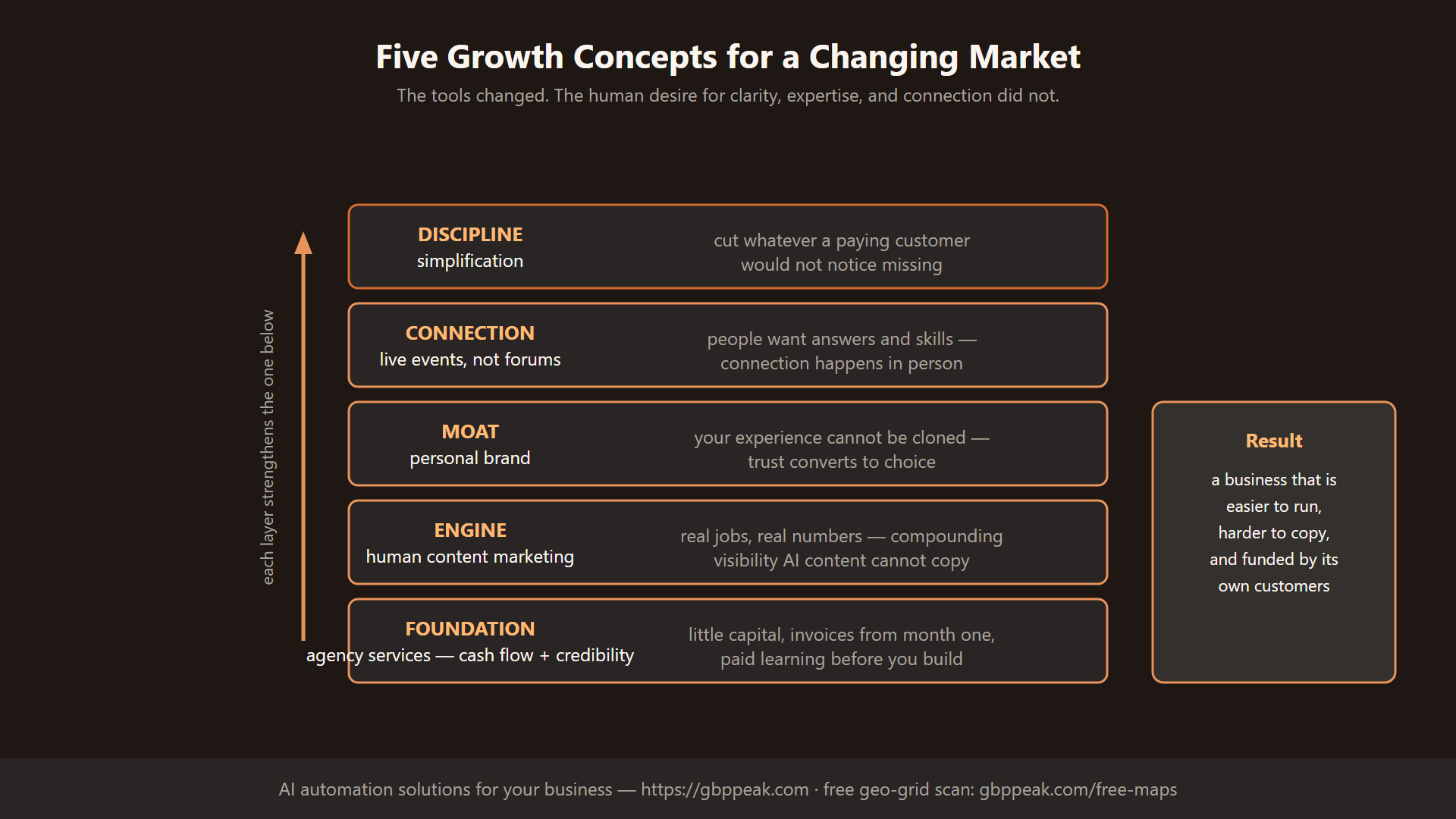
Putting the Five Together
The concepts stack rather than compete:
{
  "stack": {
    "foundation": "agency services — cash flow + credibility",
    "engine": "human content marketing — compounding visibility",
    "moat": "personal brand — the part competitors cannot copy",
    "connection": "periodic live events — depth with the best customers",
    "discipline": "simplification — cut whatever customers would not miss"
  }
}
For a local service business, the same stack applies one level down: a complete Google Business Profile and focused service pages are the foundation; reviews that mention specifics are the moat. If local visibility is your starting point, see where you actually stand — a free geo-grid scan at gbppeak.com/free-maps maps your rank across the city.
FAQs
Is content marketing still effective in the age of AI?
Yes — more selectively. AI floods the market with average content, which makes human, experience-driven content stand out more, not less. Content built on real jobs, real numbers, and a real point of view keeps building trust and search visibility long after it is published.
Why are businesses moving away from online communities?
Because most members do not want a forum to maintain; they want direct answers and specific skills. Online communities carry heavy moderation overhead with declining engagement, while a content library plus periodic in-person events delivers more value with bounded effort.
What makes a personal brand valuable?
It converts trust into a competitive advantage. When services and websites look increasingly alike, a recognized person with a specific track record becomes the reason a customer chooses you — and unlike a service page, your experience cannot be copied by a competitor.
Should I build a platform or start an agency first?
Start with the agency. Services need little capital, generate cash flow immediately, and teach you through paid work which problems are worth automating. Build the platform later, once you have been paid to solve its problems manually — that way it is engineering, not gambling.
One Focus This Quarter
Pick a single concept and run it for ninety days: publish one honest piece of content a week, or host one small dinner for your best customers, or cut your offer list to the one thing that sells. Depth in one beats dabbling in five — and ninety days of focus will tell you more than a year of planning.