
Five "Boring" Business Models That Pay Every Month
Lead gen, outbound agencies, directories, events, cleaning: five proven models with inelastic demand and recurring revenue that survive every trend.
Every few months a new business idea goes viral: drop-shipping stores, AI newsletters, whatever the timeline is cheering this quarter. A year later, most of them are gone. Meanwhile the cleaning company that has serviced the same office building since 2015 keeps invoicing every month, and the local lead-gen site that ranks for "emergency plumber Bangkok" keeps selling the same phone calls.
"Boring" is not an insult here. It means the business solves a need that survives every trend cycle. This guide walks through five such models — with a local-search lens, because that is where we work — and shows what makes each one stable enough to build a life around.
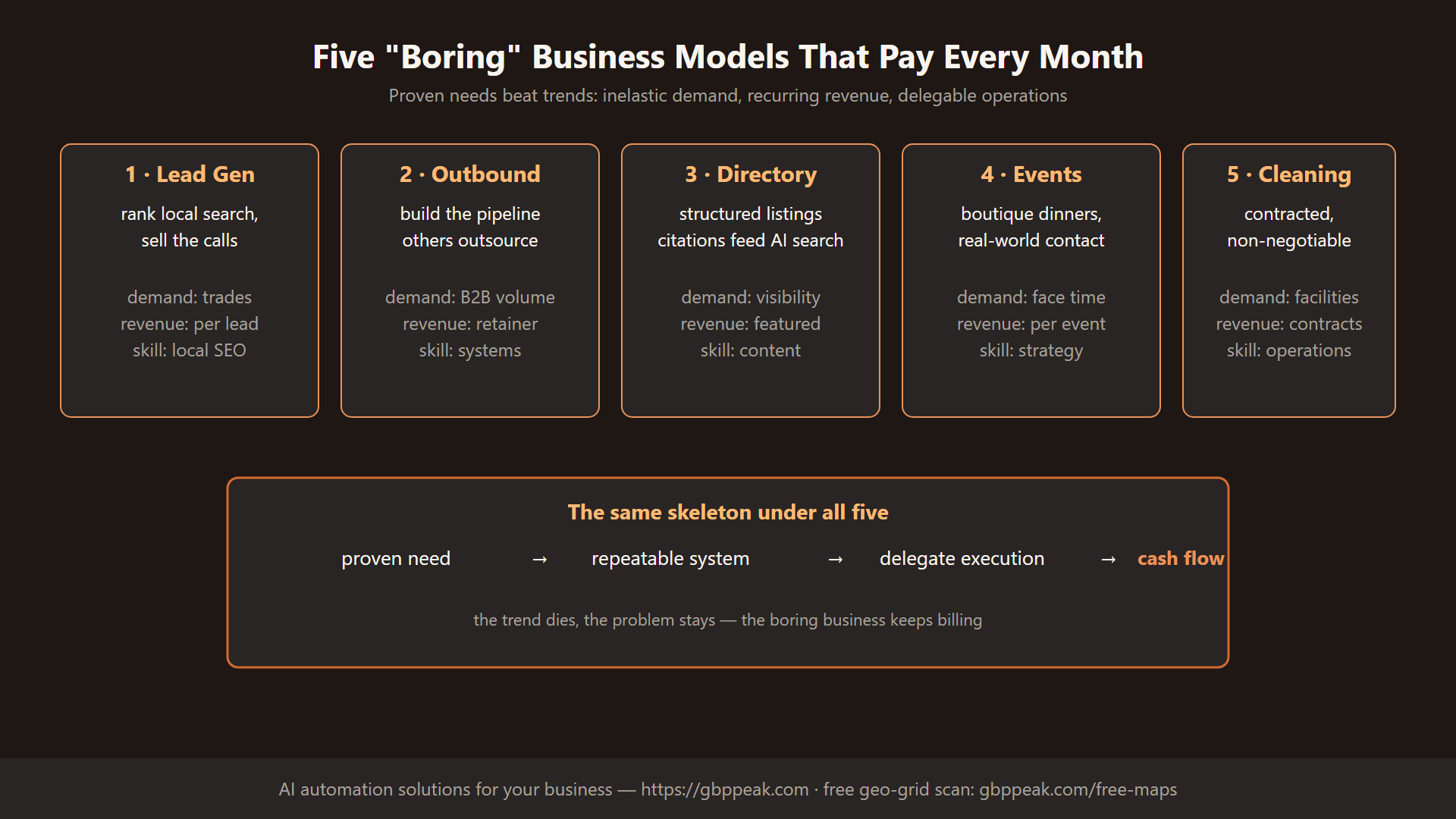
The most reliable "boring" business models solve recurring, non-negotiable problems for established industries: local lead generation, outbound pipeline agencies, niche business directories, boutique event marketing, and commercial cleaning. They are durable because demand is inelastic — businesses always need customers, visibility, and clean facilities — and because they run on proven mechanisms like recurring contracts and search visibility rather than hoping a trend lasts long enough to pay you back.
What Makes a Business Model "Boring but Durable"
The distinction is the moat. A trendy business depends on a trend or a piece of software staying hot. A boring business depends on a problem staying unsolved. If the trend fades, the trendy business collapses; the boring business keeps billing, because the underlying problem is still there.
Four traits show up in every model below:
- Inelastic demand — the customer needs it, not wants it. Cleaning, plumbing, patient acquisition.
- Recurring or repeat revenue — contracts and pipelines, not one-off launches.
- Delegable operations — the work can be handed to a team while the owner handles growth.
- Low churn — a signed commercial client or a ranking website is rarely canceled on a whim.
| Model | Who pays | Why it lasts | Main skill |
|---|---|---|---|
| Local lead generation | Local service businesses | Trades can't be offshored | Local SEO |
| Outbound pipeline agency | B2B companies needing volume | Sales outreach is grinding work | Systems + copy |
| Niche business directory | Businesses wanting visibility | Citations feed SEO and AI search | Content + structure |
| Event marketing agency | Brands wanting real contact | Digital fatigue raises physical value | Strategy + network |
| Commercial cleaning | Offices, clinics, industry | Cleanliness is non-negotiable | Operations + hiring |
1. Local Lead Generation
A local lead-gen business connects brick-and-mortar businesses with new customers — landscapers, plumbers, dentists, auto repair shops. You build the visibility; they do the work.
Why it survives every technology shift: the underlying need is constant. Phone books became Google, Google is being layered with AI answers, but a flooded kitchen in Bangkok still needs a plumber tonight. AI and automation cannot replace the plumber — they only change how the customer finds one. That is exactly the gap we cover in building an inbound lead generation engine.
The practical version:
pick a trade + city
  └─ build or optimize a Google Business Profile
       └─ rank it in the local map pack
            └─ sell the calls/leads to a vetted local operator
                 └─ recurring monthly fee per lead or per ranking
The model is a marketing bridge: the operator is excellent at the craft and indifferent about digital marketing, so you rent them the top of the search results. Check rank reality across the whole city, not just at the office pin — a free geo-grid scan at gbppeak.com/free-maps shows exactly which neighborhoods a profile already owns and which are wide open.
2. Outbound Pipeline Agency
Inbound is popular; outbound is the gritty engine most companies want to outsource. You build the sales pipeline for businesses that need consistent volume: scrape and clean target lists, run cold email sequences, follow up on inquiries, and hand over booked calls.
Honest framing: outbound converts at a lower rate than inbound, so it runs on volume and repetition — which is precisely why clients pay someone else to do it. The deliverable is simple to explain and hard to execute well:
outbound_engine:
  list_building: "scrape + verify target contacts weekly"
  sequencing: "5-7 touch email cadence, plain text, one clear offer"
  multichannel: "email + LinkedIn/line touch + follow-up on inbound"
  handoff: "booked calls land directly in client calendar"
  pricing: "retainer + per-booked-meeting"
The durable part is the pricing logic: the client's sales team stays productive because your pipeline never goes empty. That is a recurring bill with a measurable return, the kind of contract that survives budget cuts.
3. Niche Business Directories
A directory is a curated list of businesses in one niche or city. It looks passive; done properly it is a layered asset.
- Citations: every listing is a name/address/phone mention that feeds local SEO — for the listed businesses and for the directory itself.
- AI search relevance: when AI answer engines recommend "the best dental clinics in Sukhumvit," they lean on structured, trustworthy sources. A clean, well-maintained directory is exactly that. We cover this mechanism in accurate search engine guide.
- Media upside: wrap the listings in genuinely useful content — comparison guides, pricing explainers — and the directory becomes a small media company with sponsorship options.
{
  "directory_asset": {
    "core": "structured listings with verified NAP data",
    "moat": "city + niche focus, e.g. 'Bangkok veterinary clinics'",
    "revenue": ["featured listings", "sponsors", "lead referrals"],
    "maintenance": "monthly: add listings, prune closed ones, publish 2 guides"
  }
}
The failure mode is starting too broad. "Business directory" loses; "verified English-speaking clinics in Bangkok" can win its corner of search.
4. Boutique Event Marketing Agency
As digital channels saturate, face-to-face contact carries a growing premium. The model here is not trade-show logistics — it is boutique, localized experiences: industry dinners, small mixers, curated meetups that put a brand in front of exactly twenty relevant people.
You do not need to be a logistics expert. The scalable split:
- You sell: the strategy — who to gather, why it matters to the brand, what relationship it opens.
- You hire: an operations freelancer or small team for venues, catering, and run-of-show.
What you are really selling is community strategy with a physical proof of work. Ten decision-makers in one room, all thanking the host, is marketing no feed algorithm can replicate — and the brand that felt it books the next one.
5. Commercial Cleaning
The classic. Commercial janitorial is the ultimate boring business because it is non-negotiable: offices, clinics, and industrial sites must be cleaned, on contract, every month.
- Recurring revenue: a signed facility contract is rarely canceled — switching costs exceed the invoice.
- Inelastic demand: cleanliness is a requirement, not a luxury, in any regulated workspace.
- Delegable labor: the work is physically straightforward to train, so the owner runs accounts and staffing, not mops.
And here is the real opportunity for a technically-minded operator: the gap in this industry is marketing. Many long-standing cleaning companies run on outdated websites and word of mouth. Building them a modern lead-generation system — profile, service pages, review flow — is underserved territory. It is the same play as living profile lead quality: the operator with the best local visibility wins contracts that used to go to whoever the building manager already knew.
Which One Fits You
Choose by what you want to operate daily, not by what sounds impressive:
- Like SEO and content? → lead gen or directory.
- Like systems and volume? → outbound agency.
- Like people and curation? → events.
- Like operations and staffing? → cleaning.
All five share the same skeleton: find a proven need, build a repeatable delivery system, delegate the execution. That is the same simplicity principle we broke down in the power of simplicity in business growth — the boring businesses win precisely because they refuse to complicate the model.
FAQs
Why are these businesses called "boring"?
Because they don't rely on viral growth or new technology. They solve basic needs — customers, visibility, cleanliness — that exist regardless of trends. "Boring" describes the demand, not the profit; steady demand is what makes the cash flow predictable.
What is the difference between a boring and a trendy business?
The moat. A trendy business depends on a trend or software staying hot, so it can collapse when attention moves on. A boring business depends on a proven need, so it keeps operating because the problem it solves is still there.
Can I start one of these alone?
Yes — most start solo. But they are built to scale: cleaning and events delegate to operations teams, while lead gen and directories run on systems. The owner's long-run job is growth and quality control, not the delivery work itself.
Which of these is easiest to start with local SEO skills?
Local lead generation. The skill you already have — ranking profiles and service pages — is the entire product. Pick one trade in one city, rank the asset, and sell the leads to a vetted operator; a directory is the natural second asset once the niche is proven.
Start With One Problem
The shiny-object trap exists because novelty feels like progress. These five models are the opposite trade: pick one proven need, build the system that serves it, and let the compounding do the quiet work. If local search is your skill, start by seeing the actual battlefield — run a free geo-grid scan at gbppeak.com/free-maps and find the neighborhoods where nobody is even trying to rank.