The Lean Operations System for Small Agencies
One tool per function — cloud drive, per-client task boards, recorded walkthroughs, one chat — runs a growing agency for tens of dollars a month.
A two-person agency signs its fifth client and suddenly everything takes longer. Not because the work is harder — because the operations are. The status of each project lives in someone's head, files are in three drives with four naming styles, and every small task needs a meeting to explain. The agency did not have a capacity problem; it had a friction problem.
When the process is the product — you are selling delivery, not software — your internal operations are part of the pitch. A lean operations system strips the friction out so that adding the tenth client feels like adding the fifth. Here is how to build one with a small, cheap, purposeful stack.
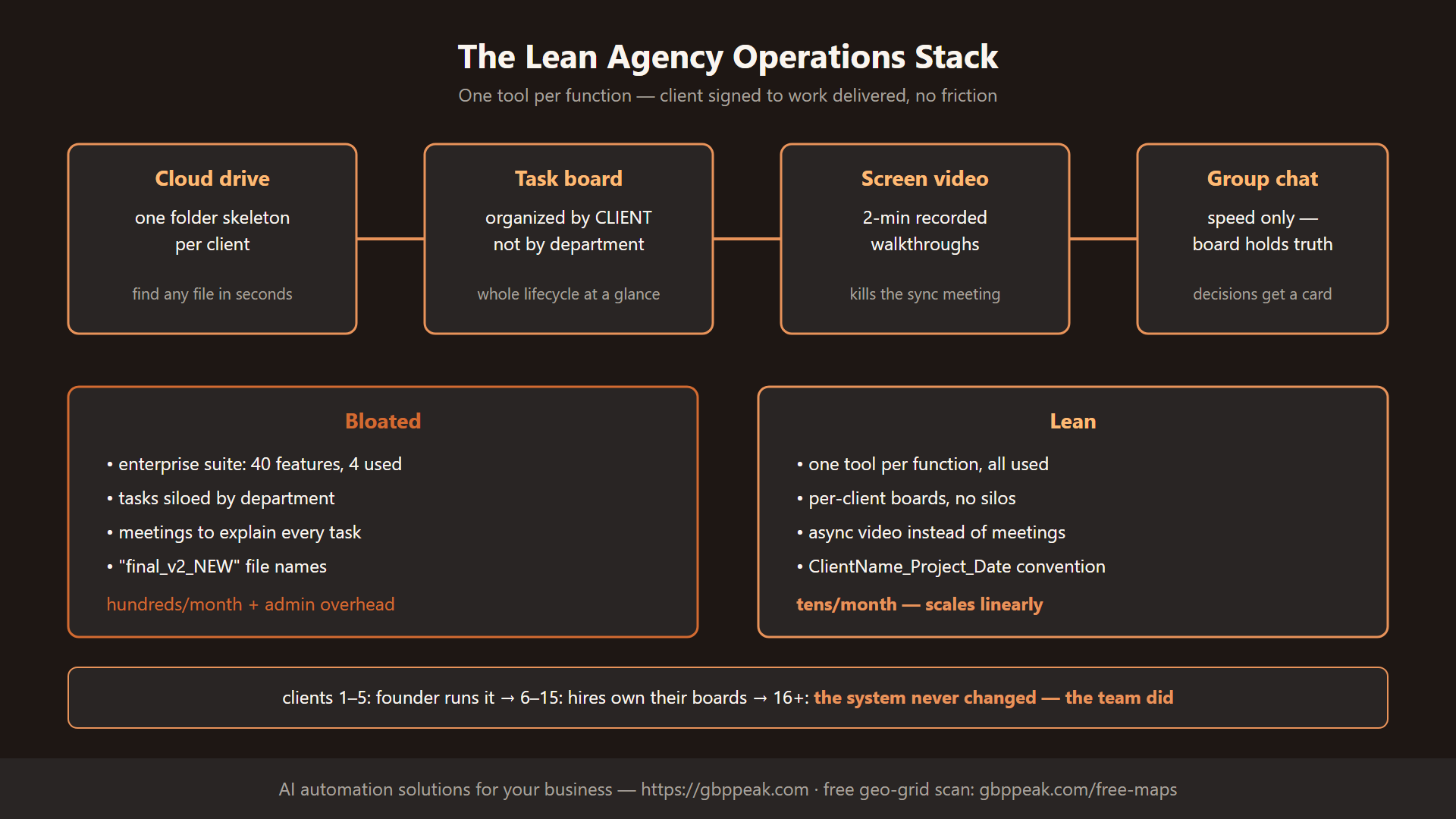
A lean operations system is a deliberately minimal workflow: one best-in-class tool per function — cloud drive for documents, a task board organized by client, short screen-recorded video for instructions, and one group chat for quick updates. Standard naming conventions and asynchronous work remove the meetings and searching that slow small agencies down. The result is a repeatable pipeline from "client signed" to "work delivered" that scales without adding management overhead, usually for tens of dollars a month rather than hundreds.
The Real Problem: Software Bloat
The instinct when things feel messy is to buy a bigger system — an enterprise project suite with Gantt charts, resource planning, and a settings menu like a cockpit. Six months later the team uses four features, nobody trusts the data inside it, and the real project status is back in chat threads.
Bloat creates friction, and friction is anything that burns time between "client signed" and "work completed":
- Searching for a contract in a badly structured drive.
- Opening three apps to answer "what is the status of this?"
- A sync meeting to explain a task that a two-minute video would have covered.
| Bloated operations | Lean operations |
|---|---|
| Enterprise suite, 40 features, 4 used | One tool per function, all used |
| Tasks organized by department | Tasks organized by client |
| Meetings to explain work | Recorded walkthroughs, watched on demand |
| Files everywhere, inconsistent names | One convention, searchable in seconds |
| New client = new chaos | New client = copy the template |
| Cost: hundreds/month + admin time | Cost: tens/month, near-zero admin |
Notice the last two rows. Lean is not just cleaner — it is cheaper and it scales linearly, the same "cut what customers would not miss" discipline we applied to the business model itself in the power of simplicity in business growth.
The Four-Tool Stack
Pick one best-in-class tool per function. Resist anything that claims to do all four.
1. Cloud Drive — the Single Source of Files
Google Drive or Dropbox — either is fine. The tool is not the point; the structure is.
/Clients
  /ACME-Dental
    /01-Contract
    /02-Onboarding
    /03-Deliverables
    /04-Reports
    /05-Admin
  /Bangkok-Fitness-Co
    ...
Every client, identical skeleton. Anyone on the team can find any client's contract in seconds without asking anyone — which is the entire test of a good file system.
2. Task Board — the Single Source of Truth
Trello, Todoist, or a simple kanban. The critical choice: organize by client, not by department.
Department boards ("Design," "Marketing") silo information — the designer never sees that marketing is waiting on them. A per-client board shows the whole lifecycle at a glance:
client_board: "ACME-Dental"
  columns:
    - "Onboarding"      # access, assets, kickoff done
    - "This week"       # committed tasks with owners
    - "Waiting on us"   # blocked, needs internal action
    - "Waiting on client"
    - "Done (this month)"
  card_rule: "one card = one deliverable, with a Loom link if it needs explanation"
3. Screen-Recorded Video — the Meeting Killer
The most expensive habit in a small agency is the sync meeting called to explain a task. Replace most of them with a two-minute screen recording: show the screen, narrate the how and the why, drop the link in the task card.
Video beats written instructions because it captures tone, clicks, and intent. A written email can be misread three ways; a recording cannot. And it compounds — the walkthrough for client #5 becomes the training material for the hire at client #25.
4. Group Chat — for Speed, Not for Truth
One chat channel per client (WhatsApp, Slack, whatever the team already lives in) for quick updates and questions. The rule that keeps it lean: the task board holds the formal state; chat holds only conversation. Anything decided in chat gets a card or a comment, or it did not happen.
Design for Asynchronous by Default
Once the team spreads across time zones — or just across schedules — synchronous work collapses. The lean system above is already 80% async: files are self-serve, tasks carry their own context, instructions are recorded. Work stops waiting for you to be awake.
async loop:
  task card created (with links to files + Loom)
    → owner picks it up on their schedule
      → done → card moved, deliverable in /03-Deliverables
        → weekly 20-min review per client (the only sync meeting left)
The naming convention carries a lot of this. ClientName_ProjectName_Date on every file and folder makes the drive's search box a genuine retrieval system — "ACME report October" finds the thing instantly. Vague names like "final_v2_NEW" are how agencies lose afternoons.
Scaling Without Adding Management
Here is what the system looks like as the agency grows:
{
  "clients_1_to_5": {
    "founder": "does the work, maintains the board",
    "overhead": "near zero — templates not needed yet"
  },
  "clients_6_to_15": {
    "first_hires": "own client boards end-to-end",
    "founder": "reviews weekly, records walkthroughs instead of training live",
    "template": "duplicate the client folder + board per signup"
  },
  "clients_16_plus": {
    "ops_lead": "runs the review rhythm",
    "founder": "sales, positioning, new services",
    "note": "the system did not change — the team did"
  }
}
That last line is the whole point. The system's job is to stay boring while the agency grows around it — which is exactly the durable-systems mindset behind reliable AI agents and the delivery-first models in five boring business models: the flashiest part of your business should be the results, never the back office.
FAQs
Why choose a minimal stack instead of an all-in-one platform?
All-in-one suites bring higher costs, steeper learning curves, and dozens of features you will never use. A minimal stack lets the team master a few tools completely, cuts training time for every new hire, and keeps you free to swap a single tool when a better one appears — instead of migrating an entire platform.
How do video walkthroughs improve efficiency?
They remove the back-and-forth of written instructions. A recording captures your screen, tone, and intent, so tasks are understood correctly the first time. It also turns explanation into a reusable asset: the same recording trains the next team member months later without your involvement.
Can a small agency really stay organized with just basic tools?
Yes — growth problems usually come from complexity, not missing features. A clear file convention, one task board per client, and recorded instructions will run a high-volume agency. If a basic tool ever genuinely limits you, upgrade that one function then; do not pre-buy enterprise capacity you have not earned.
How do I stop chat from becoming the real project manager?
Enforce one rule: chat is conversation, the board is truth. Any decision, deadline, or deliverable agreed in chat gets a card or comment within the day. Teams that skip this step gradually run the agency from message history — the least searchable, most fragile system there is.
This Week's Cleanup
Run a friction audit: pick yesterday and list every minute spent searching for files, clarifying task status, or sitting in a meeting that a video could replace. Then fix the biggest one — usually either the folder convention or the task board structure. One afternoon of cleanup, and every client after that inherits the smoother system. And when the ops side is calm, the growth side deserves the attention: a free geo-grid scan at gbppeak.com/free-maps shows exactly where your market visibility stands.