
How to Rank Higher on "Massage Near Me"
"Massage near me" picks different winners at every search point. Here is how massage and spa businesses can measure where they actually appear, close the gaps that matter, and re-check over time.
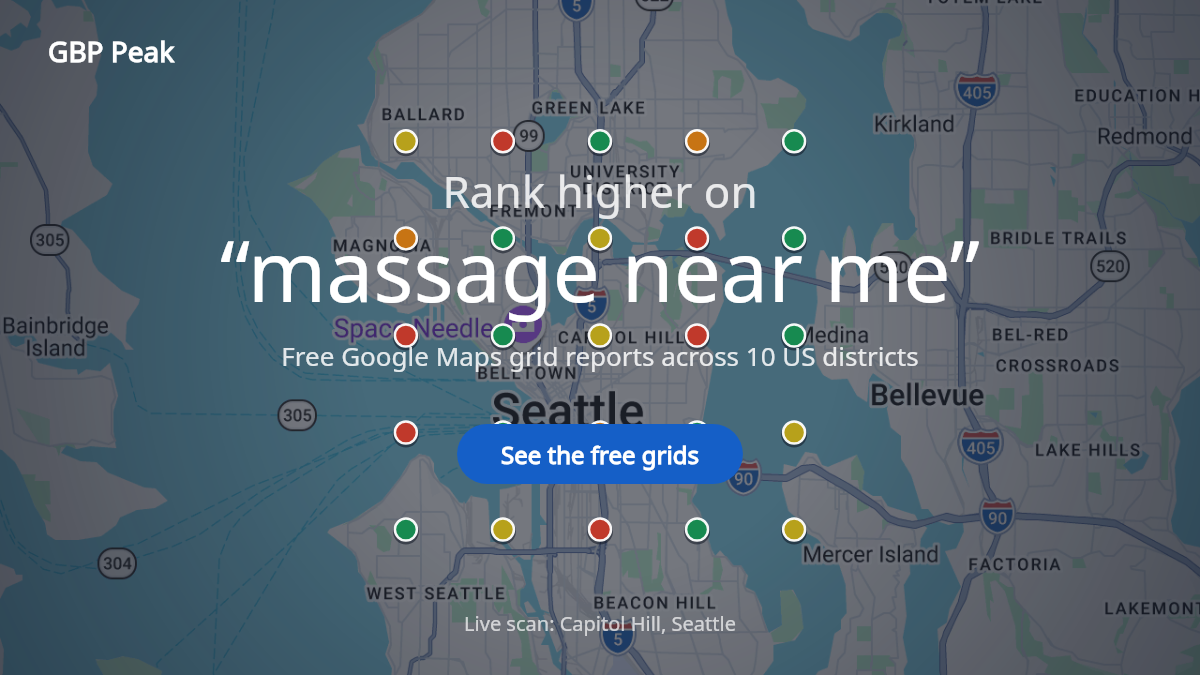
"Near me" means every search has its own winner
When someone searches "massage near me", Google decides what to show using relevance, distance and prominence — and two of those three are judged at the moment of searching, from wherever the searcher stands. Run the same search two streets apart and the list changes. A shop that is the first result beside its own door can be missing from the top three half a mile away.
That is why checking your ranking once from your own phone tells you so little. You sampled one point. Your potential customers are sampling dozens of points all around your area, and each of them sees a slightly different set of massage businesses.
Before trying to rank higher, find out where you actually appear. The rest of this guide walks through that first, because every fix after it depends on knowing which neighborhoods and search points you are losing.
Step 1: measure where you appear, point by point
A grid scan repeats your keyword — for this guide, "massage near me" — at evenly spaced points around your location and records who appears at each one. Instead of one ranking number you get a map: strong here, absent there, competitor everywhere in between. It is a dated measurement of the points you sampled, not a promise about every future search, which is exactly what makes it honest.
You can create your first grid scan free — sign in with Google, choose your business, no card needed. Keep the business, keyword and grid consistent between scans so comparisons stay fair, the same way we recommend in our guide to reading a map rank tracker.
Step 2: read the grid like a diagnosis
Three patterns cover most massage and spa businesses:
- Strong core, fading edge. You appear near the shop and drop off with distance. This is normal proximity behavior. Improve it by strengthening prominence signals — the steps below — rather than chasing every far point.
- Patchy everywhere. You appear at some nearby points and vanish at others. That often points to weak or ambiguous profile information: a category that is too broad, missing services, or incomplete hours. Steps 3 and 4.
- Absent even beside your own door. Usually a profile problem, not a ranking problem — suspension, duplicate listings, or a category mismatch. Fix the listing first; ranking tactics are wasted on a broken profile. The three levers of local ranking explains what Google is actually reacting to.
Real "massage near me" grids in ten US districts
To make this concrete, we publish free public grids for massage, spa and wellness businesses in ten US districts, each scanned on the keyword "massage near me" with about a 5 km radius. Every business in a scan gets its own report showing exactly which points it wins and which it loses. The maps below are each district's scan area:
Capitol Hill, Seattle
Every massage business ranked on "massage near me" around Capitol Hill — open the full leaderboard.
East Village, New York
Every massage business ranked on "massage near me" around the East Village — open the full leaderboard.
Wicker Park, Chicago
Every massage business ranked on "massage near me" around Wicker Park — open the full leaderboard.
Koreatown, Los Angeles
Every massage business ranked on "massage near me" around Koreatown — open the full leaderboard.
Wynwood, Miami
Every massage business ranked on "massage near me" around Wynwood — open the full leaderboard.
Montrose, Houston
Every massage business ranked on "massage near me" around Montrose — open the full leaderboard.
Downtown Austin
Every massage business ranked on "massage near me" around Downtown Austin — open the full leaderboard.
LoDo, Denver
Every massage business ranked on "massage near me" around LoDo — open the full leaderboard.
Las Vegas Strip
Every massage business ranked on "massage near me" around the Strip — open the full leaderboard.
Old Town Scottsdale
Every massage business ranked on "massage near me" around Old Town — open the full leaderboard.
The most-read single-business reports
Readers open these individual reports most often:
- Adriana Full Body Massage and Spa Therapy — Capitol Hill, Seattle
- Kathrina Full Body Massage Spa — Wynwood, Miami
- Isabella Mary Massage and Spa — East Village, New York
- Timikia Massage Spa — Montrose, Houston
- Hannah Massage Spa — Wynwood, Miami
- Elena Massage and Spa Wellness — Wicker Park, Chicago
Open any of them next to your own situation and ask the only question that matters: would my map look like this?
Step 3: close the category and service gaps
Google matches a "massage near me" search against what your profile says you are. Two fields carry most of that weight:
- Primary category. If you are a day spa that also does massage, or a wellness center, or a massage therapist — pick the primary category that matches what most customers actually book. Compare against the businesses that appear most often in your grid; their category choices are public.
- Services list. Add the services you genuinely offer, named the way customers name them — thai massage, deep tissue, couples massage, foot massage. Each service is another phrase your profile can legitimately match.
Hours, phone, website and address should simply be correct and identical everywhere they appear. Inconsistent listings do not help anyone's ranking.
Step 4: build the review habit, not the review spike
Reviews feed prominence, but the pattern Google and customers react to is a steady flow of genuine reviews plus owner responses — not a burst of ten in one week. Two habits are enough:
- Ask every happy client, every time, with a direct link — a QR card at checkout or a message template. Make it one tap.
- Respond to every review, good or bad, within a couple of days. A calm, specific reply to a bad review is read by every future customer who checks you before booking.
For a deeper treatment, managing reviews without panic covers the bad-review side in detail.
Step 5: keep the profile alive
A profile that never changes is a profile that gives Google nothing new to judge. Keep photos current — treatment rooms, the entrance from the street, the menu — and publish an occasional update post about what is actually happening: new therapist, extended weekend hours, a seasonal package. None of this is dramatic; all of it is evidence that the business is operating.
Step 6: re-scan on the same grid and compare
Give changes a few weeks, then run the same scan again — same keyword, same center, same grid — and put the two maps side by side. Coverage grew or it didn't; the average position moved or it didn't. That comparison, not a single day's ranking, is how you know whether the work is paying off. Spa owners can follow the full measurement routine in our spa visibility guide.
The short version
"Massage near me" is won neighborhood by neighborhood, not once for the whole city. Measure where you appear, fix the profile fields that decide relevance, build a steady review-and-response habit, keep the profile alive with real photos and updates, and re-scan to prove movement. Start with a free grid scan of your own business — or browse the free public maps first to see what a finished one looks like.