
Intent Over Volume: Finding Keywords That Actually Attract Customers
Page one for a 90,000-search term brought 3 inquiries a quarter. The long-tail page paid the rent. Seeds, intent reading, free expansion, and the page-one reality check.
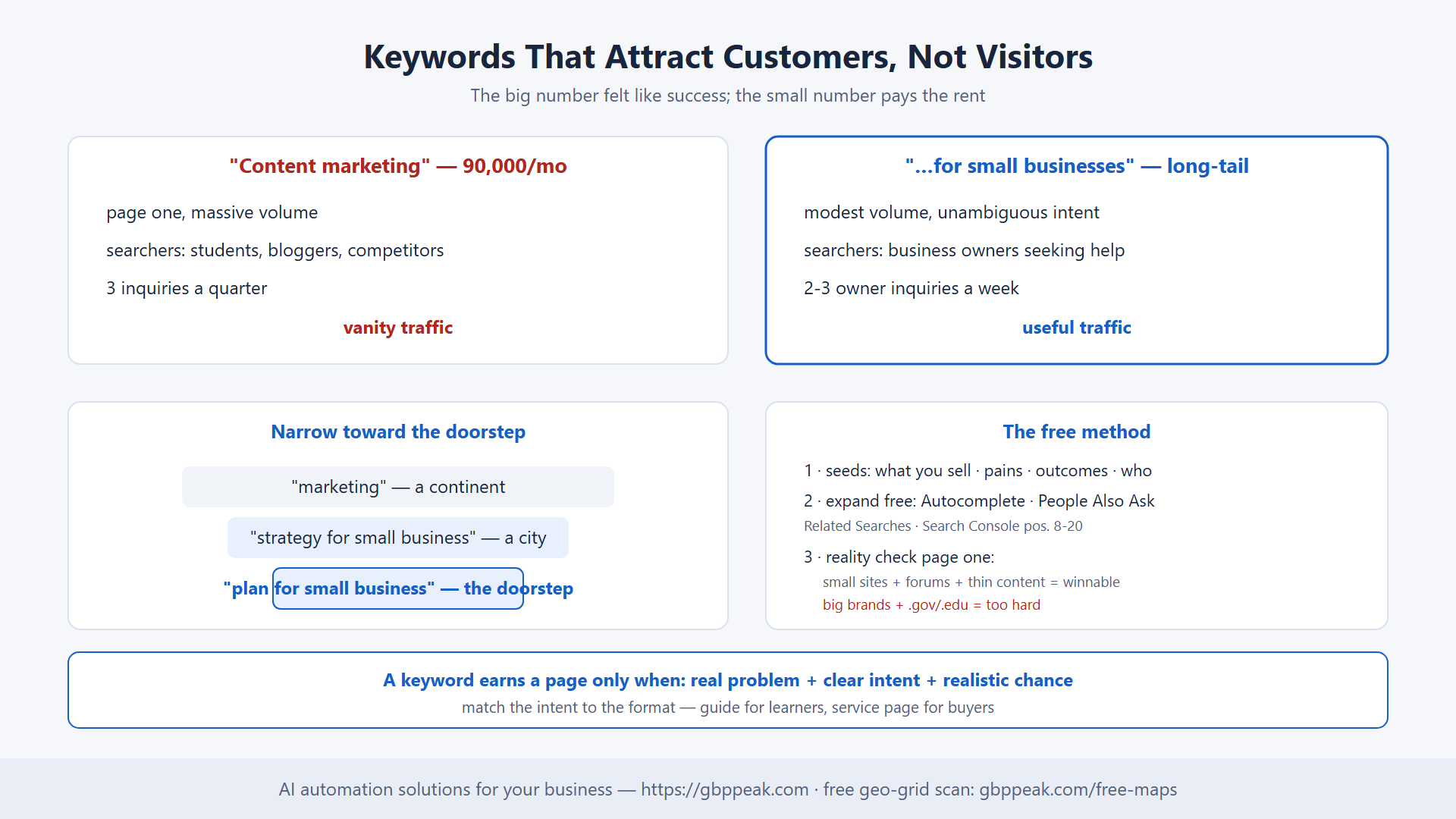
A consultant ranks on page one for "content marketing" — 90,000 searches a month — and gets three inquiries a quarter, mostly from students and competitors. Meanwhile her page targeting "content marketing for small businesses" brings two or three owners a week. The big number felt like success; the small number pays the rent.
High volume is a vanity metric for small businesses. What converts is intent: specific phrases, typed by people with the exact problem you solve, at the moment they want it solved. Here is the complete method for finding those keywords — no paid tools required.
Find customer-attracting keywords by prioritizing intent over volume: start from the problems your customers actually bring you (seed topics: what you sell, their pains, their desired outcomes, who they are), narrow broad terms into specific long-tail phrases ("marketing" → "marketing plan for small business"), identify search intent (informational, commercial, transactional, navigational) and match the page format to it, expand free via Google Autocomplete, People Also Ask, Related Searches, and Search Console positions 8–20, and verify opportunity by checking that page one is beatable — small sites, forums, thin content — not dominated by giant brands.
Traffic vs Useful Traffic
"Traffic" is people landing on your page. "Useful traffic" is people landing because they have a problem you specifically solve.
| Keyword | Who searches | Likely outcome |
|---|---|---|
| "Content marketing" (broad) | Students, bloggers, competitors | Browsing, no inquiry |
| "Content marketing for small businesses" (long-tail) | Business owners seeking help | Inquiry, client |
Fewer searches, dramatically better business. For a solo operator, twenty right visitors beat two thousand curious ones.
Step 1: Start with Problems, Not Tools
Close the keyword tool. Open what you know: map your business into four seed categories — the raw material keywords are made from.
seed_map:
  what_you_sell:    "SEO audit · consulting · coaching"
  customer_pains:   "site gets no traffic · not enough leads"
  wanted_outcomes:  "more customers · page 1 · grow the list"
  who_they_are:     "freelancers · local plumbers · e-commerce owners"
combinations of these = the keywords worth researching
This keeps research anchored to business goals instead of drifting toward whatever a tool suggests, per creating content that ranks.
Step 2: Narrow Toward Long-Tail
Each step down loses volume and gains intent:
"marketing"                        ← a continent
  → "marketing strategy for small business"   ← a city
    → "marketing plan for small business"     ← the doorstep

the doorstep keyword: lower volume, unambiguous intent,
                      and easy to write a page that fits perfectly
Step 3: Read the Intent
Four intents, four page formats — and matching them is where most keyword strategies silently fail:
| Intent | Searcher wants | Example query | Winning format |
|---|---|---|---|
| Informational | To learn | "what is content marketing" | Guide, tutorial |
| Commercial | To compare | "best marketing tools 2026" | Comparison, review |
| Transactional | To hire/buy | "marketing agency for small business" | Service page |
| Navigational | A specific brand | "[your brand] reviews" | Homepage, About |
Selling a service to an informational searcher (or teaching a buyer who's ready to hire) wastes the match — one page, one intent, per the inbound engine.
Step 4–5: Expand Free, Mine Your Own Data
The paid tools are optional. The free expansion stack:
- Google Autocomplete — type the seed, don't press enter; the suggestions are real queries.
- People Also Ask — ready-made FAQ questions and section headings.
- Related Searches — the bottom-of-page term cluster Google considers adjacent.
- Search Console — your most valuable source: the actual words people already find you with. Filter for positions 8–20 — the low-hanging fruit where a small improvement (a section added, a title sharpened) can jump you onto page one.
Step 6: The Reality Check — Read Page One
Difficulty scores are estimates; the live results are facts. Before committing, search the keyword and inspect who you'd have to beat:
GOOD opportunity — page one shows:
  · small businesses / solo practitioners ranking
  · Reddit or Quora threads
  · old articles, untouched for years
  · thin content that half-answers the question

TOO HARD — page one shows:
  · global brands (Amazon-grade)
  · .gov / .edu domains on high-stakes topics
  · major media publishers
The Three-Criteria Filter
A keyword earns a page only when it passes all three:
- Real problem — a pain your customers actually feel.
- Clear intent — the searcher wants something you offer.
- Realistic chance — you can out-help what's currently on page one.
Applied to our opening example: "Content Marketing" fails (too broad), "Content Strategy" is closer but still broad, "Content marketing for small businesses" passes — specific audience, clear intent, winnable page. That's the pattern: choose the doorway over the continent, every time.
FAQs
Should I focus on high-volume keywords?
Generally no, unless you have a large team and budget. High-volume terms are broad — they attract many searchers but very few of your customers, and they're dominated by big sites. Long-tail phrases reach fewer people but far more of the right ones, and they're realistically winnable.
How do I know if a keyword is transactional?
Look at page one. If it's filled with how-to guides and articles, the intent is informational; if it's service listings and "Contact Us" pages, it's transactional. Matching your page to what ranks is faster and more reliable than any tool's classification.
What is a seed topic?
A broad starting point drawn from your own business knowledge — your services, customer pains, desired outcomes, and audience type. Seeds aren't final keywords; they're the combinations you narrow into specific phrases customers actually type.
Do I need paid SEO tools to do this?
No. Google Autocomplete, People Also Ask, Related Searches, and Search Console cover research, expansion, and opportunity-finding for a solo business. Paid tools add scale for larger teams, not accuracy for yours.
Useful Beats Big
Keyword research is not hunting easy words with big numbers; it is connecting your skills to a person who needs help — the doorway keywords with unambiguous intent and a beatable page one. Start from the pains you hear every week, narrow twice, read the intent, mine Search Console, check page one, and build the page that out-helps it. When the plan turns local, see the market first: a free geo-grid scan at gbppeak.com/free-maps.