
Intent, Clarity, Value: Creating Content That Ranks
200 posts about topics lose to 30 pages that answer questions. Match intent, answer in the first 100 words, go deep not long, and add only-you evidence.
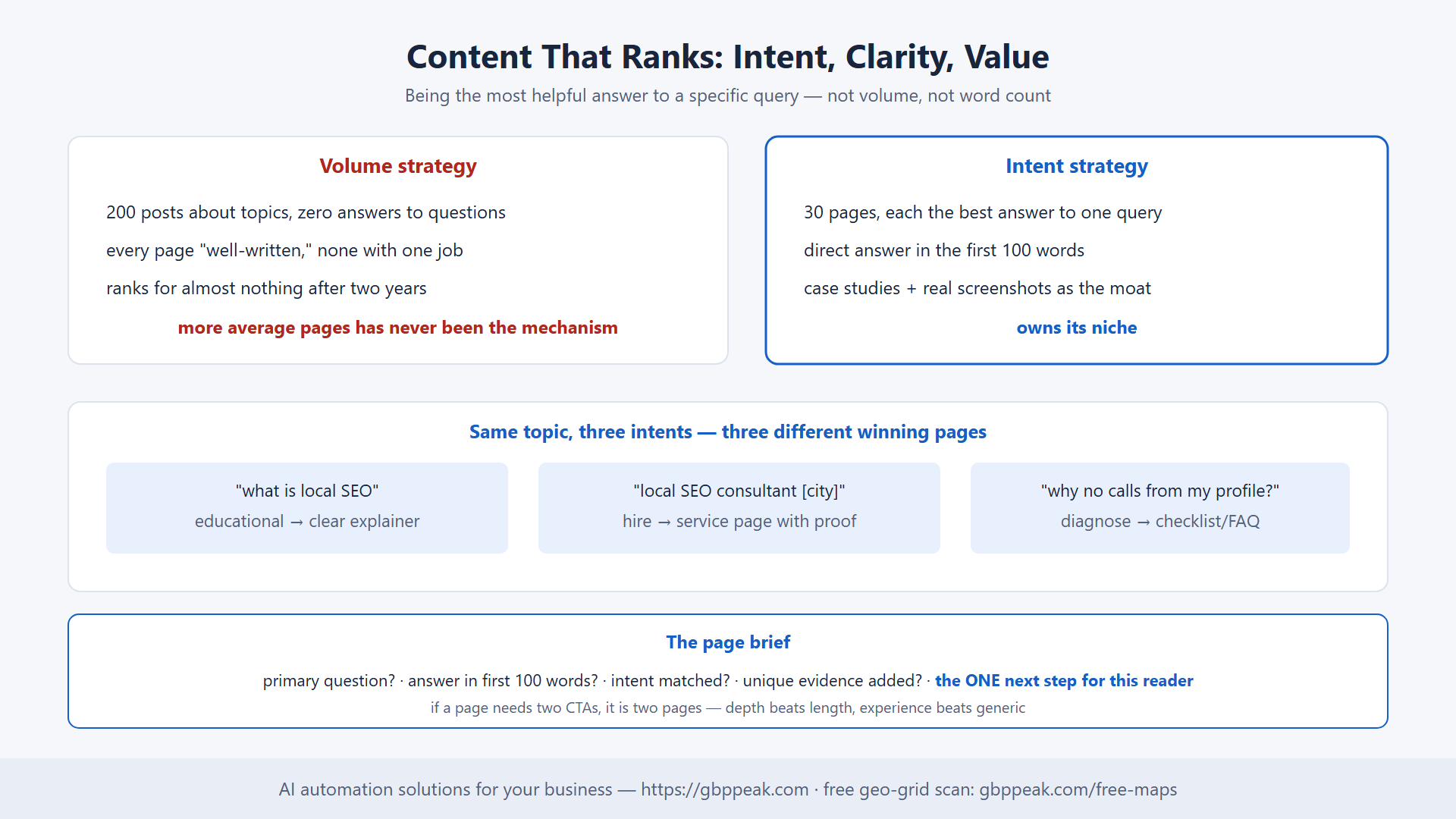
A website publishes 200 blog posts in two years and ranks for almost nothing. A competitor with 30 posts owns its niche. The volume strategy failed for the same reason most content fails: every page was about a topic, but no page answered a question. Publishing more average pages has never been the ranking mechanism — being the most helpful response to a specific query is.
This is the guide to building pages that earn their rank: match intent, answer first, go deep not long, add what only you can, and give every page one job.
Content ranks by being the most helpful response to a specific query, not by word count or keyword volume. Match the search intent first (educational, comparison, or ready-to-buy each need different pages), place the direct answer within the first 100 words for both readers and AI engines, pursue depth over length, differentiate with what only you can provide — case studies, real frameworks, actual screenshots — and end with one next step suited to the reader's stage. Every page gets a single clear job.
Intent: The Goal Behind the Words
A keyword is what the user types; intent is what they want. Same topic, three different intents:
| Search | Intent | Page that wins |
|---|---|---|
| "what is local SEO" | Educational | Clear explainer guide |
| "local SEO consultant in [city]" | Hire | Service page with proof |
| "why isn't my profile getting calls" | Diagnose a problem | Diagnostic checklist/FAQ |
Serving the educational searcher a sales page (or the buyer a history lesson) fails both human and algorithm. Before writing, research the standard: search the phrase, note what currently ranks — short posts, long guides, service pages, People-Also-Ask boxes, map packs? That result set is the exam your page must pass. Your job is to meet the standard, then beat it on clarity and helpfulness.
One Page, One Job
The most common audit finding is the "mismatched" page — well-written, no single purpose. A Services page trying to explain every offering serves nobody; split offerings into individual pages, each answering exactly one question for exactly one reader.
page_job_checklist:
  who:        "who specifically is this for?"
  problem:    "what exact question/problem does it address?"
  evidence:   "what proves we know (case, data, screenshots)?"
  next_step:  "the ONE action this page should lead to"
  rule: "if a page needs two different CTAs, it is two pages"
This is one-page-one-keyword applied to purpose — the discipline from building an inbound engine.
The First 100 Words Decide Everything
In AI-assisted search, nobody climbs a mountain of throat-clearing to find the answer. The opening must do three things: give the direct answer, add the necessary context, and tell the reader what to do next.
- ❌ "In today's digital landscape, businesses face unprecedented challenges…"
- ✅ "Your site may lack visibility due to indexing problems, low search demand, or a content-audience mismatch. Start by checking Search Console to find your specific bottleneck."
Same topic; the second one answers, ranks, and gets extracted by AI engines — the direct-answer discipline of answer engine optimization working for classic search too.
Depth ≠ Length
The word-count myth dies hard: a 3,000-word page can be shallow and repetitive while a 700-word page answers perfectly. Depth means coverage of what this reader actually needs.
educational page must cover:
  the main question — answered directly
  why it matters
  the follow-up questions they'll have next
  practical next steps + a real example

service page must make clear:
  what you do + who it's for
  the specific problem solved
  what the client receives · the process · the cost
  what's promised — and what isn't
Differentiation: What Only You Can Provide
AI can generate "correct" text instantly, which makes generic correct text worthless. The value is in what machines can't fake — your practical experience:
- Case studies — "calls up 30% from a headline change alone."
- Frameworks — the checklist you actually use daily.
- Pitfalls — "we keep seeing small businesses make this exact mistake…"
- Original visuals — screenshots of your real work, real data charts.
These move a page from "content" to "authority" — the same human-element moat as surviving the AI content flood.
Scannability: Readers Skim, So Let Them
Nobody reads search results like a novel. Descriptive headings ("How to check if your page is indexed" — not "Let's Dive In") let a skimmer navigate by headers alone, and bullets, numbered steps, tables, and bolded takeaways break the walls of text. Structure is a courtesy that doubles as an SEO tactic — engines parse the same signals readers skim.
The Right Next Step for the Right Reader
Not every page is a sales pitch, and the CTA must match the journey stage:
the learner ..... → a checklist or the next guide
the evaluator ... → a case study or comparison
the ready buyer . → contact, booking, or pricing
mismatched CTAs lose readers the same way mismatched intent does
FAQs
Does a longer page always rank better?
No — relevance and completeness rank, not length. A concise page that fully answers a how-to question routinely outranks a rambling long one. Write until the reader's question and its natural follow-ups are answered, then stop.
How do I know if I'm targeting the wrong keywords?
Read your Search Console signals: impressions without clicks point to a weak title/description; clicks without conversions point to intent mismatch or missing trust. The pattern tells you whether to fix the packaging or the page itself.
Should I repeat keywords in the title to rank?
No. Keyword stuffing reads badly to humans and earns no ranking credit. Use the main phrase naturally once, in a title that honestly describes the page — clarity outperforms repetition for both click-through and ranking.
How can my content stand out from AI-generated pages?
Add what AI cannot: your case studies with real numbers, your daily-use frameworks, your local knowledge, and original screenshots. Generic correctness is now free and everywhere; specific experience is the differentiator that readers — and ranking systems — reward.
Write the Answer, Then Get Out of the Way
Ranking content is a clear path from a question to a solution: match the intent, answer in the first hundred words, cover the follow-ups with depth instead of padding, prove it with your own experience, and end with the one next step this reader needs. Before your next page, run the brief: primary question, first-100-words answer, intent match, unique evidence, single next step. And to see how your existing pages' visibility actually stands across your market, run a free geo-grid scan at gbppeak.com/free-maps.