
Be the Answer: Answer Engine Optimization for Local Businesses
AI search names three businesses per answer — decided by clarity, not budget. Direct answers, question-shaped headings, plain facts, and entity statements get you quoted.
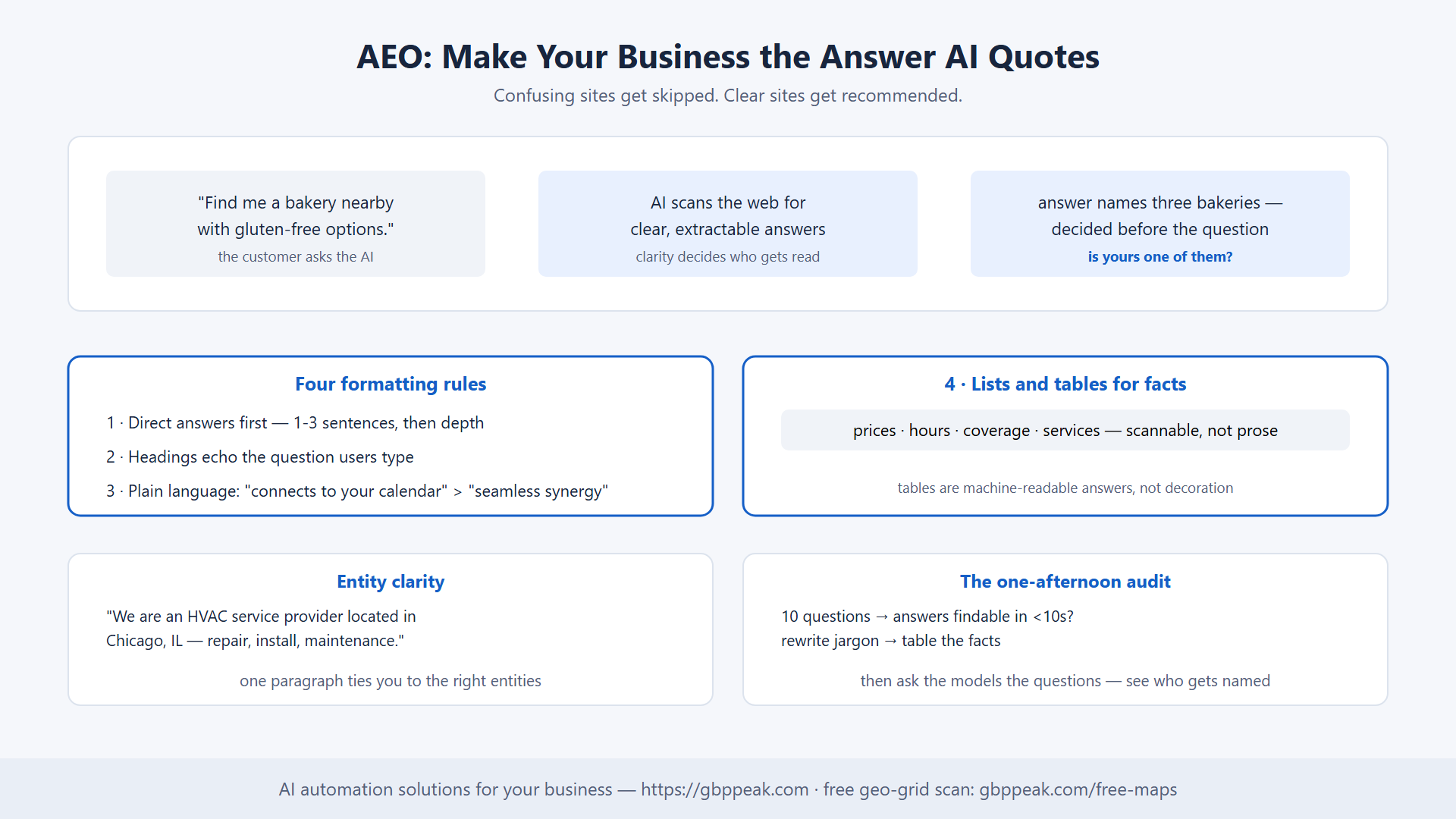
A customer opens a chat and types: "Find me a bakery nearby that does gluten-free cakes." The AI scans the web and composes an answer naming three bakeries. Whether yours is one of them was decided long before the question — by how clearly your website states what you are, where you are, and what you specifically offer. Confusing sites get skipped. Clear sites get recommended.
That is AEO — Answer Engine Optimization: structuring your presence so AI models can identify, understand, and confidently recommend you. It is not a new channel to buy; it is a clarity upgrade to what you already publish.
To appear in AI search results, optimize for AEO: write content that directly answers real customer questions in 1–3 sentences at the top of each section; use headings phrased as the questions users actually type; state your identity plainly ("We are an HVAC provider in Chicago"); replace marketing speak with concrete facts; and present prices, hours, and features as lists or tables that both humans and AI can scan. Clear, structured, unambiguous information is what answer engines extract and recommend — if a human can find your answer fast, an AI usually can too.
SEO vs AEO: What Actually Changes
| Traditional SEO | Answer Engine Optimization | |
|---|---|---|
| Primary goal | Rank high in results | Be the chosen answer in AI chats |
| Target | Keywords and phrases | Direct questions and intent |
| Content style | Engaging, informative articles | Concise, direct answers first |
| Format | Long-form pages | FAQs, structured data, lists, tables |
| Winning move | Match the query | Answer the question unambiguously |
The overlap is large — clarity helps both. The difference is what gets extracted: SEO ranks a page; AEO lifts a passage out of it and puts your name in a sentence. That extraction has requirements: findable, self-contained, unambiguous.
The Four Formatting Rules
1. Direct answers first
When the AI looks for a concise summary to pull, give it one. Take the ten questions customers actually ask, and for each, open the relevant section with the answer in 1–3 sentences — then add depth below for human readers.
section pattern:
  H2: the question ("Do you offer gluten-free cakes?")
  → answer: "Yes. We bake four gluten-free cake flavors daily,
    available whole or by the slice, at both branches."
  → then: flavors, ordering, lead times (for humans)
2. Headings that echo the question
AI models use heading hierarchy to map your content. "Our Vision" tells them nothing; "What services do we offer?" tells them exactly what lives below. Phrase headings as the questions users type into the chat box — the section becomes findable at the moment of extraction.
3. Plain language over marketing speak
Jargon gives models nothing to extract. Compare:
- ❌ "Our proprietary technology empowers your workflow with seamless integration."
- ✅ "Our software connects with your existing calendar to automate weekly booking updates."
Same product. The second is quotable. The first is noise — the clarity principle from how AI search reads content.
4. Lists and tables for facts
Prices, hours, service lists, coverage areas — put them in bullet points or tables. Structure removes ambiguity and lets the model extract exact data points instead of guessing from prose. Tables like the one above are not decoration; they are machine-readable answers.
Entity Clarity: Help the AI Know Who You Are
In AI systems, your business is an entity — a thing with attributes: name, location, industry, services. The model can only connect you to the right questions if your site states those attributes plainly. On your About and Services pages, say it explicitly:
entity_statement:
  who:   "We are an HVAC service provider"
  where: "located in Chicago, IL — serving the north side"
  what:  "repair, installation, and maintenance for residential units"
  extra: "24/7 emergency line, free estimates"
That single paragraph ties you to the geographic and industry entities the AI uses to judge relevance. Complement it with consistent name/address/phone everywhere — contradictions make models hedge, per citations and NAP consistency.
The AEO Audit (One Afternoon)
# audit your site for answer-engine readiness:
1. list the 10 questions customers actually ask
2. for each: can the answer be found on your site in <10 seconds?
3. check headings — do any echo the real questions?
4. hunt marketing speak on service pages → rewrite as concrete facts
5. prices / hours / coverage → lists or tables, not prose
6. entity statement present on About + Services?
7. then: ask the AI models the 10 questions → see who gets named
Step 7 is the proof: run your question battery across ChatGPT, Perplexity, and Google's AI Overviews and log whether you appear — the tracking method from tracking your AI visibility. Note also that AI recommendations draw on more than your site: the wider web's consensus about you matters as much as your own clarity, per SEO to GEO. AEO makes you extractable; consensus makes you chosen.
FAQs
What is the difference between SEO and AEO?
SEO aims to rank your page high in traditional search results for keywords. AEO aims to make your business the answer an AI engine quotes or recommends when a user asks a direct question. SEO rewards engaging, comprehensive pages; AEO rewards concise, structured, unambiguous answers that are easy to extract.
Do I need to be on social media to appear in AI search?
Not primarily. Your website is the source of truth the models read for your facts. Social presence adds signals of popularity and identity, but a well-structured site with clear answers outweighs a large following for AEO purposes.
How long until AI models "find" my optimized site?
It varies: some answer engines crawl the web in near real time, others refresh on periodic schedules. Consistency decides the outcome — once your clarity upgrades are live and cited, they enter the data pool the models draw from. Monthly re-testing of your question battery shows the drift.
Do I need special "AI-friendly" code or schema?
Schema markup (labeled data for hours, services, prices) helps, but it is not mandatory. The dominant factor is human-readable clarity: if a person can find the answer on your page in seconds, an AI almost always can too. Add schema after the words are right, not instead of fixing them.
Serve, Don't Sell
AEO is the shift from selling in every sentence to serving clear information — because clear information is what the machines quote and what the customers they advise actually need. Rewrite the ten questions this week, restructure the headings, table the facts, state your entity plainly. Then ask the machines and see who they name. Pair the check with the map side too: a free geo-grid scan at gbppeak.com/free-maps shows where you stand district by district.