
SEO Said, GEO Confirms: Winning the AI Search Consensus
AI answers trust the web's consensus, not your homepage. Build the 70% footprint — mentions, co-citations, specific reviews — on top of your 30% site foundation.
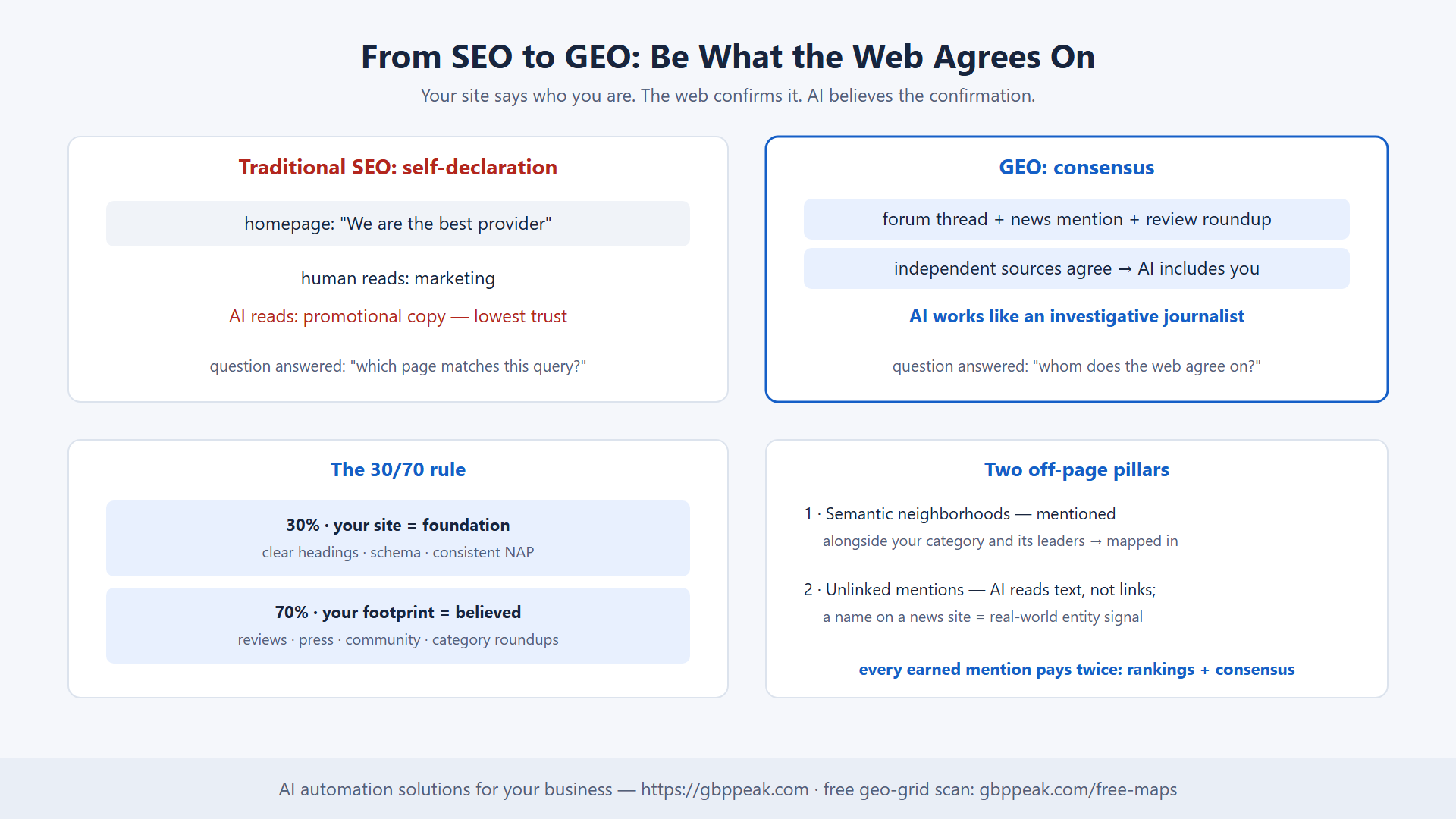
Your homepage says "the best plumbing service in the district." A human reads that as marketing. An AI model reads it the same way — and discounts it, because self-praise is the least trustworthy source of information about yourself. Then a customer asks ChatGPT for a plumber, and the answer is built from what everyone else says: the community forum thread, the news mention, the review site roundup.
That is the shift from SEO to GEO — Generative Engine Optimization. For a decade, visibility meant optimizing what you said on your own site. In the AI-search era, it increasingly means building a consensus across the web that you are who you claim to be.
GEO (Generative Engine Optimization) is the practice of making AI search engines — ChatGPT, Perplexity, Google AI Overviews — recognize and recommend your brand. Where traditional SEO optimized your own website, GEO builds consensus: third-party mentions, citations, reviews, and community discussions that independently confirm your claims. On-page content still matters as the factual foundation (roughly 30% of the equation), but the decisive 70% is your digital footprint — how the rest of the web, including unlinked brand mentions and co-occurrence with your category, talks about you.
From Self-Declaration to Consensus
AI models work like investigative journalists. Asked "who is the best provider in [industry]?", they do not take your homepage's word — they cross-examine sources:
| Traditional SEO | GEO | |
|---|---|---|
| Trusted most | Your own optimized pages | Independent third parties |
| Currency | Backlinks | Mentions, citations, co-occurrence |
| Question answered | "Which page matches this query?" | "Whom does the web agree on?" |
| Winning move | Rank your page | Be the consensus answer |
| Unlinked mention | Worth little | Fully readable signal |
The failure mode of pure SEO thinking in an AI world: a perfectly optimized site that nobody else talks about. The model can read your claims; it has no reason to believe them.
Pillar 1: Co-Citations and Semantic Neighborhoods
AI engines map the web as entities — brands, people, places — connected by how often they appear together. That map is your semantic neighborhood.
- If your brand repeatedly appears near "reliable," "same-day service," or "fair pricing," the model associates you with those attributes.
- If you are consistently mentioned alongside the recognized players in your category, the model files you into that category — you get considered when the category is asked about, even if nobody searched your name.
You influence the neighborhood the same way you earn any reputation: show up where the category is discussed, described accurately, in good company. The tactical layer is exactly the community participation and event content from guerilla local SEO.
Pillar 2: Unlinked Mentions
In classic SEO, a mention without a link was half a victory. AI engines read text, not just links — an unlinked "many teams now use [Your Business] for scheduling" on a news site or forum teaches the model that you are a real, recognized entity. No anchor tag required.
Where these mentions come from is the practical work — and it is the same work as the earned layer of backlink building: press features, expert quotes, community answers, review platforms, roundups. Every earned mention now pays twice: once for rankings, once for the AI consensus.
The 30/70 Rule
On-page is not obsolete — it is the foundation. A clean, well-structured site with accurate services, hours, and schema gives the models the base facts about you. But it is now roughly 30% of AI-era visibility. The other 70% is the footprint:
geo_stack:
  foundation_30pct:              # your site — accurate, readable
    - clear headings: what/who/where stated plainly
    - schema markup: hours, services, prices, unambiguous
    - consistent NAP everywhere (see citations guide)
  footprint_70pct:               # the wider web — believed
    - third-party reviews with specifics
    - press + news mentions (linked or not)
    - community discussions + expert answers
    - co-mentions in category roundups
  measure: "monthly AI question battery (track-ai-search-visibility)"
Site says who you are; the web confirms it. The answer engines believe the confirmation.
Making the Consensus Machine-Readable
Three mechanical pieces make your consensus legible:
- Consistent identity everywhere — same name, same category language, same service descriptions across your profile, directories, and social. Contradictions make models hedge, per citations and NAP consistency.
- Specific reviews — "fixed our bakery's cold room same day" does more than "great service," because it pins you to a service and an attribute. Reviews are training data, per tracking your AI visibility.
- Quotable facts — prices, timelines, service areas stated plainly on your site give the AI citable sentences instead of marketing fog, the clarity principle from how AI search reads content.
Then verify the loop monthly: ask the models the customer questions, note whether you appear and how you are described, and trace any absence back to a footprint gap.
FAQs
What is the difference between SEO and GEO?
SEO ranks your website in traditional results using keywords, structure, and backlinks. GEO makes your brand visible and trusted in AI-generated answers by building a consensus of third-party mentions and citations. SEO optimizes what you say; GEO proves the rest of the web agrees.
Do I still need a website if AI answers directly?
Yes — more than ever, as the factual home base. The AI pulls its answer from the web, users still click through to verify, contact, and buy, and your site provides the clean base data (services, hours, prices, schema) that the models cite. What changes is that the site alone is no longer sufficient; it is the 30% foundation under the 70% footprint.
What counts as a "mention" for AI visibility?
Any time your brand appears tied to a topic or service in content: press articles, blog posts, review platforms, forum threads, roundups, social discussions. The mention does not need a link — AI models read the surrounding text and register the association regardless.
How long does GEO take to show results?
Expect months, not weeks. Models update on their own schedules, and consensus is accumulated trust — each earned mention nudges the map slightly. The compounding is the good news: unlike ad spend, every mention keeps working, so visibility built this year is still paying next year.
Be What the Web Agrees On
Search is becoming asking. When the next customer asks, the answer will name whoever the web's evidence supports — so spend this quarter making the evidence: earn the mentions, collect the specific reviews, keep the base facts clean, and check the machines monthly. Pair it with the map-side picture using a free geo-grid scan at gbppeak.com/free-maps, and you will know both answers: what AI says, and where Maps shows.