Ask the Machines: How to Track Your Business in AI Search
In AI answers you are either mentioned or invisible — and nobody notifies you. A monthly question battery, weekly signals, and quarterly audits keep you in the answer.
A florist asks ChatGPT to recommend flower shops in her district. The answer names four competitors — with confident descriptions of their specialty bouquets. Her shop, open eight years, is simply absent. Not ranked low. Absent. And she only found out because she happened to ask herself.
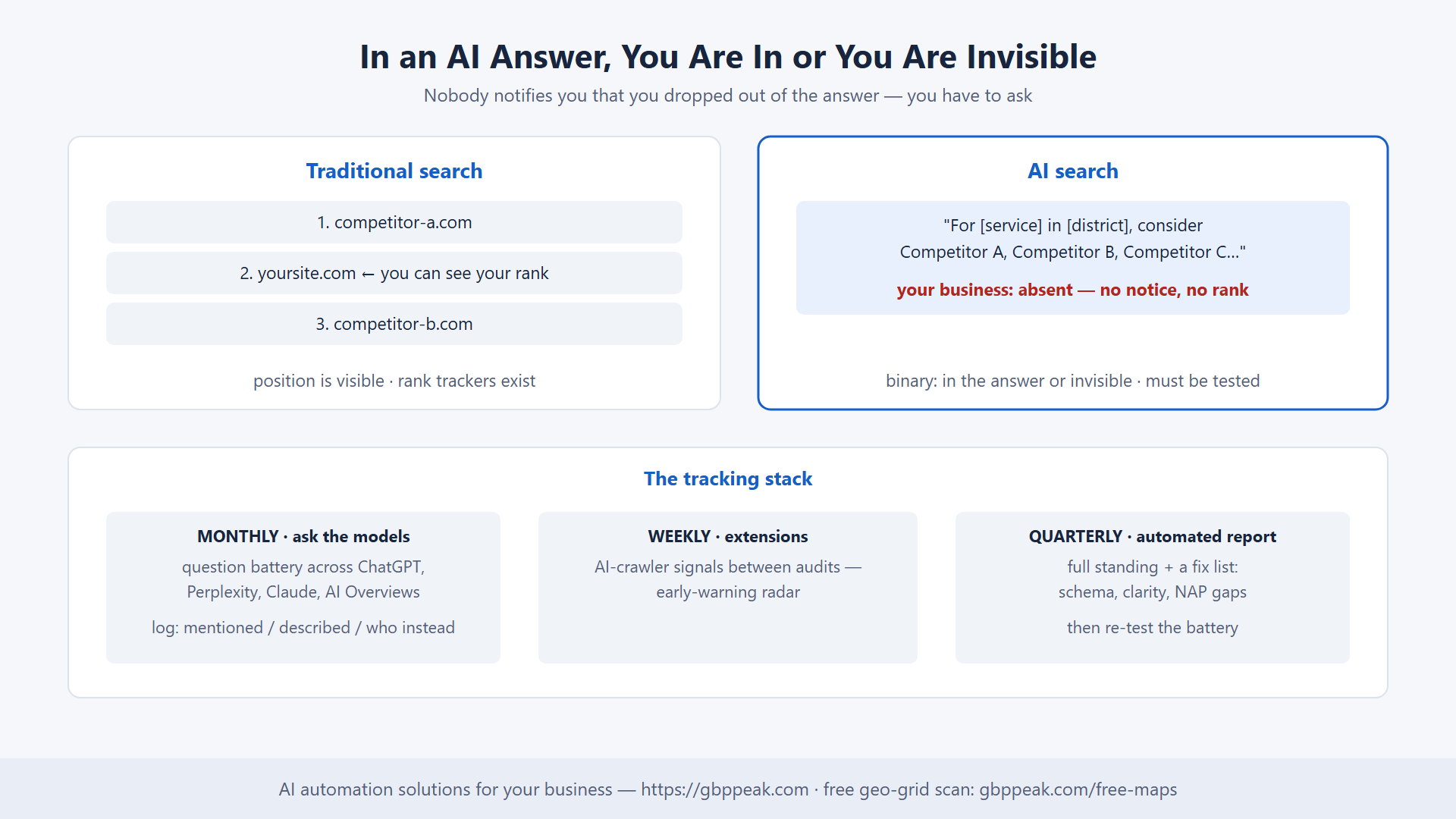
That is the new visibility problem. Traditional search shows a list of links where you can at least see your position; AI search generates an answer, and either your business is in it or it does not exist for that customer. Nobody sends you a notification that you dropped out of the answer. You have to go looking — here is how.
Track your AI search visibility three ways: ask the AI models directly with niche-and-location questions ("best [your service] in [your area]?") across ChatGPT, Perplexity, and Google's AI Overviews to see whether and how you're mentioned; use browser extensions that surface AI-crawler data for daily monitoring; and run automated AI-visibility audits that benchmark your standing and output a fix list. To improve standing, make your data machine-readable: clear headings, schema markup for hours/prices/services, and consistent NAP citations so the models learn one accurate version of your business.
Why Tracking Is Different Now
| Traditional search | AI search | |
|---|---|---|
| Output | A list of links | A composed answer |
| Your position | Rank #1–#100, visible | In the answer, or absent |
| Stability | Shifts gradually | Changes with each model update |
| Data shown | Who ranks | Who is cited and recommended |
| Notification of a drop | Rank trackers exist | None — you must test |
Ranking tools told you where you stood. AI answers tell you nothing unless you ask — and the asking has to be done right, because the question phrasing changes the answer.
Method 1: Ask the Models Directly
The cheapest, most honest baseline is manual testing. Open ChatGPT, Perplexity, Claude, and Google's AI Overviews, and ask the questions your real customers ask — specific, local, service-shaped:
question battery (run monthly, log answers):
  "best [service] in [district]"          → named? how described?
  "who does [specific job] near [landmark]?"
  "[service] recommendations [city] — what do reviews say?"
  "is [your business name] good for [service]?"   → known at all?
log per platform:
  mentioned?  yes/no
  described:  accurate / wrong / vague
  competitors named instead: ____
Run the same battery monthly and after any major site change. Patterns matter more than single answers: if three of four platforms skip you, the gap is your data's clarity, not bad luck. This is the audit habit at the heart of AI grounding visibility.
Method 2: Browser Extensions for Daily Signals
Manual testing is thorough but slow. Browser extensions built for AI visibility surface the technical layer — how AI crawlers interpret your pages, whether your content is being picked up by AI-driven features — without running a search every time. They are best treated as an early-warning radar between the monthly manual audits, per the monitoring stack in the sustainable local SEO system.
Method 3: Automated AI-Visibility Reports
When you need the full picture, automated audits take your URL, niche, and location and return a structured report: where you appear, where you don't, and — most usefully — a to-do list. Instead of "you were not mentioned," a good report says why: missing schema, thin service descriptions, inconsistent citations. That converts a vague worry into a work queue.
visibility_stack:
  monthly:   "manual question battery across 4 platforms"
  weekly:    "extension signals (crawl + pickup anomalies)"
  quarterly: "automated AI-visibility report → fix list"
  rule:      "re-test after every significant site change"
Improving What the Models Know
Tracking tells you the score. Changing it is about data clarity — AI models learn from what the web says about you, so make the readable version unambiguous:
- Clear content — plain headings that state what you do, for whom, where; the passage-level clarity we covered in how AI search reads your site.
- Schema markup — back-end code that states your hours, services, and prices in a format machines parse without guessing.
- Consistent NAP — identical name/address/phone across site, profiles, and directories, because contradictions make models hedge or skip you (citations and NAP consistency).
Then close the loop: fix clarity → re-run the question battery → check whether the mentions changed. Visibility in AI is earned the same way as everywhere else — one verified improvement at a time.
FAQs
What is the difference between traditional search visibility and AI search visibility?
Traditional search shows a rankable list of links, so your visibility is a position you can track with rank tools. AI search composes a direct answer, so your visibility is binary — mentioned accurately or absent — and it shifts with model updates, which means it must be tested by asking, not tracked by position alone.
Can I see what information AI models use about my business?
There is no public dashboard, but citations tell you most of it. Perplexity and Google's AI Overviews show which websites each answer draws from; reviewing those citations reveals the sources the models trust for your niche — and which of them you should get your accurate information onto.
How often should I check my AI visibility?
At minimum monthly, plus after every significant website change. Models are updated and retrained continuously, so a standing you verified once decays silently. A monthly question battery, weekly extension signals, and a quarterly automated report is a rhythm that catches changes early without becoming a job.
Do reviews affect AI search visibility?
Yes, strongly. Models describe businesses using the language of their reviews — a review that names a specific service teaches the AI what you are known for. Detailed, recent reviews are both social proof for humans and training data for the machines that recommend you.
Ask the Machines
Your next customer may never see a search results page — they will ask a question and take the answer. Whether your business is in that answer is now a monthly check, not an assumption: run the question battery, watch the signals, fix the clarity gaps, re-test. Start this week — and pair the AI picture with the map picture using a free geo-grid scan at gbppeak.com/free-maps, so you know exactly where both machines and maps stand.