
Perfect in January, Invisible by July: Building a Sustainable Local SEO System
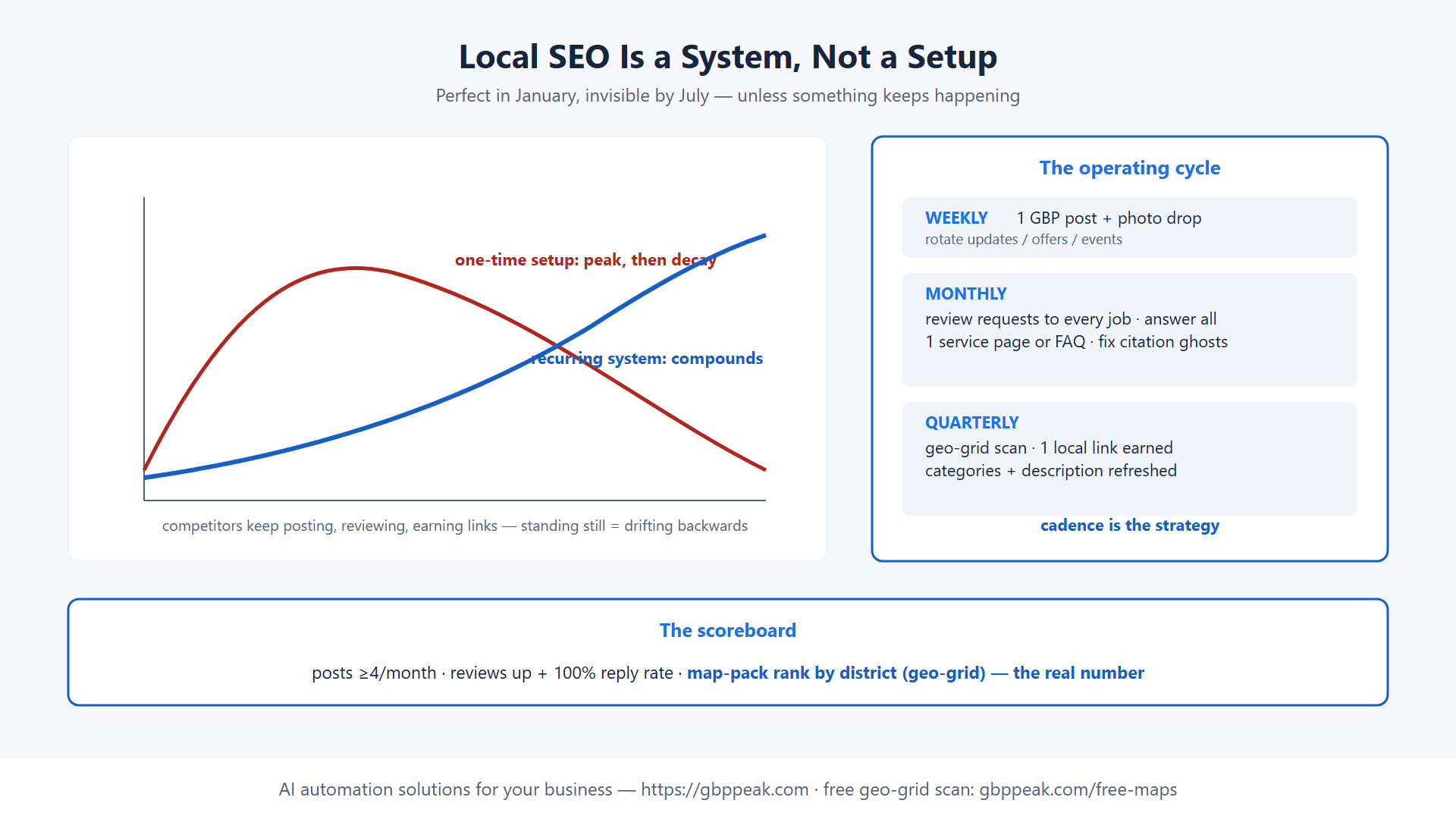
One-time setups peak at launch and decay. Weekly profile posts, engineered review requests, service pages, and quarterly links build visibility that compounds.
An agency optimizes a restaurant's Google Business Profile in January — categories, hours, photos, description, the works. The client is thrilled. In July the restaurant has dropped out of the map pack entirely, and the agency is confused: the setup was perfect.
It dropped because nothing happened after the setup. Local search is not a test you pass once; it is a living competition where the algorithm consistently favors businesses showing a pulse. The profile that posts, collects reviews, and builds links every month beats the perfect-but-silent one, every time.
Sustainable local SEO replaces the one-time setup with a recurring operating cycle: weekly posts and photos on the Google Business Profile (Updates, Offers, Events), a proactive system for requesting detailed customer reviews, service-specific website pages linked to the profile, and steady citation and local-link building for authority. Search algorithms reward active entities — consistent cadence signals the business is alive and relevant, so visibility compounds month over month instead of peaking at launch and decaying.
Setup vs System
The "one and done" mistake is understandable — setup produces visible, checkable work. But setup is inventory; a system is throughput.
| One-time setup | Recurring system | |
|---|---|---|
| Profile | Optimized once, then silent | Posts weekly, photos monthly |
| Reviews | Whatever arrives naturally | Systematically requested |
| Website | Static pages | Content that answers real questions |
| Authority | Initial citations | Links earned continuously |
| Trajectory | Peak at launch, then decay | Compounding visibility |
| Client outcome | "It worked" (for a while) | "It keeps working" |
The decay is not a penalty — it is the market moving. Competitors keep posting, keep collecting reviews, keep earning links. Standing still in a moving market is drifting backwards.
The Operating Cycle
A sustainable program is a calendar, not a checklist. Here is the whole thing on one page:
local_seo_operating_cycle:
  weekly:
    - "1 GBP post (rotate: update / offer / event — the three types
       we detailed in the GBP content guide)"
    - "photo drop from the shared folder"
  monthly:
    - "review requests sent to every completed job (same week)"
    - "answer every review — positive and negative"
    - "1 new service page or FAQ answer on the site"
    - "citation mismatch report reviewed, ghosts corrected"
  quarterly:
    - "geo-grid scan → rank movement by district"
    - "1 local link earned (association, blog list, news feature)"
    - "categories + description refreshed against real services"
None of these tasks is hard. The system's power is that they happen every cycle without fail — cadence is the strategy.
Give the Profile a Pulse
Treat the Google Business Profile like a neighborhood bulletin board, not a directory entry — it accepts posts, photos, and offers, and the algorithm reads activity as life. The three post types and the never-run-dry content pipeline (shared photo folder, 30-minute Monday queue, repurposed social assets) are covered in detail in Updates, Offers, Events.
Alongside posting, engagement matters: answer every review. A profile that replies reads as managed; the review-response habit is also what feeds the "living profile" effect we described in living profile lead quality.
Reviews: Engineered, Not Hoped For
Reviews are a ranking factor and the first thing customers read. A passive approach — hoping happy customers remember — loses to a system every time:
review engine:
  trigger .... completed job → request within 48 hours
  channel .... the app the customer already uses (SMS/email/chat)
  ask ........ one line, direct link, no forms in between
  multiply ... repeat customers asked once per great interaction
  quality .... invite specifics: "what did we fix?" — detail
               gives search engines (and AI answers) keywords
  respond .... every review, same week
Detailed reviews do double duty: they convert readers, and the specific service words inside them teach search engines what the business is known for.
The Website Feeds the Profile
The profile is the face; the website is the backbone — and they reinforce each other. Service-specific pages ("Emergency plumbing in [district]") linked correctly tell search engines exactly what you do and where, the one-page-one-keyword discipline from building an inbound lead engine. Website authority flows into the profile's ranking; the profile's traffic flows back into the site. That virtuous cycle only spins if both sides stay active.
Authority: Citations Plus Local Links
Authority is how much the internet trusts the entity, built from two layers:
- Citations — consistent NAP across directories. Automated distribution keeps hundreds of listings identical; manual work secures the high-authority local ones. The consistency rules are in citations and NAP consistency.
- Backlinks — local endorsements that raise domain authority. For local rankings, one neighborhood blog or association link outweighs dozens of generic ones, per offsite SEO and domain authority.
One per quarter, earned honestly, compounds. Authority is the moat precisely because competitors cannot copy it quickly.
Measuring the System
A recurring program needs a scoreboard that matches its cadence:
monthly glance (10 min):
  posts shipped .......... ≥4
  new reviews ............ vs last month, with reply rate 100%
  map-pack rank .......... the real number — by district

quarterly review:
  geo-grid scan ......... visibility across the whole service area
  links + citations ..... added this quarter
  trajectory ............ flat / rising / falling → adjust cycle
The geo-grid is the honest scoreboard — profile activity can feel productive while rank stands still. Run one free at gbppeak.com/free-maps and let district-level movement, not task lists, tell you the system is working.
FAQs
What is the difference between a one-time setup and a recurring workflow?
A setup fixes the baseline — profile created, hours added, categories chosen — and its effect peaks at launch. A recurring workflow keeps the business visible over time: fresh posts, new reviews, added pages, and earned links every cycle. Setup is a snapshot; the workflow is the film that keeps you in the map pack.
Why do reviews matter so much for local rankings?
Search engines read the frequency, volume, and content of reviews as evidence of an active, reputable business. Recent detailed five-star reviews — especially ones naming the service received — improve map-pack visibility and give AI search tools the keywords they quote when recommending local businesses.
What are citations in local SEO?
Citations are mentions of your business's Name, Address, and Phone number across directories, maps, and industry sites. When they are consistent everywhere, search engines verify you as a stable, legitimate local entity; when they conflict, trust — and ranking — dilutes.
How often should a Google Business Profile be updated?
A weekly cadence is the common sustainable target: at least one post or photo drop per week, with Offers and Events layered in as they arise. Consistency beats intensity — weekly for a year outperforms daily for a month followed by silence.
From Launch to Long-Term
Local SEO has no finish line, which is good news for anyone willing to operate a system: the competition mostly won't. Weekly profile posts, engineered review requests, service pages that compound, citations kept clean, one local link a quarter — that loop, run honestly for a year, builds what no one-time setup ever has. See where your loop stands today with a free geo-grid scan at gbppeak.com/free-maps.