Updates, Offers, Events: Content Types That Keep a Google Profile Alive
Rotate Updates, Offers, and Events on your Google profile, fed by a shared photo buffer and a 30-minute Monday queue — under an hour a week.
A restaurant's Google profile goes silent for six weeks. Nothing closed, nothing changed — the owner was just busy. But to the ranking system, a silent profile starts to look like a possibly-closed one, and to a customer comparing three restaurants on Maps, the one with a fresh photo and a "new seasonal menu" post simply feels more alive. Silence costs visibility and customers at the same time, quietly.
The fix is not heroic daily posting. It is a small system built around the three post types Google gives you — Updates, Offers, and Events — fed by a buffer of content you collect for free during normal operations.
Keep a Google Business Profile active by posting three content types on rotation: Updates (news and education), Offers (discounts that drive immediate action), and Events (dated occasions like workshops or seasonal sales). Each post is an activity signal that tells Google the business is operational and relevant to local intent, while giving customers a direct path to your website. Sustain the cadence with a proactive system — a shared photo folder filled during daily work, a scheduler for queueing posts, and repurposed social content — so the profile never goes silent.
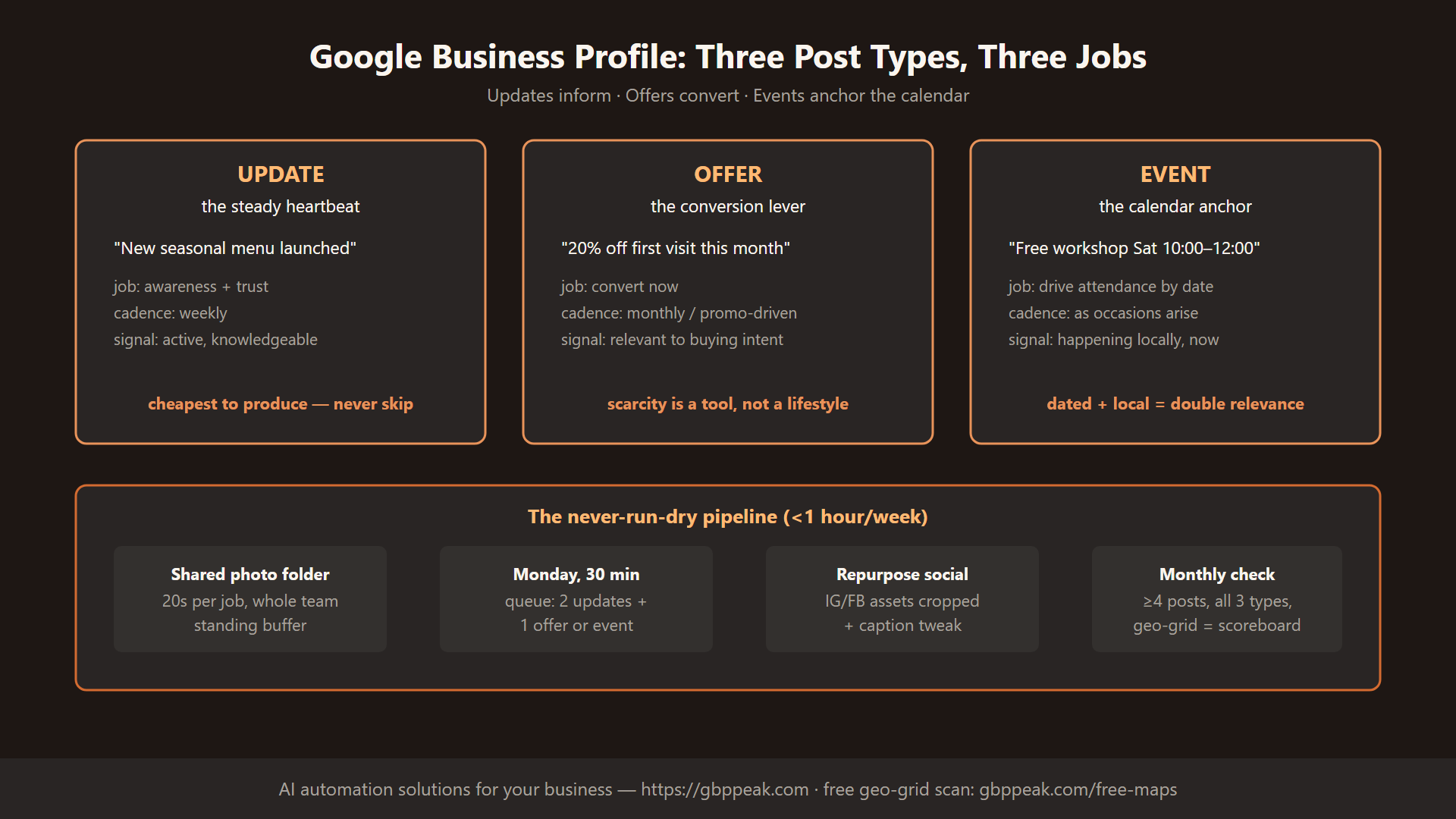
Three Post Types, Three Jobs
Google gives every profile three formats, and they are not interchangeable — each is designed for a different moment in the customer's decision.
| Update | Offer | Event | |
|---|---|---|---|
| Purpose | Inform, teach, stay present | Convert now | Drive attendance by date |
| Example | "New seasonal menu just launched" | "20% off first visit this month" | "Free workshop Sat 10:00–12:00" |
| Best for | Awareness, trust | Conversion | Footfall, seasonal peaks |
| Cadence | Weekly | Monthly or promo-driven | As occasions arise |
| Signal sent | Active, knowledgeable | Relevant to buying intent | Happening locally, now |
The mistake most businesses make is posting only Updates — the "we're great" genre. A profile with all three types in rotation reads as a living business: it teaches, it sells, it hosts.
Updates: the steady heartbeat
General news, educational tips, finished jobs, team moments. "We just added cold brew to the menu," "Here's how to tell your AC needs a chemical clean before summer." Updates are the cheapest post to produce and the reason the profile never looks abandoned — the cadence logic we covered in keeping your profile alive.
Offers: the conversion lever
An Offer is the only post type built for immediate action: a code, a discount, a deadline. "Get 20% off your first visit this month" gives a comparing customer a reason to choose you today. Use them deliberately — scarcity is a tool, not a lifestyle.
Events: the calendar anchor
Events attach dates: a grand opening, a workshop, a seasonal sale. They matter twice — for the customers planning around them, and for the relevance signal a dated, local happening sends to search.
Why Posting Moves Local Rankings
Posts are not just decoration for the profile page. Each one feeds the ranking system in three ways:
- Activity signal — regular posting tells Google the business is operational. Silent profiles drift; active ones get the benefit of the doubt.
- Relevance — an Offer or Event tied to a real service ("aircon service promotion before Songkran") demonstrates match with what local searchers want right now.
- Traffic gateway — every post carries a link to your site. Posts are small funnels that keep web traffic moving even when the profile itself is the discovery point.
Posts are one signal among several — reviews and offsite authority (the moat we built in offsite SEO for local search) matter more per unit. But posting is the cheapest signal to maintain, and the only one you control entirely day to day.
The System: Never Run Out of Content
The "content gap" — a profile going silent because there is nothing to post — is a logistics problem, not a creativity problem. Solve it once with a pipeline:
1. Collect media during normal work
The content already exists; it just is not captured. A shared cloud folder that everyone on the team can drop photos into turns daily operations into a standing buffer:
/GBP-content            ← shared folder, whole team
  /raw-photos           ← job sites, dishes, finished work
  /ready-to-post        ← cropped, picked, caption-drafted
  /used                 ← what went out, with date
Twenty seconds of photo-taking per job, and the content gap disappears — the same "collect once, use forever" logic as the SOP library in scalable service systems.
2. Schedule, don't remember
Log in and post manually and the cadence dies the first busy week. Use a scheduler (native or third-party) to queue a week of posts in one sitting:
weekly_queue:   # 30 minutes, every Monday
  monday:    "update: one photo + one sentence from /ready-to-post"
  wednesday: "update: answer a customer question (from your FAQ)"
  friday:    "offer or event (rotate: promo this week, event next)"
  evergreen: "keep 2 dated offers drafted for surprise quiet weeks"
One caveat when choosing a third-party tool: verify it supports what you actually post — several schedulers handle images but choke on video, while the native Google backend accepts video reliably.
3. Repurpose, don't create twice
The Instagram post that performed, the Facebook album from the event, the reel of the finished kitchen — most social assets adapt to GBP posts with a crop and a caption tweak. Cross-posting keeps every channel active from one production effort, the multiplier habit at the heart of the agency-directory-media flywheel.
Measuring Whether It Works
Posting is a system, so measure it like one — by output and by rank movement, not vibes:
monthly GBP check (15 minutes):
  posts shipped this month .......... goal ≥ 4 (1/week)
  post types used ................... goal: all 3 per quarter
  views per post (profile insights) .. which type performs?
  map-pack rank by district ......... the real scoreboard
That last line is the one that matters. Posts feed the machine, but the scoreboard is where you rank across your service area — visible district by district with a geo-grid scan, free at gbppeak.com/free-maps. If rank is flat after two months of consistent posting, the constraint is usually elsewhere: reviews, categories, or offsite authority.
FAQs
What is the difference between an Update and an Offer on Google?
An Update shares general information or news — "new flavors on the menu," a tip, a finished job. An Offer is built for conversion: it carries a discount, coupon code, or deadline that gives the viewer a reason to act now. Updates build presence; Offers drive bookings.
Can I post videos on my Google Business Profile?
Yes. The native Google backend accepts video reliably; some third-party scheduling tools have format limits for video. If video is central to your strategy, test your scheduler's video support first, or post videos natively and schedule images through the tool.
How often should a business post to its profile?
There is no official rule, but consistency beats intensity: about once per week is a common, sustainable target, with Offers and Events layered in as they arise. A profile posting weekly for a year outperforms one that posts daily for two weeks and goes silent — activity signals read cadence, not volume.
Do GBP posts directly improve map rankings?
Posts are one signal among several. They demonstrate activity and local relevance and drive traffic to your site, which supports rankings — but reviews, profile completeness, and offsite authority typically carry more weight. Post consistently because it compounds with everything else, and measure movement with a geo-grid scan rather than assuming.
Keep the Heartbeat
An active profile is a living storefront, and the three post types are its heartbeat: Updates inform, Offers convert, Events anchor the calendar. Back them with a shared photo buffer, a Monday scheduling habit, and repurposed social content, and the profile maintains itself in under an hour a week. Start by checking where your heartbeat is already reaching — run a free geo-grid scan at gbppeak.com/free-maps and see which districts see you, and which see only your competitors.