
Your Process Is the Product: Building Scalable Systems for a Service Business
Escape the manual labor trap: rigid onboarding checklists, repeatable strategy one-pagers, 20-minute proof reports, and SOPs built from simple tools.
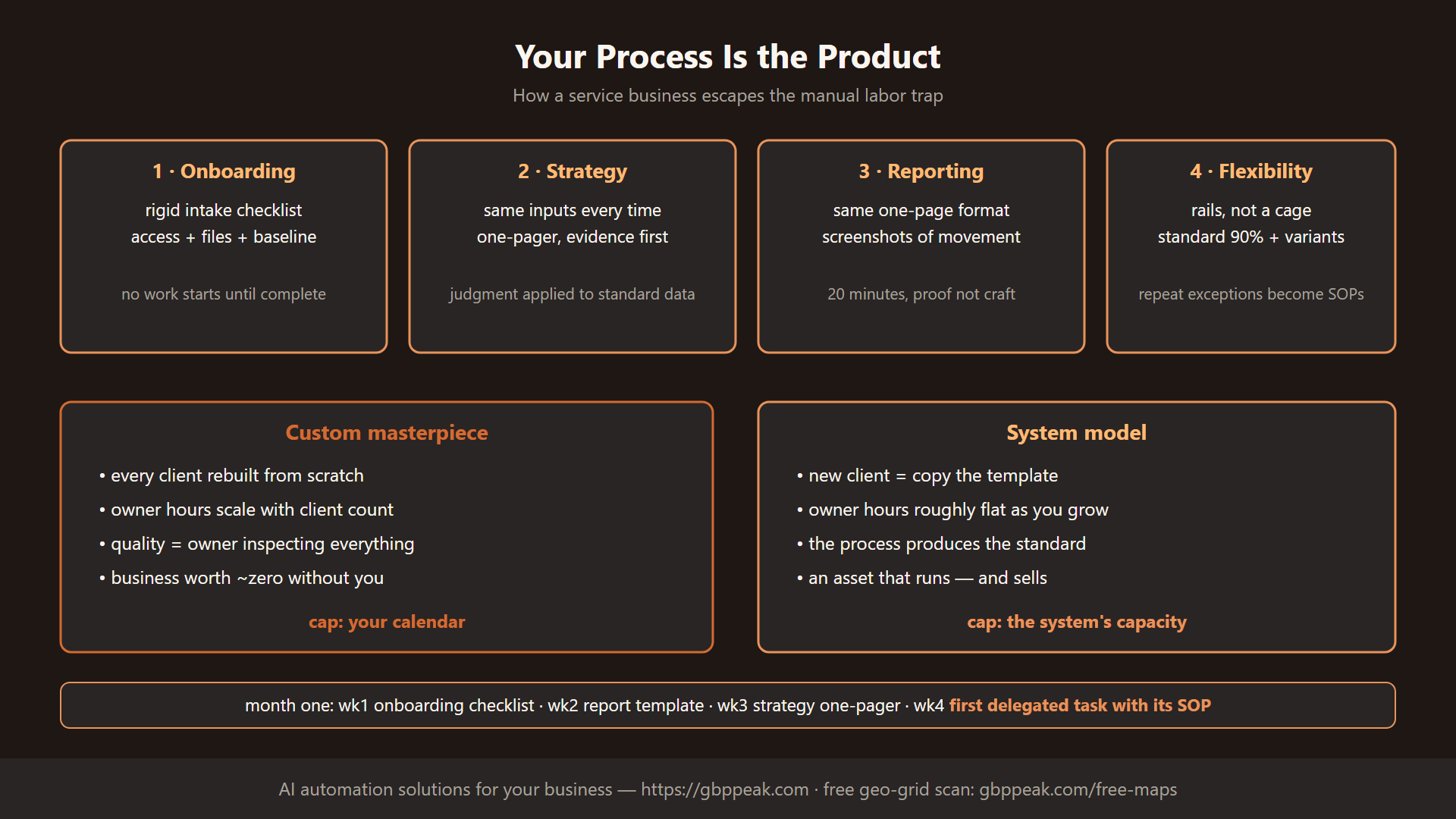
A marketing consultant delivers good work for seven clients and hits an invisible wall. An eighth client would mean eighty-hour weeks. The work itself is not the problem — the eight clients get nearly identical work. The problem is that each project is rebuilt from scratch every time, inside the consultant's head, as a custom masterpiece.
That is the manual labor trap, and the exit is a mental flip: in a service business, your process is your product. The client buys the result; the thing that makes the result repeatable — without your hands on every step — is the system. This post is how to build it.
To scale a service business, replace custom, hand-built work with documented, repeatable systems. Standardize onboarding with a rigid intake checklist, make strategy a consistent data-gathering step instead of an art, deliver simplified proof through standardized reporting, and document any task you do more than three times a week as an SOP using simple tools like docs and boards. The goal is a business where any trained teammate can produce the same result — decoupling your personal hours from your revenue.
The Manual Labor Trap
Early on, doing everything yourself is quality control — nobody cares like the owner. But every task kept in your head has a hidden cost: it can only run when you run. Growth multiplies that cost until the owner becomes the bottleneck, usually right around the moment the business looks successful from outside.
| Custom masterpiece model | System model | |
|---|---|---|
| Each new client | New design, new chaos | Copies the template |
| Quality control | Owner inspects everything | The process produces the standard |
| Owner's hours | Scale with client count | Roughly flat |
| New teammate | Months of shadowing | Weeks of reading SOPs + coaching |
| Margins as you grow | Shrink (more of your time) | Expand (same system, more volume) |
| Sale value of the business | ~Zero without you | An asset that runs |
The shift is from "doing the work" to "managing the system that does the work" — the same owner-to-operator move we detailed in building the team that replaces you. Systems and team are two halves of one mechanism: the team runs the system; the system makes the team sufficient.
Pillar 1: Onboarding That Starts on Day One
The most common hidden time-waster in a service business is chasing missing information — access to accounts, brand files, credentials, baseline data — three weeks after the project started. Every chase is an interruption, and interruptions are where hours quietly die.
The fix is a rigid intake checklist:
onboarding_checklist:
  access:
    - "Google Business Profile owner access"
    - "website CMS login (view + edit)"
    - "analytics / search console read access"
  materials:
    - "logo files + brand colors"
    - "service list with real prices"
    - "top 10 customer questions (from their inbox)"
  baseline:
    - "current rank snapshot / geo-grid scan"
    - "review count + rating at start"
  rule: "work does not start until the checklist is complete"
That last line is the system speaking. When kickoff only happens with everything in hand, the team starts productive on day one — and the client learns the rhythm of a business that runs on rails.
Pillar 2: Strategy as a Repeatable Step
Strategy feels like it should be custom genius work. In a systematized service, it is a consistent data-gathering routine with judgment applied at the end. You do not need expensive research suites; you need the same inputs, every time, in the same document:
strategy one-pager (per client, refreshed quarterly):
  1. who they serve + where (neighborhoods, districts)
  2. top 3 competitors per core keyword — and what they do visibly
  3. current visibility snapshot (geo-grid + profile health)
  4. the 3 highest-gap opportunities, ranked
  5. what we will NOT do this quarter
Because the inputs are standardized, the thinking starts from evidence instead of vibes — and any teammate can gather the first three rows before the strategist (you) applies judgment to the last two. That division is what makes strategy scale. For local visibility, the evidence step is exactly what a geo-grid scan provides — free at gbppeak.com/free-maps.
Pillar 3: Reporting as Proof, Not Craft
Reports that take three hours to build are a system failure wearing a professional costume. The client does not need a bespoke magazine; they need to see the win consistently.
The lean version:
- Same format every month — one page, same sections, comparable numbers.
- Screenshots of movement — the map position that improved, the review that mentions the service by name, the calls graph.
- One number the client cares about most — leads, bookings, direction requests — up front.
monthly report = 20 minutes:
  cover: "headline metric vs last month" (1 screenshot)
  middle: "what we did" (3 bullets, links to deliverables)
  end: "next month's focus" (1 sentence)
Consistency beats sophistication. A simple report that arrives on the same day every month builds more trust than a beautiful one that arrives late — and it takes a fraction of the time to produce.
Pillar 4: Disciplined but Not Rigid
A system is rails, not a cage. Reality will always produce a client who needs something the template does not cover, and a system that cannot bend will either break or get abandoned.
The rule of thumb: the standard process handles the standard 90%; defined deviations handle the rest. If a special request appears twice, it graduates into a documented variant — "here is how we do X for regulated industries" — instead of remaining an exception that lives in your head.
How to Start Systemizing This Month
You do not buy a system; you document your way into one. The five moves, in order:
- List repetitive tasks. Anything done more than three times a week is a system candidate.
- Document one. A simple doc or 3-minute recording — exact steps, links, and what "done" looks like.
- Standardize the tools. Same stack, same templates, every client — this is the four-tool discipline from the lean operations stack.
- Audit for friction. Wherever you or the team feel frustrated, the process is missing or broken there.
- Close the loop with clients. Ask what they value in the reporting, then automate exactly that — nothing more.
week 1: onboarding checklist
week 2: monthly report template
week 3: strategy one-pager
week 4: first delegated task, with its SOP
result: one month, four systems, first task off your plate
Notice none of this requires new software. Docs, a board, a screen recorder — the value is in the method, not the price tag. That restraint is the same one that made the models durable in five boring business models: the boring, repeatable version of the work is the one that scales.
FAQs
What is the difference between a process and a product?
The product is the result the client pays for — more leads, a working site, a clean facility. The process is the internal roadmap that produces that result. When the process is documented and repeatable, the product becomes consistent, and delivery stops depending on any single person's memory or heroics.
Do I need expensive software to build business systems?
No. Docs, spreadsheets, a task board, and a screen recorder cover nearly everything a service business needs. The value lives in the method — the checklist, the template, the recording — not in the tool's price tag. Upgrade a specific tool only when a real limitation appears, never in advance.
How do I know when a process is good enough?
When a trained teammate can run it with minimal supervision and the output still meets the client's standard. If a task needs you to rescue it every time, the process needs more detail — usually a screenshot, a threshold, or a "what to do if X looks wrong" line, not more prose.
How do systems affect what my business is worth?
Directly. A business where everything runs through the owner is worth roughly the owner's remaining contract value, because it stops working when they do. A documented, system-run business keeps producing without the founder — which is precisely what makes it sellable, fundable, or simply ownable without burning you out.
Make the Process the Product
The hustle model caps your income at your calendar. The system model removes the cap: every documented process is a task that no longer needs you, every template is a client onboarded in hours instead of weeks, every standardized report is trust delivered on schedule. Start with one checklist this week — and if local visibility is your service, start where the evidence is free: run a geo-grid scan at gbppeak.com/free-maps and let the system see the market the way your clients' customers do.